Antonyms (Nearly Opposite in Meaning) Explained for SHS 2 English Language (Semester 2, Week 7)
Words with opposite meanings help us express contrasts clearly and communicate more effectively. Learning antonyms expands vocabulary, improves comprehension and enables learners to choose the most appropriate words in different situations.
What You Will Learn
- The meaning of antonyms.
- The three main types of antonyms.
- The functions of antonyms in communication.
- The challenges learners may encounter when studying antonyms.
- How to apply antonyms in speech and writing.
Main Explanation
Antonyms are words that have opposite meanings. They are used to express contrasting ideas and enrich language by helping speakers and writers communicate differences more clearly. Understanding antonyms enables learners to use vocabulary appropriately in different contexts and improve both spoken and written communication.
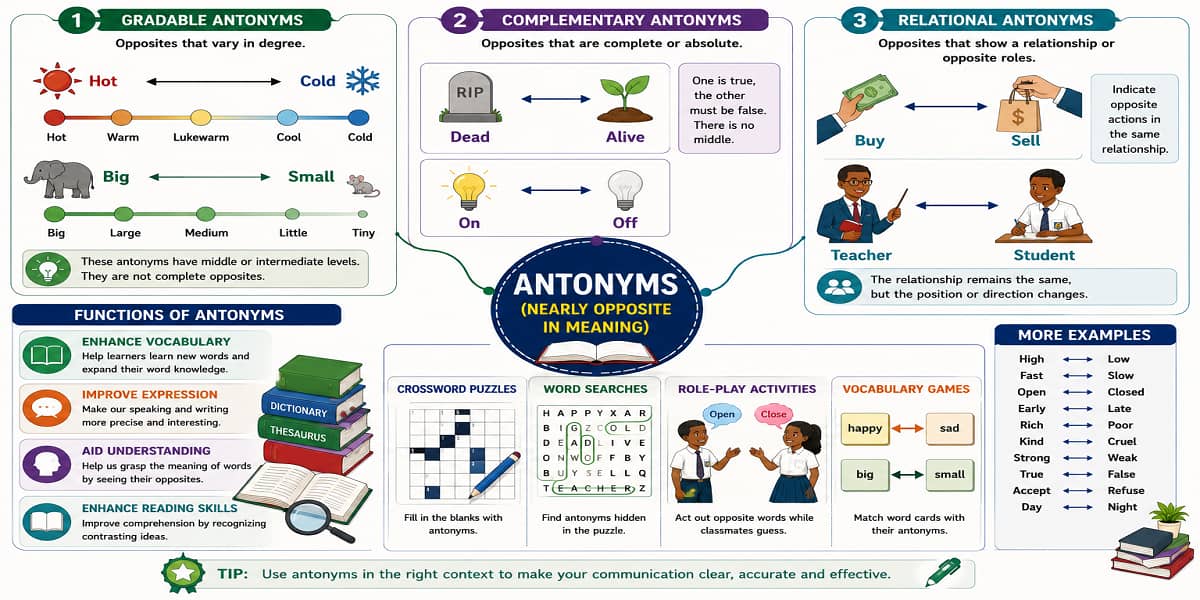
There are three main types of antonyms. Gradable antonyms describe opposite ends of a continuous spectrum. Examples include hot/cold and big/small. These opposites may have intermediate degrees such as lukewarm between hot and cold, or tiny as a degree of small.
Complementary antonyms are complete opposites with no middle ground. Examples include dead/alive and on/off. A person or object belongs to one state or the other without any intermediate condition.
Relational antonyms describe opposite perspectives of the same relationship. Examples include buy/sell and teacher/student. One word exists in relation to the other, and each describes a different role within the same situation.
Learning antonyms provides several benefits. It expands vocabulary, improves expression, strengthens reading comprehension and helps learners understand the meanings of unfamiliar words by recognising their opposites. Using antonyms also allows speakers and writers to express ideas more precisely and effectively.
Learners should also understand that some antonyms are context-sensitive. For example, the opposite of light depends on its meaning. If light refers to weight, its opposite is heavy. If it refers to brightness, its opposite is dark. Another challenge involves understanding gradable antonyms because they allow different degrees rather than simple opposites.
The lesson encourages active learning through games, crossword puzzles, word searches, role-play, group discussions and presentations. These learner-centred activities strengthen vocabulary development while promoting collaboration, critical thinking, communication and leadership skills.
| Type of Antonym | Description | Examples |
|---|---|---|
| Gradable | Opposite ends of a continuous scale | Hot / Cold, Big / Small |
| Complementary | Complete opposites with no middle ground | Dead / Alive, On / Off |
| Relational | Opposite perspectives within a relationship | Buy / Sell, Teacher / Student |
| Function of Antonyms | Benefit |
|---|---|
| Enhance Vocabulary | Develops a broader range of words. |
| Improve Expression | Allows more varied and accurate communication. |
| Aid Understanding | Clarifies meanings by showing opposites. |
| Enhance Reading Skills | Improves comprehension and contextual understanding. |
Worked Examples
Example 1
Scenario: A learner is asked to classify the pair dead and alive.
Explanation: These words are complementary antonyms because they represent complete opposites with no middle ground between them.
Example 2
Scenario: During a reading activity, a learner encounters the word light in two different sentences.
Explanation: The learner determines the meaning from the context before choosing the appropriate antonym. If light refers to weight, the opposite is heavy. If it refers to brightness, the opposite is dark.
Why This Topic Matters
Understanding antonyms improves vocabulary, reading comprehension and effective communication. It helps learners express contrasting ideas clearly, understand unfamiliar vocabulary through context and use language appropriately in conversations, writing tasks and examinations. Interactive activities such as role-play, games and collaborative learning also develop confidence, teamwork and critical thinking skills.
Quick Practice
- Explain the three types of antonyms.
- Identify the antonyms of ten common vocabulary items.
- Classify antonym pairs as gradable, complementary or relational.
- Explain how context affects the choice of an antonym.
- Discuss how antonyms are used in everyday conversations and practical situations.
Summary
Antonyms are words with opposite meanings that enrich language and improve communication. Understanding gradable, complementary and relational antonyms helps learners select appropriate vocabulary for different contexts. Regular practice through games, role-play, group discussions and writing activities strengthens vocabulary, reading comprehension and language proficiency.
Access NaCCA-aligned Support Packs
Download your structured NaCCA-aligned Teacher Support Pack and Student Learning Pack, designed for clarity, practicality, and reliable teaching and learning.