Subject–Verb Agreement, Speech Writing and Imagery Explained for SHS 2 English Language (Sem. 1 – Week 10)
English in Action: Accuracy, Public Speaking and Creative Expression
English is used in many situations: explaining an idea in a conversation, addressing an audience at a public gathering, defending a position in a debate or creating a memorable scene in a story. Each situation demands choices. A speaker must select words that communicate clearly, organise ideas for listeners and use language that suits the occasion. A writer must also pay attention to grammar and expression so that the reader can follow the message.
Three areas of English Language bring these demands into focus: concord or subject–verb agreement, formal and informal speech writing, and imagery in narrative, drama and poetry. They may appear to be separate topics, but they share a central purpose: helping people communicate meaning accurately and effectively.
Why Subject–Verb Agreement Matters
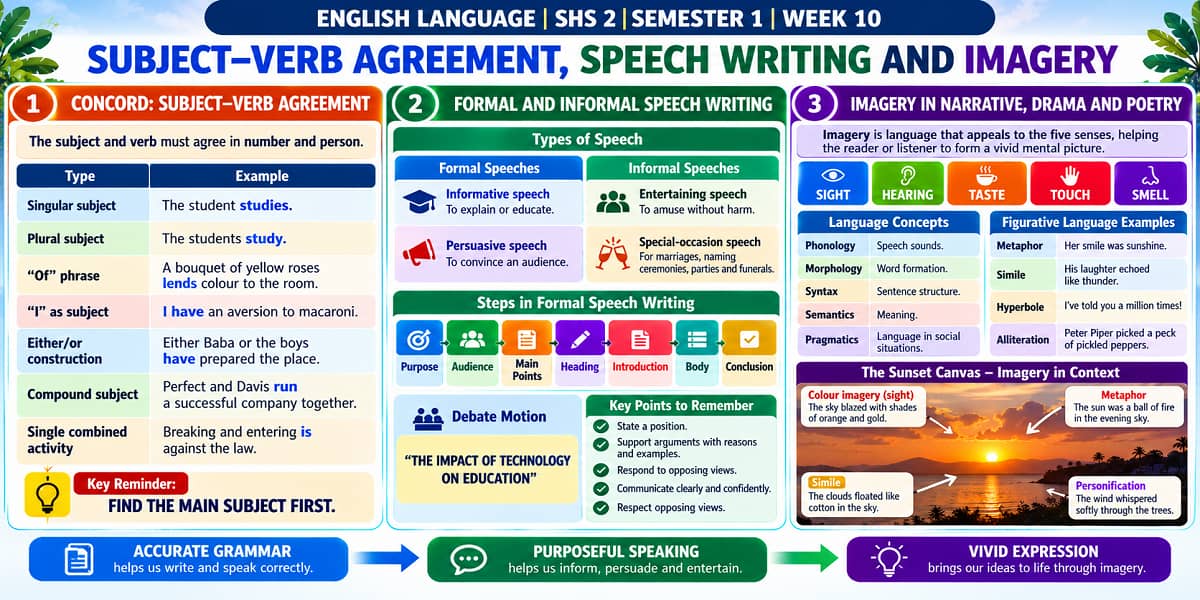
Subject–verb agreement is the relationship between a subject and the verb that belongs to it. In English, a singular subject generally takes a singular verb, while a plural subject generally takes a plural verb. Compare The student studies with The students study. The change in the subject requires a corresponding change in the verb.
Errors in agreement can distract readers and listeners. A sentence may contain an interesting idea, but an incorrect verb form can make the speaker appear careless or make the sentence harder to process. Agreement is therefore not simply a classroom rule; it contributes to clarity in everyday communication, formal writing and public speaking.
Look beyond the nearest noun
One common source of error is choosing a verb based on a nearby noun rather than identifying the main subject. Consider A bouquet of yellow roses lends colour and fragrance to the room. The subject is bouquet, which is singular. The phrase of yellow roses describes the bouquet; it does not make the subject plural. The correct verb is lends.
Now compare it with The parents of the said children have arrived. Here, the subject is parents, which is plural, so the verb is have. The key is to identify the word or expression performing the role of the subject before deciding on the verb.
Important agreement patterns
| Pattern | Example | What to notice |
|---|---|---|
| Singular subject | She goes to school. | The singular subject takes goes. |
| Plural subject | The men are in the dining room. | The plural subject takes are. |
| Pronoun “I” | I have an aversion to macaroni. | Use have, not has. |
| “Of” phrase | The list of groceries is with Priscilla. | The main subject is list. |
| Two singular subjects with “or” | My aunt or my uncle is coming. | The singular verb agrees with the alternatives. |
| “Either…or” / “neither…nor” | Either Baba or the boys have prepared the place. | The verb agrees with the nearer subject. |
| Compound subjects with “and” | Perfect and Davis run a successful company. | Two subjects generally take a plural verb. |
There are useful details within these patterns. The pronoun I takes forms such as I go, I drive, I have and I make. In sentences with either…or and neither…nor, the verb agrees with the subject closest to it. Thus, Neither the plates nor the serving bowl goes on that shelf uses goes, while Either Baba or the boys have prepared the place uses have.
Subjects joined by and generally take a plural verb because they refer to more than one person or thing. However, some paired expressions are treated as one activity or unit. In Breaking and entering is against the law, the two actions are presented as a combined concept. The verb is singular. This shows why the writer should consider both grammar and meaning.
Speech Writing: Speaking with Purpose
A speech is oral communication delivered for a particular purpose. It may inform, persuade, entertain or address a special occasion. The nature of the event and the people listening help determine the type of speech and the language that should be used.
Formal speech: informing or persuading
Formal speeches are generally planned and prepared for official gatherings or occasions where important matters are discussed. An informative speech aims to explain, educate or enlighten an audience. A company or institutional leader, for example, may address employees to explain policies, principles or changes. The speaker’s responsibility is to make the information understandable and relevant to the audience.
A persuasive speech has a different central purpose: to convince listeners to accept a position. Politicians and debaters commonly use persuasive speaking. A persuasive speaker should present a clear view, develop supporting arguments and respond to objections. Merely repeating a position does not make an argument convincing; the speaker must explain why the audience should consider it reasonable.
Informal speech: entertaining or marking an occasion
Informal speeches are often spontaneous or impromptu and may be delivered in a range of settings. An entertaining speech aims to amuse an audience or make people laugh without harming another person’s reputation. A special-occasion speech is delivered at an event such as a marriage, naming ceremony, party or funeral. Its language and tone should suit the occasion.
These categories remind us that speaking is not one-size-fits-all. A speech intended to explain an organisational policy needs a different approach from a humorous address or a vote of thanks. Effective speakers recognise the occasion, understand their audience and remain focused on the purpose.
A practical process for writing a speech
A formal speech can be prepared through a series of manageable steps. First, identify the purpose: are you informing or persuading? Second, identify the audience and consider what they need to know. Third, list four or five main points. Fourth, choose a suitable heading. Fifth, prepare an introduction that addresses the audience and establishes the subject. Sixth, develop the main points into the body of the speech. Finally, write a conclusion that brings the ideas together and leaves the audience with a clear message.
Informal speeches are more flexible, but they generally contain an introduction, body and conclusion. The ending deserves particular attention. In a vote of thanks, for example, the speaker should make sure that appreciation is clearly expressed and that the audience is brought together around the purpose of the occasion.
Example: A birthday celebration
Imagine that you are organising a parent’s forty-fifth birthday party and have been asked to speak to the guests. This is an informal special-occasion speech. You might welcome those present, recognise the importance of the celebration, express appreciation for the person being honoured and thank the guests for attending. The speech should be warm and appropriate to the occasion.
A suitable opening could be: “Distinguished guests, family members and friends, good evening. We are gathered here to celebrate a special milestone: the forty-fifth birthday of someone whose care, encouragement and presence mean so much to us.” This opening welcomes the audience and establishes the occasion before the speaker develops the main message.
Debate: Making a Case and Responding to Others
A debate is an organised discussion in which speakers argue for or against a motion. The motion “The Impact of Technology on Education” provides an opportunity to consider the effects of technology from different positions. A strong debater states a position clearly, develops relevant points, communicates confidently and responds to objections raised by the opposing side.
Preparation begins with understanding the motion. Speakers should decide which points they will defend, arrange those points logically and consider what the other side may argue. During delivery, clear expression, appropriate register, well-articulated vocatives, eye contact and purposeful gestures can help engage the audience. Collaboration also matters: group members need to stay focused, complete tasks, respect different views, tolerate disagreement, resolve conflicts and take responsibility.
A debate assessment can consider three areas. Content can be judged by the number of impacts discussed: four, three, two or one. Communication skills include appropriate register, clear expression, well-articulated vocatives, gestures and eye contact. Collaboration skills include encouraging others, staying focused, respecting views, tolerance, conflict resolution and responsibility. Each area can receive up to four marks, giving a total of twelve marks.
Imagery: Helping Readers Experience a Text
Imagery is language that appeals to the senses: sight, hearing, taste, touch and smell. It enables readers to imagine or experience what a writer describes. A simple statement may tell us what something is like; imagery can make us feel as though we are present in the scene.
For example, The room was cold gives basic information. The expression A chill crept across my fingers as cold air slipped beneath the door makes the sensation more immediate. The reader can imagine the cold moving across the fingers. This is the power of sensory detail.
Expressive language and how meaning is formed
Expressive language communicates thoughts and feelings through words, gestures or signs. It includes speaking, writing and sign language. Different aspects of language help explain how expression works:
- Phonology deals with speech sounds.
- Morphology focuses on word formation.
- Syntax governs sentence structure.
- Semantics relates to meaning.
- Pragmatics addresses language use in social situations.
These areas show that communication involves more than vocabulary. Speakers and writers form words, arrange sentences, create meaning and adjust expression to the social context.
Figurative language: meaning beyond the literal
Figurative language uses words beyond their literal meaning to create an effect. A metaphor describes one thing as another: Her smile was sunshine. A simile makes a comparison using like or as: His laughter echoed like thunder. Hyperbole deliberately exaggerates: I’ve told you a million times! Alliteration repeats initial consonant sounds in nearby words: Peter Piper picked a peck of pickled peppers.
These devices can make a description more memorable, emphasise a feeling or create a particular atmosphere. Their value depends on how effectively they serve the text. A writer should not insert figurative expressions merely to display vocabulary; the language should contribute to the reader’s experience.
What “Sunset Canvas” teaches about imagery
The passage “Sunset Canvas” describes the sun dipping below the horizon, the sky taking on burnt orange and dusky pink colours, and the landscape changing as evening approaches. The writer describes cirrus clouds as delicate strokes of a master painter and compares the sky to a canvas. These expressions invite readers to picture the sunset as an artwork.
The description of rolling hills, shadows, grass and trees adds visual detail. Colours such as emerald green, crimson, amber and bronze help readers imagine the changing landscape. The expression shadows danced gives shadows a human action, while the sun seeming to kiss the treetops creates another imaginative image. The passage also includes the laughter of children and the whispered promises of lovers, suggesting sounds and memories connected to the landscape.
The sunset therefore becomes more than a description of a natural event. It becomes an experience linked with memory and emotion. The lone figure observes the scene and commits it to memory, recognising that the beauty of the moment may not remain in exactly the same form the following day.
Why more imagery is not always better
Imagery is successful when it strengthens a description, creates atmosphere or deepens meaning. However, excessive imagery can become counter-productive. Too many elaborate expressions may overwhelm readers, slow the movement of a story or distract from its central idea. The writer should select details carefully and ask whether each image helps the reader understand or experience the scene.
When analysing a passage, look beyond identifying a device. Explain its effect. If a writer compares clouds to brushstrokes, for example, the comparison helps the reader imagine the sky as a painted scene. If shadows are described as dancing, the personification makes the landscape appear lively. Interpretation becomes stronger when the reader connects the language to the atmosphere or meaning it creates.
Bringing Grammar, Speaking and Imagery Together
These three areas work together in practical communication. A speaker preparing a persuasive address needs concord to construct accurate sentences. The speech-writing process helps organise the message for a particular audience. Imagery can make an argument more vivid when a suitable description helps listeners understand the point.
In creative writing, subject–verb agreement contributes to grammatical accuracy, while imagery gives descriptions life. In public speaking, a clear structure helps the audience follow the message, and appropriate language makes the speech effective for its occasion. The skills are therefore useful in academic work, employment, public communication and everyday life.
Questions for Reflection
- Why does “A bouquet of yellow roses lends colour to the room” use “lends”?
Because the main subject is the singular noun bouquet; the phrase of yellow roses does not determine the verb. - What is the difference between informative and persuasive speech?
An informative speech mainly explains or educates, while a persuasive speech aims to convince the audience to accept a position. - What makes a special-occasion speech appropriate?
It recognises the event, suits the audience and uses language and tone that fit the occasion. - How does imagery appeal to readers?
It uses sensory language to help readers imagine, hear, taste, touch or smell what is described. - Why should figurative language be used purposefully?
Because its role is to strengthen meaning and atmosphere; excessive or irrelevant imagery can distract readers.
Conclusion
Subject–verb agreement supports accurate communication, speech writing helps speakers address audiences with purpose, and imagery allows writers to create vivid experiences. Learning these skills involves more than memorising rules or naming devices. It requires applying grammar in connected sentences, organising ideas for real audiences and choosing expressions that make meaning clearer and more memorable. When accuracy and creativity work together, English becomes a more powerful tool for learning and communication.
Access NaCCA-aligned Support Packs
Download your structured NaCCA-aligned Teacher Support Pack and Student Learning Pack, designed for clarity, practicality, and reliable teaching and learning.