How Grammar, Good Writing and Literature Shape Effective Communication (Sem. 1 – Week 2)
Introduction: Language Is More Than Words
Imagine receiving a message that contains several sentences but does not communicate a clear idea. The words may be correctly spelt, yet the sentences do not connect. Alternatively, consider reading a story that introduces interesting characters and events but leaves you unable to understand its message.
These situations reveal an important principle: effective communication depends not only on the words we know but also on how we use, arrange and interpret them.
Grammar helps us construct meaningful sentences. Writing enables us to organise those sentences into coherent paragraphs and essays. Literature demonstrates how language can communicate experiences, emotions, ideas and cultural values through artistic expression.
For Senior High School learners, understanding the relationship between these areas provides a strong foundation for academic work and everyday communication.
1. Grammar Begins with Understanding How Words Work
Words do not perform identical roles in sentences. Some identify people and objects, while others communicate actions or describe relationships. Understanding these differences helps writers construct meaningful expressions.
One important grammatical category is the noun.
A noun names a person, place, thing or idea. Words such as cat, bicycle, Accra, Tamale, Amina and Kofi are examples.
However, recognising a noun is not enough. A learner must also understand its function within a sentence. The same noun may perform different grammatical roles depending on how a sentence is constructed.
2. Five Ways Nouns Function in Sentences
Nouns can perform five important functions: subject, direct object, indirect object, subject complement and object complement.
The Subject
The subject is the person or thing performing an action or being described. In the sentence “Amina reads a book”, Amina is the subject because she performs the action.
The Direct Object
The direct object receives the action expressed by the verb. In “Kofi bought a bicycle”, bicycle is the direct object because it receives the action of buying.
The Indirect Object
The indirect object identifies the recipient of something. In “The teacher gave the learners an assignment”, learners identifies those receiving the assignment.
The Subject Complement
A subject complement follows a linking verb and identifies or describes the subject. In “Adwoa is a student”, student identifies Adwoa.
The Object Complement
An object complement identifies or describes the direct object. In “The class elected Kofi captain”, captain identifies the position given to Kofi.
These functions are important because they explain how nouns contribute to the meaning and organisation of sentences.
3. Nouns Have Different Forms
Beyond their sentence functions, nouns can be classified according to how they are counted, how they form plurals and how they express possession.
Count Nouns
Count nouns refer to things that can be counted individually. Examples include pen/pens and book/books.
Non-Count Nouns
Non-count nouns refer to substances or things not ordinarily counted as separate individual units. Examples include water, oil and sugar.
Collective Nouns
Collective nouns identify groups or collections. Examples given in this lesson include children, family and leaders.
Regular Nouns
Regular nouns generally form their plural by adding an appropriate ending, commonly -s or -es. Examples include boy/boys and chair/chairs.
Irregular Nouns
Irregular nouns do not follow the usual plural formation pattern. Examples include man/men, sheep/sheep and ox/oxen.
These differences matter in everyday writing because choosing the appropriate noun form helps communicate number and meaning accurately.
4. Showing Ownership Through Possessive Nouns
Ownership and possession can be expressed through possessive or genitive forms of nouns.
One common method is to add apostrophe-s to a singular noun. Examples include Akwasi’s bag, Fuseina’s car and Dzifanu’s house.
For regular plural nouns ending in s, an apostrophe can be placed after the final s. Examples include the boys’ dormitory, the girls’ house and Mfantsipim Boys’ School.
The possessive forms of nouns ending in s may also be represented with an apostrophe, as illustrated by Abass’ book, Rawlings’ speech, James’ bag and Akos’ bicycle.
Another method uses the word of. Expressions such as the title of the poem and the wife of Hamza communicate relationships or possession.
Learning these forms helps learners express relationships clearly in both formal and informal writing.
5. Good Writing Requires Connected Ideas
Correct grammar is important, but a collection of grammatically correct sentences does not automatically become a good paragraph.
Consider a paragraph containing five sentences. If each sentence introduces an unrelated idea, readers may struggle to understand the writer’s purpose. Even when the sentences are correct individually, the paragraph may lack coherence.
This is why writers need cohesive devices.
Cohesive devices are expressions that help ideas flow logically from one sentence to another and from the beginning to the end of a paragraph.
They act as signals that help readers understand whether the writer is introducing a point, adding information, providing an example, showing a contrast or concluding an argument.
6. Choosing the Right Cohesive Devices
Different expressions communicate different relationships between ideas.
Introducing a Point
First and foremost and in the first place can introduce the initial argument in a discussion.
Adding Information
Also, further and furthermore introduce additional information related to an earlier point.
Providing Examples
For instance and for example introduce illustrations that clarify an explanation.
Showing Results
Consequently indicates an outcome that follows from an earlier situation.
Showing Differences
However and in contrast help introduce opposing or different ideas.
Concluding
In a nutshell, in conclusion and conclusively can signal that a discussion is reaching its final point.
Other expressions, including and, before, since, while, as and until, can also connect ideas and establish relationships between events or statements.
The important principle is to select expressions according to their meanings. Using however when the ideas are not contrasting, for example, can confuse the reader rather than improve the writing.
7. What Makes a Paragraph Effective?
A paragraph is a group of sentences focusing on a particular idea. It should not be treated as a random collection of statements.
Three qualities are particularly important.
Unity
Unity means that the sentences contribute to one central idea. A paragraph about the importance of education should not suddenly introduce unrelated information about an entirely different subject.
Coherence
Coherence means that ideas are arranged and connected logically. Readers should be able to follow the movement of thought without struggling to understand how one sentence relates to another.
Clarity
Clarity means that the central idea and supporting information are communicated understandably. Unnecessary repetition and poorly organised explanations can weaken clarity.
8. The Topic Sentence Gives a Paragraph Direction
Every well-developed paragraph needs a central idea. This is communicated through the topic sentence.
The topic sentence establishes what the paragraph is about and provides the foundation for the discussion.
It is generally placed at the beginning of the paragraph, although it may also appear in the middle or at the end.
Supporting sentences then develop the central idea through explanations, examples, scenarios and illustrations. Some provide major supporting points, while others add further details.
For example, a paragraph may begin with the statement: “Road accidents have caused a lot of havoc in Ghana.” The remaining sentences can explain factors such as illegal overtaking, drunk driving and excessive speeding.
The opening statement introduces the subject, while the supporting information develops the discussion.
9. Understanding the Three Parts of a Paragraph
A paragraph can be organised into an introduction, body and conclusion.
Introduction
This introduces the subject matter and establishes the purpose or central idea of the paragraph.
Body
The body develops the central idea through supporting statements, explanations, examples and illustrations.
Conclusion
The conclusion brings the discussion to a meaningful close. It signals that the idea has been sufficiently developed.
These parts work together to create a logical progression. The introduction establishes the direction, the body provides development and the conclusion completes the discussion.
10. How Paragraphs Become Essays
An essay is developed through the arrangement of paragraphs that contribute to a larger subject or argument.
Each paragraph should communicate a central idea while maintaining a logical relationship with the surrounding paragraphs.
Cohesive devices help establish these connections. For example, a paragraph may introduce an argument, while the next develops an additional point using furthermore. Another paragraph may introduce a contrasting perspective using however.
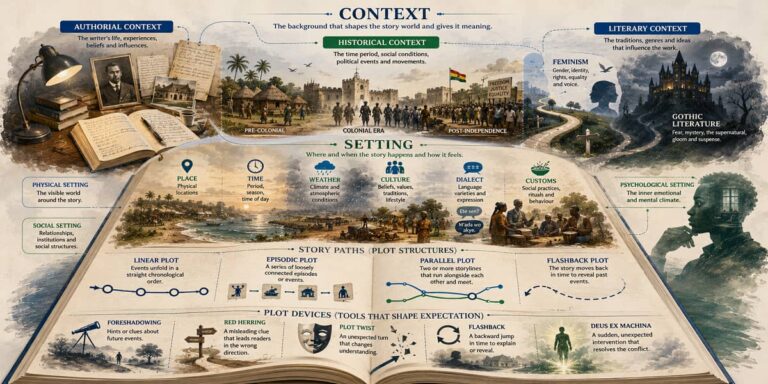
Planning is equally important. A story map can help organise ideas before writing. It can identify the title, setting, characters, problem and solution of a story.
Organising these elements beforehand makes it easier to develop a coherent narrative instead of attempting to arrange disconnected ideas after writing.
11. Literature: Language as a Form of Human Expression
Language is not used only for ordinary conversations and practical communication. It can also be used creatively to communicate emotions, ideas, experiences and cultural knowledge.
Literature refers to works of imaginative, artistic or intellectual value that use language to express ideas, emotions and experiences.
It includes novels, poems, plays, essays, short stories and other literary works.
Literature provides opportunities to understand different experiences and perspectives. It can preserve cultural knowledge, communicate values and provide entertainment while contributing to education.
12. Oral and Written Literature
Literature can be considered in two major forms: oral literature and written literature.
Oral Literature
Oral literature consists of works of art transmitted by word of mouth. It includes festivals, customary practices, music and dance, folktales, folklore, dirges, myths and legends.
Dirges are ceremonial expressions associated with praising or remembering a deceased person. They may take the form of a eulogy.
Oral literature is important because it provides ways of communicating cultural experiences and traditions through spoken and performed forms.
Written Literature
Written literature consists of works of art transmitted in written form.
Examples include The Beautiful Ones Are Not Yet Born by Ayi Kwei Armah, The Dilemma of a Ghost by Ama Ata Aidoo and Raider of the Treasure Trove by Lade Worsonoo.
Written literature allows ideas, stories and experiences to be preserved in texts that can be read and studied.
13. Why Literature Matters
Literature contributes to human development and society in several ways.
Entertainment
Stories, poems and plays provide enjoyment through creative expression and engaging experiences.
Cultural Preservation
Literature preserves cultural practices, beliefs, traditions and experiences that may otherwise be lost or forgotten.
Source of Income
Writing, publishing and other literary activities can provide income and opportunities for creative work.
Values and Moral Lessons
Literary works can communicate lessons about relationships, responsibilities and human behaviour. Readers can reflect on the decisions and experiences presented in different works.
Education
Literature exposes readers to knowledge, ideas and experiences that contribute to intellectual development.
14. The Three Major Genres of Literature
Understanding literary genres helps readers recognise the different ways writers organise and communicate their work.
Prose
Prose is a form of written language that typically contains narration and dialogue. It is the most common form of writing in literature, with fiction and non-fiction as its two main types.
Prose is found in novels, short stories, plays and essays as described in the lesson.
Examples include The Kaya Girl by Mamle Wolo and Things Fall Apart by Chinua Achebe.
Poetry
Poetry uses language to communicate emotions or ideas in a concise and often rhythmic manner. It is written in lines and verses.
Its artistic use of language allows writers to express experiences and ideas through carefully selected words.
Examples include Makola by Theresah Ennin and Skirt by Niyi Osundare.
Drama
Drama communicates a story through dialogue and movement. It often has a clear plot and characters who experience change or development.
Drama includes subgenres such as tragedy, comedy and farce.
Examples include The Son of Umbele by Bill Marshall, The Blinkards by Kobina Sekyi, The Marriage of Anansewa by Efua T. Sutherland and A Tribe Called Judah by Funke Akindele.
15. Recognising the Differences Between Genres
| Genre | How it communicates | Examples |
|---|---|---|
| Prose | Through narration and dialogue. | Novels and short stories. |
| Poetry | Through concise, rhythmic language arranged in lines and verses. | Makola and Skirt. |
| Drama | Through dialogue, movement, plot and characters. | The Blinkards and The Marriage of Anansewa. |
Recognising these differences makes literary reading more meaningful. A reader approaching a poem, for example, should pay attention to its lines and verses, while someone studying drama should consider dialogue, movement and character development.
16. Bringing the Three Learning Areas Together
Grammar, writing and literature are not isolated areas of language study. They reinforce one another.
Grammar provides the structures needed to construct meaningful sentences. Writing uses those structures to develop organised ideas. Literature demonstrates how language can be used creatively and intellectually to communicate experiences.
For example, a learner writing about a literary work needs to identify the characters and other important nouns, organise the discussion into coherent paragraphs and use suitable cohesive devices to connect the ideas.
Understanding literary genres also helps the learner recognise whether the work communicates through prose narration, poetic expression or dramatic presentation.
Conclusion: Developing a Complete Approach to English Language
Strong communication requires accurate grammar, organised writing and an appreciation of how language expresses human experiences.
Understanding the functions and forms of nouns helps learners construct meaningful sentences. Cohesive devices and paragraph development make written communication more coherent and understandable. Literature introduces different forms of human expression and demonstrates the importance of language in culture, education and society.
These areas provide a foundation for more advanced English Language learning. The ability to identify grammatical functions, connect ideas logically and recognise literary forms will support learners in academic tasks and everyday communication.
The essential lesson is simple: understand how words work, organise ideas carefully and appreciate the many ways language communicates meaning.
Access NaCCA-aligned Support Packs
Download your structured NaCCA-aligned Teacher Support Pack and Student Learning Pack, designed for clarity, practicality, and reliable teaching and learning.