Challenges And Solutions To The Agricultural Sector In Ghana
Introduction
Agriculture is one of the major sectors of Ghana’s economy and forms part of the primary industry. It contributes significantly to employment, food production, raw materials supply, and national income. The sector includes crop production, livestock and poultry, fisheries, and forestry. Despite its importance, the agricultural sector faces several challenges that affect productivity and income. Appropriate measures are required to address these challenges and promote sustainable agricultural development.
Key Concepts
- Primary Industry: Economic activities involving extraction and production of raw materials.
- Agriculture: Activities involving crop production, livestock rearing, forestry, and fishing.
- Climate Change: Long-term changes in weather patterns that affect agricultural production.
- Mechanisation: The use of machinery and equipment in farming operations.
- Extension Services: Training and advisory services provided to farmers.
- Land Tenure: The system governing ownership and use of land.
- Integrated Pest Management: Strategies used to control pests and diseases to improve productivity.
Explanation
Agriculture is an important sector in Ghana and contributes significantly to Gross Domestic Product (GDP). It provides employment and income for about half of the workforce. Major crops include cocoa, maize, cassava, yams, rice, plantain, and oil palm. Ghana is one of the world’s leading producers of cocoa, which contributes substantially to foreign exchange earnings. Most agricultural activities are undertaken by smallholder farmers with limited access to modern technologies.
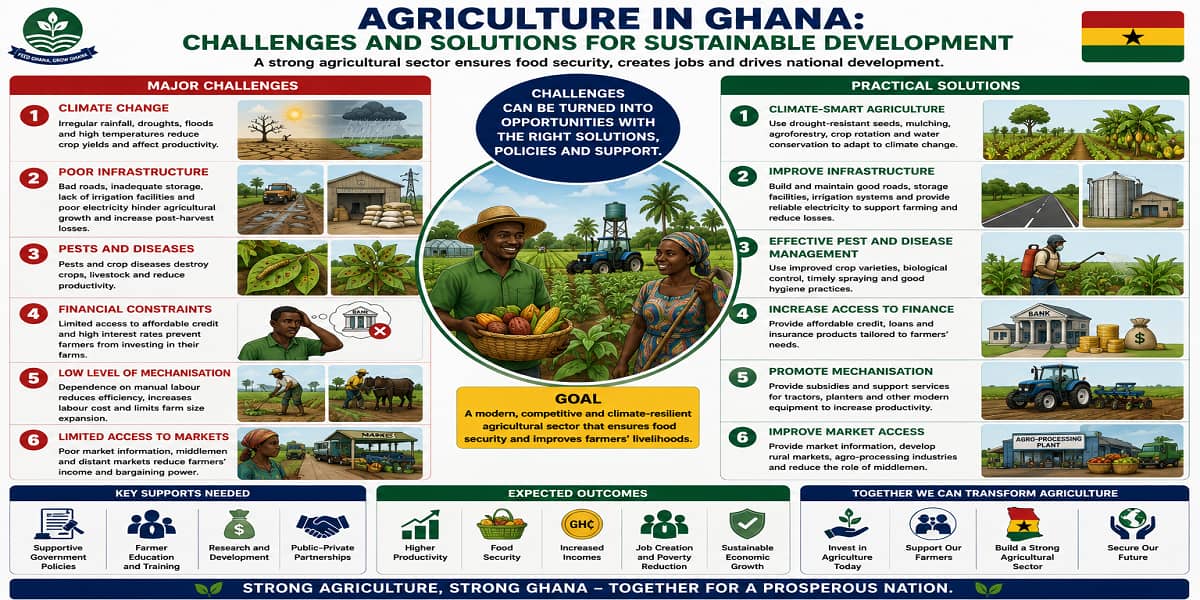
The agricultural sector faces numerous challenges. Climate change and weather variability lead to unpredictable rainfall, prolonged droughts, and floods, reducing crop yields and threatening food security. Limited access to modern farming techniques results in low productivity because many farmers rely on traditional methods. Inadequate infrastructure, including poor roads and insufficient storage facilities, contributes to high post-harvest losses and limited market access. Financial constraints restrict farmers’ ability to purchase improved seeds, fertilisers, and machinery. Land tenure problems make access to land difficult and discourage investment in land improvement. Pests and diseases also affect crop and livestock production, while low levels of mechanisation and weak extension services reduce efficiency and the adoption of improved farming practices.
Challenges Facing The Agricultural Sector
| Challenge | Description | Effect |
|---|---|---|
| Climate Change And Weather Variability | Irregular rainfall, droughts, and floods | Reduced crop yields and food insecurity |
| Limited Access To Modern Farming Techniques | Dependence on traditional farming methods | Low productivity |
| Inadequate Infrastructure | Poor roads and storage facilities | High post-harvest losses |
| Financial Constraints | Limited access to credit | Low investment in inputs and equipment |
| Land Tenure Issues | Complex ownership systems | Difficulty acquiring land |
| Pests And Diseases | Crop infestations and livestock diseases | Production losses |
| Low Levels Of Mechanisation | Limited use of machinery | Labour-intensive farming |
| Poor Extension Services | Inadequate farmer education | Limited knowledge of innovations |
Several measures can be adopted to overcome these challenges. Climate-resilient farming techniques such as drought-resistant crops and efficient water management improve resilience and productivity. Access to modern farming technologies enhances efficiency, while investment in infrastructure reduces transportation costs and post-harvest losses. Expanding financial services enables farmers to invest more in agriculture. Land reforms can promote secure land ownership and encourage sustainable practices. Integrated pest and disease management reduces production losses. Mechanisation support increases efficiency, and stronger extension services improve farmers’ knowledge and adoption of best practices.
Solutions To Agricultural Challenges
| Solution | Description | Expected Outcome |
|---|---|---|
| Climate-Resilient Farming Practices | Use of drought-resistant crops and efficient water systems | Improved yields and resilience |
| Access To Modern Technologies | Provision of improved tools and techniques | Higher productivity |
| Infrastructure Development | Roads, storage facilities, and irrigation systems | Reduced post-harvest losses |
| Financial Support | Credit and insurance services | Increased investment and income |
| Land Reform Policies | Secure land tenure systems | Greater investment in land improvement |
| Integrated Pest Management | Control measures for pests and diseases | Higher productivity |
| Mechanisation Support | Subsidies for machinery acquisition | Improved efficiency |
| Strengthening Extension Services | Farmer training and support | Adoption of innovations |
Examples
Example 1
Problem: State one effect of poor infrastructure on agriculture.
- Identify infrastructure challenges.
- Determine their effect on agricultural activities.
- State the consequence.
Final Answer: Poor infrastructure contributes to high post-harvest losses and reduced access to markets.
Example 2
Problem: Explain one solution to low agricultural productivity.
- Identify the challenge.
- Determine an appropriate solution.
- Explain its effect.
Final Answer: Access to modern farming technologies improves efficiency and increases agricultural productivity.
Application and Activities
- Identify major agricultural activities in your locality.
- Discuss the effects of climate change on farming.
- Examine the role of extension services in agriculture.
- Suggest measures to improve agricultural productivity in Ghana.
Practice Questions
- State three challenges facing the agricultural sector in Ghana.
- Explain three solutions to the challenges facing agriculture.
- Discuss the importance of mechanisation in agriculture.
Summary
Agriculture is an important component of Ghana’s economy and contributes significantly to employment and national income. However, the sector faces challenges such as climate change, financial constraints, pests and diseases, poor infrastructure, and low mechanisation. Measures including climate-smart agriculture, improved technologies, financial support, infrastructure development, and stronger extension services can enhance productivity and promote sustainable agricultural development.
Access NaCCA-aligned Support Packs
Download your structured NaCCA-aligned Teacher Support Pack and Student Learning Pack, designed for clarity, practicality, and reliable teaching and learning.