Market Structure
Introduction
Market structures refer to the organisational and other characteristics of a market that influence the nature of competition and pricing within the market. Market structures determine how firms operate, how prices are fixed, and the degree of competition in an economy. The two broad forms of market structures are perfect competition and imperfect competition. Imperfect competition includes monopoly and monopolistic competition.
Key Concepts
- Homogeneous: Goods or products that are identical in quality and characteristics and can perfectly substitute one another.
- Information Asymmetry: A situation where one party in a transaction has more or better information than another party.
- Externalities: Costs or benefits that affect third parties not directly involved in an economic transaction.
- Efficiency: The optimal use of resources to achieve the best possible outcome.
- Consumer Surplus: The benefit consumers receive when they buy goods at prices lower than what they are willing to pay.
- Producer Surplus: The benefit producers receive when they sell goods at prices higher than the minimum they are willing to accept.
- Normal Profit: The minimum level of profit required to keep a firm operating in the long run.
- Supernormal Profit: Profit earned above the normal profit level.
- Economies of Scale: Cost advantages gained when production increases.
Explanation
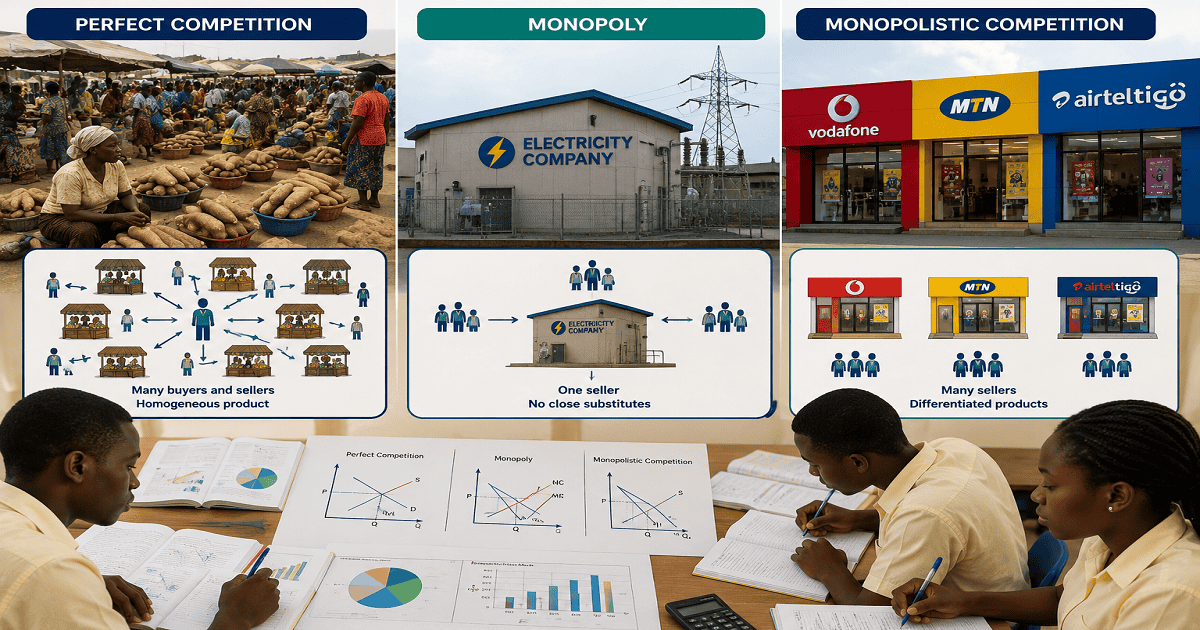
Perfect competition is a theoretical market structure used as a benchmark for comparing other market structures. It is characterised by many buyers and sellers, homogeneous products, free entry and exit, perfect information, price-taking firms, profit maximisation, and the absence of externalities.
In perfect competition, no single firm can influence market price because all firms are small relative to the market. Firms produce identical products, making consumer choice dependent mainly on price. Entry and exit into the market are unrestricted, allowing firms to respond quickly to changing market conditions.
Perfect information means all buyers and sellers have complete knowledge of prices, quality, and production methods. Firms maximise profits by producing where marginal cost equals marginal revenue. In the short run, firms may earn supernormal profits or losses, but in the long run, only normal profits are possible because firms can freely enter or leave the market.
The advantages of perfect competition include efficient allocation of resources, consumer benefits through lower prices, incentives for efficiency improvements, maximisation of economic welfare, and transparency due to perfect information. However, disadvantages include lack of supernormal profits for long-term investment, limited product differentiation, unrealistic assumptions about perfect information, inability to enjoy economies of scale, weak dynamic efficiency, and limited real-world applicability.
A monopoly is a market structure where a single firm controls the entire market for a particular product or service. The monopolist is the sole supplier and therefore has substantial market power.
Characteristics of monopoly include a single seller, unique products without close substitutes, high barriers to entry, price-making ability, and strong market power. These barriers may arise from high start-up costs, legal restrictions, ownership of resources, or economies of scale.
Monopolies may enjoy economies of scale, lower average costs, stable prices, efficient large-scale production, and the ability to invest in research and development. They can also standardise products and allocate resources efficiently in industries requiring heavy capital investment.
Despite these advantages, monopolies can lead to higher prices, restricted output, economic inefficiency, reduced innovation, poor customer service, barriers to entry for other firms, and regulatory challenges.
Monopolistic competition combines elements of monopoly and competition. In this market structure, many firms sell similar but differentiated products. Product differentiation may occur through branding, quality, design, or customer service.
Characteristics of monopolistic competition include numerous firms, product differentiation, free entry and exit, independent pricing, and non-price competition such as advertising and product innovation.
Advantages of monopolistic competition include greater consumer choice, innovation, relatively competitive prices, flexibility, efficient response to consumer demands, and informative advertising. However, disadvantages include productive inefficiency, higher prices compared to perfect competition, excessive advertising expenditure, limited long-term profits, consumer confusion, misleading information, and duplication of effort.
Comparison of Market Structures
| Feature | Perfect Competition | Monopoly | Monopolistic Competition |
|---|---|---|---|
| Number of Firms | Many firms | One firm | Many firms |
| Product Type | Homogeneous products | Unique product | Differentiated products |
| Entry and Exit | Free | Highly restricted | Free |
| Control Over Price | No control | Strong control | Some control |
| Competition Type | Price competition | Little or no competition | Non-price competition |
Examples
Example 1
Problem: Identify the market structure in a yam market where many farmers sell identical yams and no farmer can influence prices.
- Observe the number of sellers in the market.
- Determine whether products are identical.
- Check whether firms can influence prices.
- Assess ease of entry and exit.
Final Answer: The market structure is perfect competition.
Example 2
Problem: Explain why electricity supply in many countries is considered a monopoly.
- Identify the number of suppliers.
- Determine whether high infrastructure costs exist.
- Assess barriers to entry.
- Examine the firm’s pricing power.
Final Answer: Electricity supply is considered a monopoly because one firm often controls supply and high infrastructure costs prevent competitors from entering.
Application and Activities
- Watch videos showing different market situations.
- Identify the market structures shown.
- Explain the characteristics of each market structure.
- Compare and contrast any two market structures.
Practice Questions
- State three characteristics of perfect competition.
- Differentiate between monopoly and monopolistic competition.
- Discuss the advantages and disadvantages of monopoly in an economy.
Summary
Market structures determine the level of competition and pricing behaviour in an economy. Perfect competition is characterised by many firms, homogeneous products, free entry and exit, and price-taking behaviour. Monopoly exists where a single firm controls the market and has strong pricing power. Monopolistic competition involves many firms selling differentiated products and competing through advertising and innovation. Each market structure has unique advantages and disadvantages affecting efficiency, consumer welfare, innovation, and resource allocation.
Access NaCCA-aligned Support Packs
Download your structured NaCCA-aligned Teacher Support Pack and Student Learning Pack, designed for clarity, practicality, and reliable teaching and learning.