Listening Comprehension, Summarising And Prepositions
Introduction
This lesson focuses on listening comprehension, summarising, and the use of prepositions. Learners develop the ability to identify important ideas in oral texts, apply summarising techniques, and use prepositions correctly in speech and writing. These skills improve communication, comprehension, collaboration, and critical thinking.
Key Concepts
- Listening Comprehension: The ability to listen critically and extract meaning from oral communication.
- Main Idea: The most important point or central message in a text or conversation.
- Subsidiary Idea: Supporting information that explains or develops the main idea.
- Summary: A brief and concise presentation of the main points in a text.
- SWBST Strategy: A summarising strategy using Somebody, Wanted, But, So, and Then.
- Preposition: A word or group of words used to show relationships involving place, time, reason, or direction.
- Paralinguistic Features: Features such as tone of voice and stress used to communicate meaning.
- Non-Verbal Cues: Gestures and facial expressions that support spoken communication.
Explanation
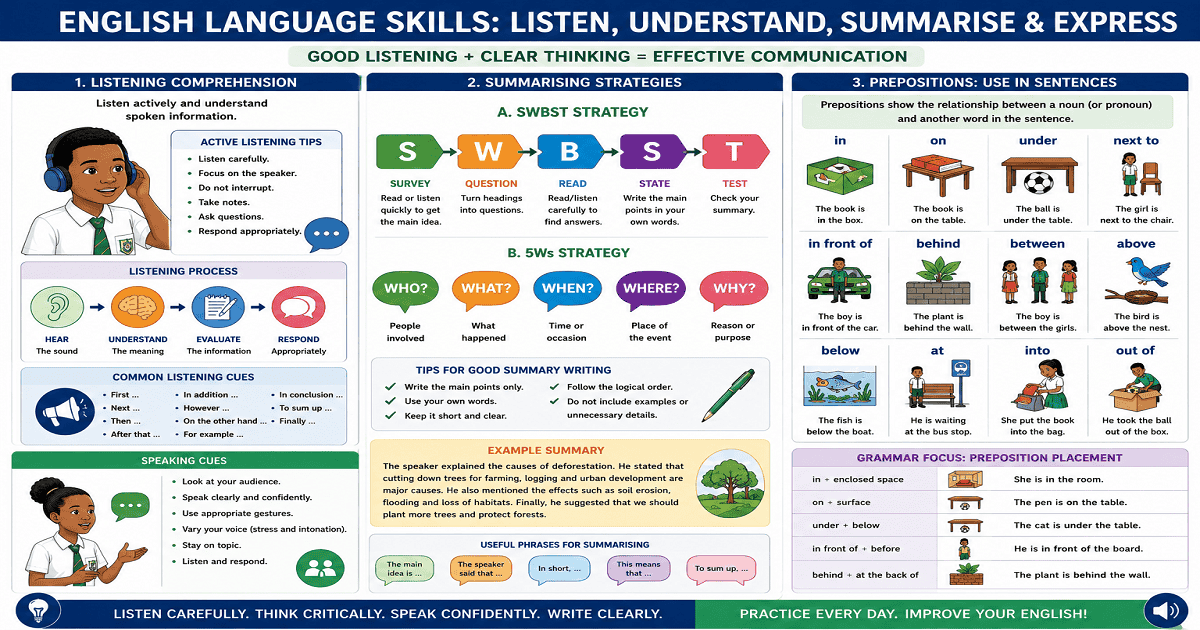
Listening comprehension involves paying close attention to oral communication in order to identify important ideas and meanings. Learners must distinguish between main ideas and subsidiary ideas in spoken texts.
Main ideas present the central focus of communication, while subsidiary ideas provide explanations, illustrations, examples, statistical information, adjectives, and adverbs that support the main idea.
To identify important information in oral texts, learners should:
- Pay attention to the beginning and end of conversations.
- Listen carefully to tone of voice and stressed or unstressed words.
- Observe gestures and facial expressions.
- Identify speaking cues such as “Today we will focus on…” and “The result of this is…”.
Experiential learning helps learners connect oral texts to personal experiences and reflect critically on information presented in discussions.
Summarising is the process of reducing information into concise main points while preserving meaning. A summary should be brief and focused on essential ideas only.
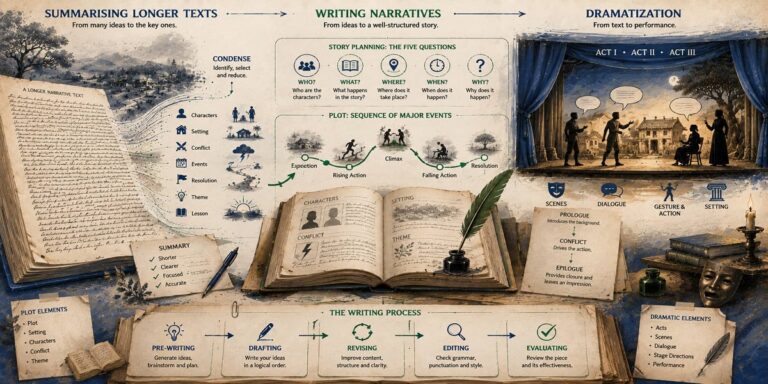
The SWBST strategy is used for summarising stories:
- S – Somebody: Who is the main character?
- W – Wanted: What does the character want?
- B – But: What problem prevents success?
- S – So: How is the problem solved?
- T – Then: What is the resolution?
Learners also use the 5Ws and How strategy:
- Who
- What
- Where
- When
- Why
- How
Prepositions belong to the minor word classes in grammar. They are used to express place, time, reason, and concession. Learners use prepositions in connected speech and writing.
Examples of prepositions include:
- In front of
- Because of
- Near to
- On behalf of
- In spite of
- Due to
- By means of
Prepositions can express:
- Place: near to, far from, in front of
- Time: at noon, during the course of, for one week
- Reason: because of, due to, on account of
- Concession: despite, apart from, in spite of
Listening Comprehension Strategies
| Strategy | Purpose | Example |
|---|---|---|
| Listening For Speaking Cues | Identifies main ideas | “Today we will focus on…” |
| Observing Tone Of Voice | Determines emphasis and meaning | Stressed words |
| Watching Non-Verbal Cues | Supports understanding | Facial expressions and gestures |
| Identifying Descriptive Terms | Recognises subsidiary ideas | Examples and illustrations |
Uses Of Prepositions
| Category | Examples | Function |
|---|---|---|
| Place | Near to, in front of, by the side of | Shows location |
| Time | At noon, for one week | Shows time relationship |
| Reason | Because of, due to | Shows cause |
| Concession | In spite of, despite | Shows contrast |
Examples
Example 1
Problem: Summarise a familiar story using the SWBST strategy.
- Identify the main character.
- Determine what the character wanted.
- State the problem faced.
- Explain how the problem was solved.
- State the final outcome.
Final Answer: A concise summary is produced using Somebody, Wanted, But, So, and Then.
Example 2
Problem: Use the preposition “because of” in a sentence.
- Identify a cause or reason.
- Construct a meaningful sentence.
- Place the preposition correctly.
Final Answer: The match was postponed because of heavy rain.
Application and Activities
- Listen to oral texts and identify main ideas.
- Use the SWBST strategy to summarise stories.
- Work in groups to discuss important and less important information.
- Construct sentences using simple and complex prepositions.
Practice Questions
- Differentiate between main ideas and subsidiary ideas.
- Explain the meaning of summary writing.
- Construct sentences using the prepositions “in spite of” and “on behalf of”.
Summary
Listening comprehension helps learners identify important ideas in oral communication using speaking cues, tone, and non-verbal signals. Summarising involves presenting the main ideas of a text concisely through strategies such as SWBST and the 5Ws and How approach. Prepositions are important grammatical elements used to express place, time, reason, and concession in speech and writing. These language skills improve effective communication and critical thinking.
Access NaCCA-aligned Support Packs
Download your structured NaCCA-aligned Teacher Support Pack and Student Learning Pack, designed for clarity, practicality, and reliable teaching and learning.