The Law Of Supply
Introduction
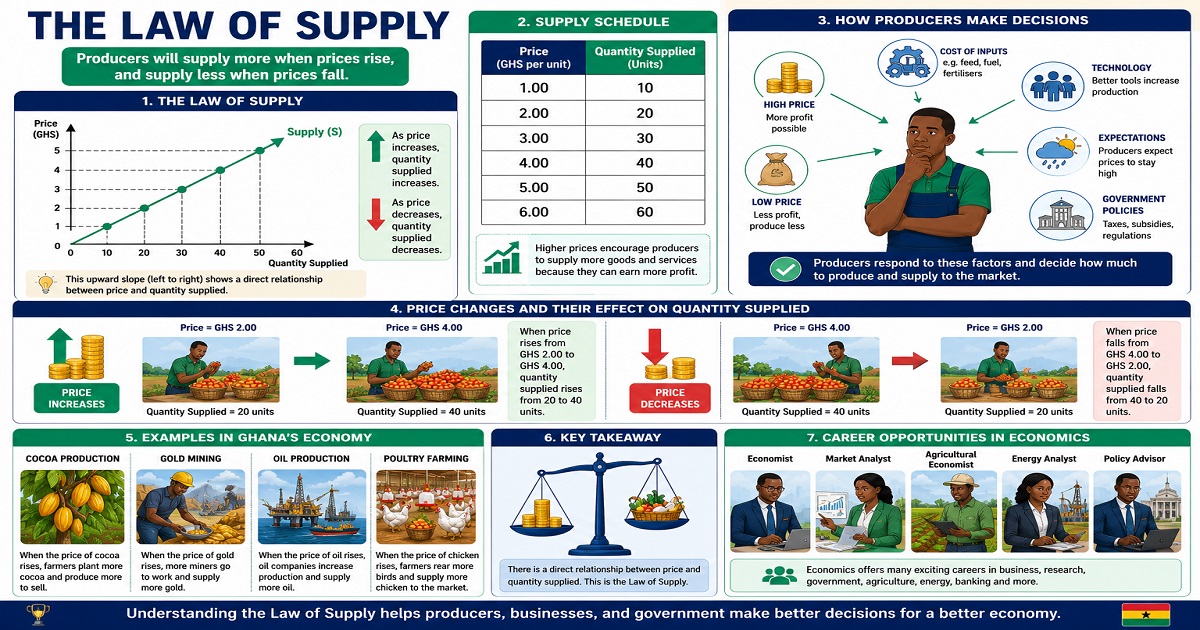
The Law of Supply is a fundamental principle in economics that explains the relationship between the price of a good or service and the quantity supplied by producers. It helps us understand how producers respond to price changes in the market and why supply levels increase or decrease under different conditions.
Key Concepts
- Law: A fundamental principle or rule that describes a regularity or pattern in economic behaviour.
- Law Of Supply: The principle stating that, all things being equal, when the price of a product rises, producers are willing to supply more, and when the price falls, they are willing to supply less.
- Supply Schedule: A table showing the quantity supplied of a good or service at different prices.
- Supply Curve: A graphical representation of the relationship between price and quantity supplied.
- Supply Function: A mathematical equation showing the relationship between price and quantity supplied.
- Ceteris Paribus: The assumption that all other factors affecting supply remain constant.
- Profit Motive: The desire of producers to maximise profits.
- Quantity Supplied: The amount of a product producers are willing to offer for sale at a given price.
Explanation
The Law of Supply describes the direct relationship between the price of a commodity and the quantity supplied. It states that all things being equal, when the price of a product increases, producers are willing to supply more of that product. Conversely, when the price decreases, producers are willing to supply less.
A supply schedule is used to show how quantity supplied changes at different prices. It provides numerical data that can be used to draw a supply curve.
| Price Of Rice | Quantity Supplied (Cups) |
|---|---|
| 1 | 8 |
| 2 | 16 |
| 3 | 24 |
| 4 | 32 |
| 5 | 40 |
The supply schedule above shows that as the price of rice increases from 1 to 5, the quantity supplied increases from 8 cups to 40 cups. This confirms the Law of Supply.
A supply curve is derived from a supply schedule. The price is plotted on the vertical axis, while quantity supplied is plotted on the horizontal axis. The supply curve slopes upward from left to right because higher prices encourage greater supply.
A supply function expresses the relationship between price and quantity supplied mathematically. It takes the form:
Q = f(P)
Where:
- Q = Quantity supplied
- P = Price
- f = Function
Example supply function:
Qs = 50 + 0.25P
This equation shows how quantity supplied changes when the price changes.
Several important points help explain the Law of Supply:
Positive Relationship: There is a direct relationship between price and quantity supplied. As prices rise, producers increase production and supply to maximise profits.
Ceteris Paribus: The Law of Supply assumes that factors such as technology, input prices, taxes, subsidies, and expectations remain constant. Changes in these factors shift the supply curve rather than cause movement along it.
Profit Motive: Producers increase supply when prices rise because higher prices create opportunities for greater profits. When prices fall, producers may reduce supply because production becomes less profitable.
Time Horizon: The Law of Supply is more applicable in the short run because producers can adjust production levels more quickly. In the long run, factors such as technology and production capacity also influence supply decisions.
Examples from Ghana include cocoa production, oil production, Shea butter production, gold mining, and poultry farming. Producers in these sectors increase supply when prices or demand rise because of profit opportunities.
Supply Function Calculations
| Price (P) | Supply Function | Quantity Supplied (Qs) |
|---|---|---|
| 100 | Qs = 50 + 0.25 × 100 | 75 Units |
| 120 | Qs = 50 + 0.25 × 120 | 80 Units |
Key Points Of The Law Of Supply
| Key Point | Explanation | Effect On Supply |
|---|---|---|
| Positive Relationship | Price and quantity supplied move in the same direction | Higher prices increase supply |
| Ceteris Paribus | Other factors remain constant | Supports accurate analysis |
| Profit Motive | Producers seek higher profits | Encourages greater production |
| Time Horizon | Supply adjustment depends on time | Short-run responses are quicker |
Examples
Example 1
Problem: Calculate the quantity supplied using the supply function Qs = 50 + 0.25P when P = 100.
- Substitute P = 100 into the formula.
- Calculate 0.25 × 100 = 25.
- Add 50 + 25.
Final Answer: Qs = 75 units.
Example 2
Problem: Explain how the Law of Supply applies to cocoa production in Ghana.
- Identify a rise in cocoa prices.
- Determine the response of cocoa farmers.
- Relate the response to the Law of Supply.
Final Answer: When cocoa prices rise, farmers increase production and supply more cocoa to benefit from higher profits.
Application and Activities
- Create supply schedules using different products and prices.
- Plot supply curves from supply schedules.
- Use supply functions to calculate quantities supplied.
- Discuss examples of the Law of Supply in Ghanaian industries.
Practice Questions
- State the Law of Supply.
- Differentiate between a supply schedule and a supply curve.
- Explain how profit motive influences the quantity supplied.
Summary
The Law of Supply states that, all things being equal, producers supply more of a product when its price rises and less when its price falls. Supply schedules, supply curves, and supply functions help explain the relationship between price and quantity supplied. Important concepts associated with the Law of Supply include positive relationships, ceteris paribus, profit motive, and time horizon. The principle is evident in many sectors of Ghana’s economy, including cocoa, oil, gold, Shea butter, and poultry production.
Access NaCCA-aligned Support Packs
Download your structured NaCCA-aligned Teacher Support Pack and Student Learning Pack, designed for clarity, practicality, and reliable teaching and learning.