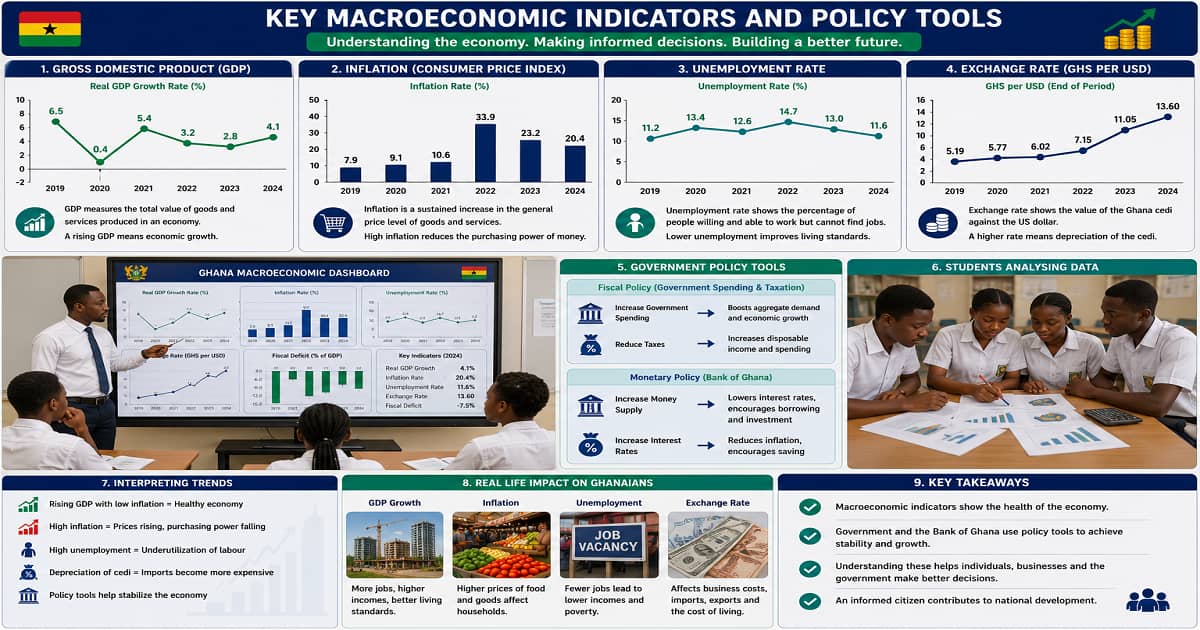
Macroeconomic Variables And Control Policies Explained for SHS 2 Economics (Semester 2, Week 4)
Economic growth, employment, inflation, and exchange rates influence the wellbeing of every country. Understanding these macroeconomic variables helps explain how economies perform and why governments introduce control policies.
What You Will Learn
- The meaning of macroeconomic variables
- How inflation affects GDP
- The effects of unemployment on economic growth
- The impact of exchange rate changes on GDP
- The different control policies used to stabilise the economy
Main Explanation
Macroeconomics examines the performance of an entire economy. Important macroeconomic variables include Gross Domestic Product (GDP), inflation, unemployment, and exchange rates. Changes in these variables affect economic growth, living standards, investment, and employment opportunities.
Inflation refers to rising prices for goods and services. Moderate inflation can encourage spending and investment because consumers and businesses expect prices to rise further. This can stimulate economic growth and increase GDP.
However, high inflation can reduce purchasing power, create uncertainty, discourage investment, and increase production costs. Deflation can also harm the economy because consumers may delay spending and businesses may postpone investment decisions.
Unemployment occurs when people who are willing and able to work cannot find jobs. High unemployment reduces household income, lowers spending, decreases tax revenue, and increases government expenditure on social welfare programs.
Unemployment also reduces productivity because available labour resources are not fully utilised. Persistently high unemployment can weaken economic growth and reduce GDP.
Exchange rates affect international trade and investment. A weak currency makes exports cheaper and more competitive internationally. It may encourage tourism, domestic production, and foreign investment.
However, a weak currency can also increase inflation and reduce purchasing power because imported goods become more expensive.
A strong currency increases purchasing power and reduces inflationary pressures by lowering import costs. However, it can make exports less competitive and reduce tourism revenues.
To manage these challenges, governments and central banks use various control policies such as monetary policy, fiscal policy, exchange rate policy, trade policy, and income policy. These policies aim to achieve sustainable economic growth, low inflation, stable employment, and currency stability.
Effects Of Macroeconomic Variables On GDP
| Variable | Positive Effects | Negative Effects |
|---|---|---|
| Inflation | Stimulates spending and investment | Reduces purchasing power and investment confidence |
| Unemployment | May encourage resource reallocation | Reduces consumption and productivity |
| Exchange Rate | Can support exports and investment | May increase inflation or reduce export competitiveness |
Major Control Policies
| Policy | Main Tool | Purpose |
|---|---|---|
| Monetary Policy | Interest rates and money supply | Control inflation and unemployment |
| Fiscal Policy | Government spending and taxation | Stimulate or slow economic activity |
| Exchange Rate Policy | Currency management | Maintain currency stability |
| Trade Policy | Tariffs and quotas | Regulate international trade |
| Income Policy | Wage and price controls | Manage inflation |
Worked Examples
Example 1
Scenario: Inflation remains low and stable for several years.
Explanation: A stable inflation environment encourages investment and consumption because businesses and consumers can plan with greater confidence, supporting economic growth.
Example 2
Scenario: The domestic currency weakens significantly against foreign currencies.
Explanation: Exports become cheaper abroad, which may increase export demand and support domestic production. However, imports become more expensive and may contribute to inflation.
Why This Topic Matters
Understanding macroeconomic variables helps learners analyse economic performance, government policies, and business decisions. It also explains how countries respond to inflation, unemployment, exchange rate fluctuations, and economic challenges.
Quick Practice
- Define GDP and inflation.
- State two effects of unemployment on GDP.
- Explain one purpose of fiscal policy.
Summary
Macroeconomic variables such as inflation, unemployment, and exchange rates influence GDP and economic performance. Governments use monetary, fiscal, exchange rate, trade, and income policies to minimise economic instability and promote sustainable growth. Understanding these relationships helps explain how economies function and respond to changing conditions.
Access NaCCA-aligned Support Packs
Download your structured NaCCA-aligned Teacher Support Pack and Student Learning Pack, designed for clarity, practicality, and reliable teaching and learning.