Calculation, Uses And Importance Of National Income
Introduction
National income is the total monetary value of all goods and services produced by a country over a specific period, usually one year. It includes wages, interest, rent, and profits earned by individuals, businesses, and government from both domestic and foreign sources. Economists use different methods to calculate national income, including the income approach and the expenditure approach. National income is important for economic planning, measuring economic performance, assessing living standards, and guiding development policies.
Key Concepts
- National Income (NI): The total monetary value of goods and services produced and incomes earned within a specific period.
- Income Approach: A method of calculating national income by summing all incomes earned by factors of production.
- Expenditure Approach: A method of calculating national income by summing all expenditures on final goods and services.
- Compensation of Employees: Wages, salaries, bonuses, and social contributions paid to workers.
- Depreciation: The loss in value of fixed capital assets over time.
- Net Factor Income From Abroad: The difference between income received from abroad and income paid abroad.
- Consumption: Household expenditure on goods and services.
- Investment: Spending on capital goods and productive assets.
- Government Spending: Expenditure by government on goods and services.
- Net Exports: Exports minus imports.
Explanation
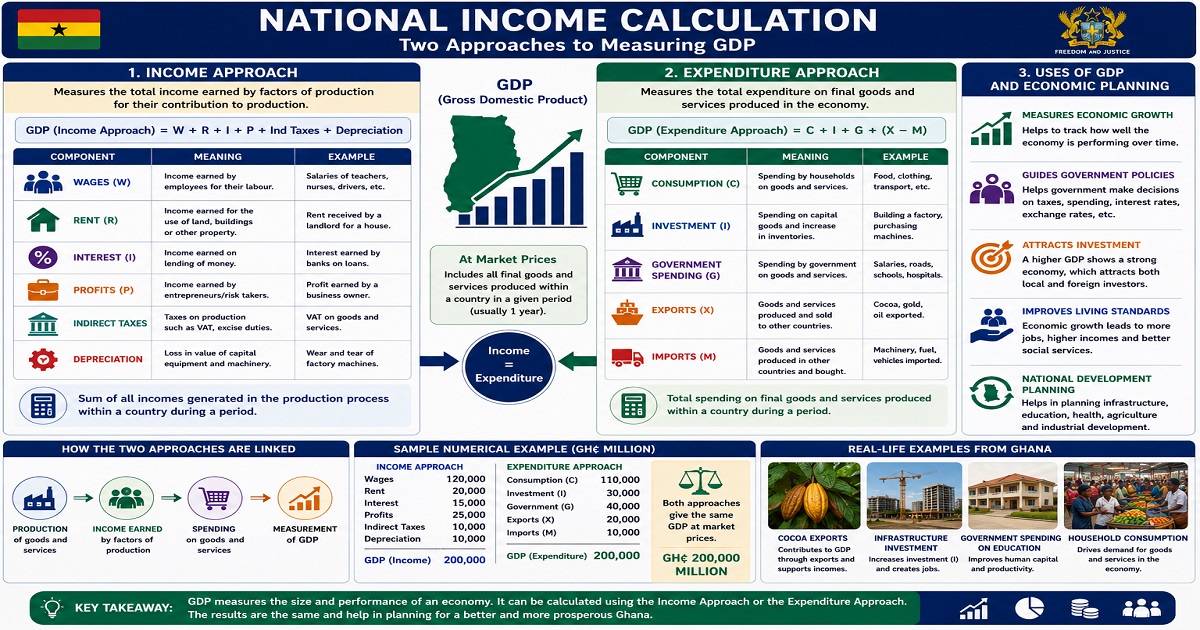
The income approach, also called the factor income approach, calculates national income by adding all incomes earned by factors of production in an economy during a given period. The main income sources include wages and salaries, rents, interest, and profits. Adjustments are then made for indirect taxes, subsidies, depreciation, and net factor income from abroad.
The formula for national income using the income approach is:
NI = Compensation of Employees + Rents + Interest + Profits + Indirect Taxes − Subsidies + Depreciation + Net Factor Income From Abroad
The expenditure approach calculates national income by summing all expenditures on final goods and services within an economy. It focuses on consumption, investment, government spending, and net exports.
The formula for Gross Domestic Product (GDP) using the expenditure approach is:
GDP = C + I + G + (X − M)
Where:
- C = Consumption
- I = Investment
- G = Government Spending
- X = Exports
- M = Imports
To obtain National Income from GDP:
NI = GDP − Depreciation + Net Foreign Factor Income − Indirect Taxes + Subsidies
National income serves several important functions. It assists governments in economic planning and policy making, measures economic performance, assesses standards of living, influences investment and savings decisions, supports international economic relations, and helps evaluate sectoral performance.
National income is also important because it indicates economic health, supports employment generation, guides social and economic policies, promotes economic stability and growth, assists public and private sector decision-making, and supports taxation and revenue collection.
Income And Expenditure Approaches
| Approach | Main Components | Focus |
|---|---|---|
| Income Approach | Wages, rents, interest, profits | Income earned by factors of production |
| Expenditure Approach | Consumption, investment, government spending, net exports | Total spending on final goods and services |
Components Of The Expenditure Approach
| Component | Description | Examples |
|---|---|---|
| Consumption (C) | Household spending on goods and services | Food, clothing, healthcare |
| Investment (I) | Spending on capital goods | Equipment, buildings |
| Government Spending (G) | Government purchases of goods and services | Education, defence, infrastructure |
| Net Exports (X − M) | Exports minus imports | International trade activities |
Uses And Importance Of National Income
| Area | Use | Importance |
|---|---|---|
| Economic Planning | Supports budgeting and policy formulation | Promotes development |
| Economic Performance | Measures growth rates | Evaluates economic progress |
| Standard Of Living | Measures per capita income | Assesses welfare levels |
| Investment Decisions | Guides public and private investments | Supports growth |
| International Relations | Supports foreign aid and loan decisions | Improves global cooperation |
| Taxation | Supports revenue planning | Funds public services |
Examples
Example 1
Problem: State the components included in the expenditure approach.
- Identify household spending.
- Identify investment spending.
- Identify government expenditure.
- Include net exports.
Final Answer: The expenditure approach consists of consumption, investment, government spending, and net exports.
Example 2
Problem: Explain how national income helps assess living standards.
- Calculate income per person.
- Compare income levels across regions.
- Evaluate welfare conditions.
Final Answer: National income helps determine per capita income, which indicates the standard of living of people within a country.
Application and Activities
- Calculate national income using both income and expenditure approaches.
- Compare the uses of national income in economic planning.
- Discuss how national income influences government policies.
- Examine Ghana’s economic growth using national income data.
Practice Questions
- Define national income.
- Differentiate between the income approach and the expenditure approach.
- Discuss three uses of national income in Ghana.
Summary
National income measures the total value of incomes earned and goods and services produced within an economy. It can be calculated using the income approach, which focuses on factor incomes, and the expenditure approach, which focuses on total spending. National income is important for economic planning, measuring economic performance, assessing living standards, supporting investment decisions, guiding government policies, and promoting economic growth and stability.
Access NaCCA-aligned Support Packs
Download your structured NaCCA-aligned Teacher Support Pack and Student Learning Pack, designed for clarity, practicality, and reliable teaching and learning.