Advantages And Disadvantages Of Taxation Explained for SHS 2 Economics (Semester 2, Week 9)
Taxes are essential to the functioning of every economy because they provide governments with the resources needed to deliver public services and influence economic activities.
What You Will Learn
- The advantages of taxation
- The disadvantages of taxation
- How taxation contributes to economic development
- The effects of taxation on individuals and businesses
- Examples of taxation in Ghana
Main Explanation
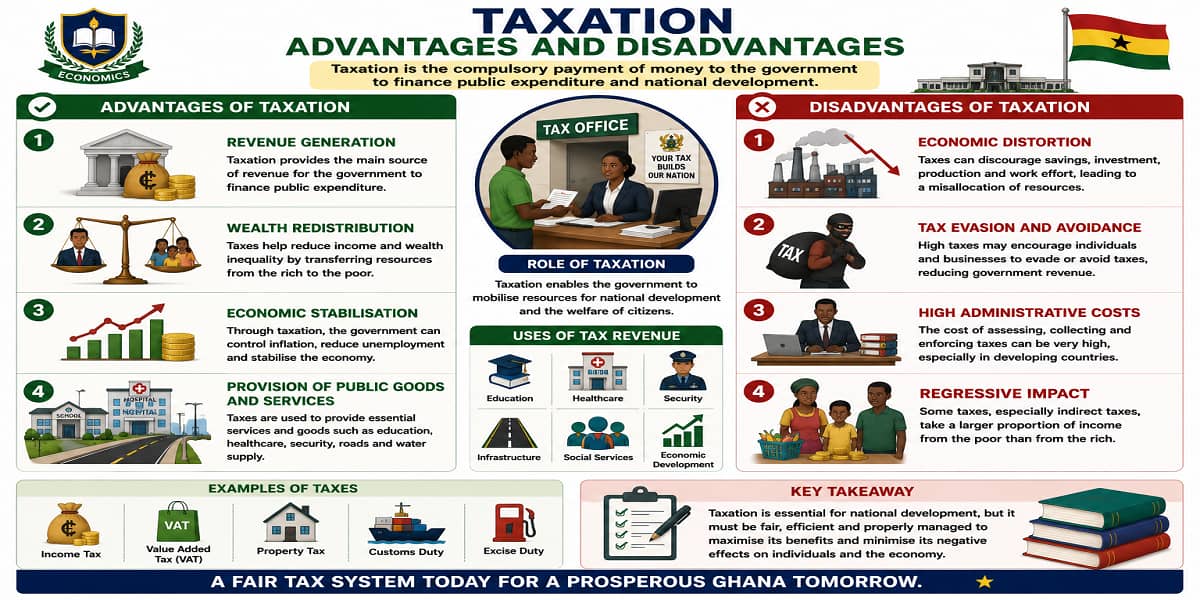
Taxation enables governments to generate revenue for public expenditure. Funds collected through taxes support healthcare, education, infrastructure, defence, and social welfare programmes. In Ghana, tax revenue is used to finance projects such as road construction and maintenance.
Another advantage of taxation is wealth redistribution. Progressive tax systems ensure that higher-income earners contribute more, helping governments support social programmes aimed at improving the welfare of lower-income groups. Ghana’s personal income tax system applies progressive rates to achieve this objective.
Taxation also helps stabilise the economy. Governments can adjust tax policies to control inflation and influence economic growth. Changes in corporate tax rates may affect business investments and overall economic performance.
Tax incentives can encourage positive behaviour such as investment in renewable energy and long-term savings. In addition, taxation provides the resources needed to supply public goods and services that may not be adequately provided by the private sector.
Despite these benefits, taxation has some disadvantages. High taxes may distort economic decisions and discourage investment. Tax administration may also be costly and complicated. Complex tax systems may encourage tax evasion and reduce government revenue. Furthermore, taxes can influence work and investment decisions and may place heavier burdens on low-income earners through regressive taxes such as VAT.
Comparison Of Advantages And Disadvantages
| Advantages | Disadvantages |
|---|---|
| Revenue generation | Economic distortion |
| Wealth redistribution | Administrative complexity and cost |
| Economic stabilisation | Tax evasion and avoidance |
| Encouraging positive behaviours | Impact on economic behaviour |
| Provision of public goods | Regressive impact |
Worked Examples
Example 1
Scenario: Government uses tax revenue to construct roads and improve hospitals.
Explanation: This demonstrates how taxation provides funds for essential public goods and services.
Example 2
Scenario: High tax rates discourage some businesses from expanding their operations.
Explanation: This illustrates how taxation may influence economic behaviour and reduce investment incentives.
Why This Topic Matters
Understanding the advantages and disadvantages of taxation helps learners appreciate how governments finance development projects and how tax policies affect individuals, businesses, and the economy.
Quick Practice
- State two advantages of taxation.
- Explain one disadvantage of taxation.
- Describe how taxation promotes wealth redistribution.
Summary
Taxation is an important source of government revenue and contributes to economic stability, wealth redistribution, and the provision of public goods. However, it may also create economic distortions, increase administrative costs, encourage tax evasion, and affect economic behaviour. A balanced tax system is essential for promoting sustainable economic development.
Access NaCCA-aligned Support Packs
Download your structured NaCCA-aligned Teacher Support Pack and Student Learning Pack, designed for clarity, practicality, and reliable teaching and learning.