Comprehension Strategies
Introduction
Reading comprehension involves using appropriate strategies to understand, retrieve and interpret information from different kinds of texts. This lesson focuses on helping learners analyse fiction and non-fiction texts by applying a variety of comprehension strategies. Learners develop their communication, reading and critical thinking skills through interactive and learner-centred activities that connect reading to real-life situations.
Key Concepts
- Reading Comprehension: The process of retrieving, understanding and interpreting information from a text.
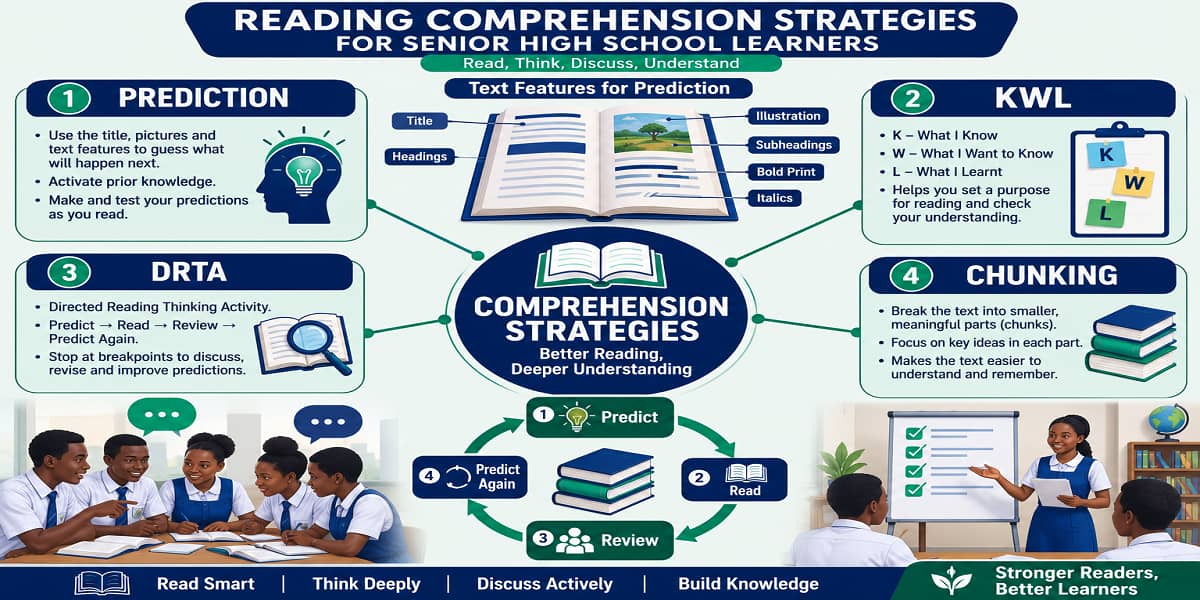
- Prediction: Using clues from a text to make logical guesses about what may happen before, during and after reading.
- KWL Strategy: A comprehension strategy that helps learners identify what they Know, what they Want to Know and what they have Learned.
- DRTA (Directed Reading Thinking Activity): A strategy that encourages learners to predict, read, confirm and revise their thinking while reading.
- Chunking: Breaking a text into smaller sections to make reading and interpretation easier.
Explanation
Learners use a variety of comprehension strategies to analyse both fiction and non-fiction texts. The teacher selects level-appropriate texts from stories, narrations, audio recordings, videos and other linked subjects. These texts should reflect varied cultural backgrounds, values, interests and affiliations.
Prediction is an important comprehension strategy. Learners discuss prediction in real-life situations before applying it to reading. They make logical predictions at the beginning, middle and end of fiction texts and support every prediction with evidence from the text.
Learners work collaboratively in mixed-ability reading groups. At teacher-created or group-created breakpoints, they predict, review and make new predictions until the text is completed. Group representatives present their findings while classmates critique and review each presentation respectfully.
For non-fiction texts, learners use titles, illustrations, headings, subheadings, bold print, italics and other text features to make predictions before reading.
Learners also apply KWL, DRTA and chunking strategies to interpret more advanced texts. These strategies encourage organised thinking, continuous prediction and deeper understanding throughout the reading process.
| Comprehension Strategy | Purpose | Application |
|---|---|---|
| Prediction | Make logical guesses using text clues | Before, during and after reading |
| KWL | Organise prior knowledge and learning | Know, Want to Know and Learned |
| DRTA | Guide thinking while reading | Predict, read, confirm and revise ideas |
| Chunking | Break text into manageable sections | Interpret advanced texts more effectively |
Examples
Example 1
Problem: Learners read only the title of a story before reading the full text.
- Read the title carefully.
- Predict what the story may be about.
- Support the prediction using clues from the title.
Final Answer: A logical prediction should be made using evidence from the title before reading the story.
Example 2
Problem: Learners stop at a breakpoint during reading.
- Review what has already been read.
- Predict what may happen next.
- Continue reading to confirm or revise the prediction.
Final Answer: Predictions should be reviewed and refined as new information becomes available.
Application and Activities
- Identify the main ideas from varied fiction texts.
- Make logical predictions at the beginning, middle and end of texts.
- Read texts collaboratively and predict, review and predict again at breakpoints.
- Use titles, illustrations, headings and other text features to predict non-fiction texts.
- Apply KWL, DRTA and chunking strategies to interpret advanced texts.
Practice
- State one comprehension strategy used before reading.
- Explain how prediction improves reading comprehension.
- Use the beginning of a given text to predict its middle and ending.
Summary
Comprehension strategies enable learners to retrieve, interpret and understand different types of texts. Prediction, KWL, DRTA and chunking help learners organise their thinking, make evidence-based predictions and improve understanding of fiction and non-fiction texts. Collaborative learning and learner-centred activities further strengthen communication, reading and critical thinking skills.
Access NaCCA-aligned Support Packs
Download your structured NaCCA-aligned Teacher Support Pack and Student Learning Pack, designed for clarity, practicality, and reliable teaching and learning.