Review Explained for SHS 1 Literature-in-English (Sem. 1 – Week 10)
Finishing a novel or reading another learner’s story is only one part of engaging with literature. The next question is often more demanding: What do you think of the work, and why?
A literary review provides a structured way to answer that question. It brings together description, critical analysis, evaluation and personal judgement to examine the quality, meaning and significance of a text.
A Review Is More Than a Retelling
When people hear the word “review”, they sometimes think of a shortened version of a story. That is closer to a summary.
A review goes further. It considers what the text is about, how it is presented, what makes it effective or less effective, what the writer seeks to achieve and what judgement the reviewer can reasonably make about the work.
The weekly material describes a review as a thorough description, critical analysis and evaluation of the quality, meaning and significance of a text. It also directs attention to impact, key moments and memorability.
The Reviewer Has Two Jobs
A useful way to understand reviewing is to think of the reviewer as performing two related jobs.
First, the reviewer helps the reader understand the work. What is it about? Who wrote it? What are its important features?
Second, the reviewer helps the reader think about the work critically. What is effective? What is less effective? What is the writer trying to achieve? What is the reviewer’s final judgement?
A successful review performs both jobs.
The Six Questions at the Heart of a Review
| Question | What It Adds to the Review |
|---|---|
| Who wrote it? | Identifies the writer and work. |
| What is it about? | Establishes the subject matter. |
| What do you like? | Identifies strengths or appealing features. |
| What do you dislike? | Identifies weaknesses or less effective features. |
| What does the writer seek to achieve? | Examines purpose and intended effect. |
| What is your opinion? | Provides the overall judgement. |
These questions form a practical framework for reviewing both another learner’s work and novels that you have read.
Why “What Is It About?” Comes Early
A reader cannot evaluate a work effectively without first understanding what the work is about.
The review should therefore establish the subject matter before moving into detailed judgement. In a narrative, this may involve referring to relevant characters, plot and setting.
The reviewer should give enough context for the evaluation to make sense without turning the review into a full retelling.
Style Matters
Two texts may deal with similar subject matter but present their ideas differently. This is why the weekly material specifically asks learners to describe the style of the work being reviewed.
When discussing style, pay attention to the way the work is presented and how that presentation affects the experience of reading it.
The important question is not merely, “What style does the writer use?” but also, “What effect does that style have on the work?”
Finding Strengths
A reviewer should be able to identify what works well.
Perhaps a particular part is memorable. Perhaps an aspect of the narrative has a strong impact. Perhaps a literary element contributes effectively to the work.
The reviewer should identify the feature and explain why it is successful.
Finding Weaknesses
Critical reading also means noticing what could be improved.
A weakness should be described clearly rather than reduced to a vague statement such as “I did not like it.” The reader benefits more when the reviewer identifies the particular feature and explains why it was less effective.
Purpose Changes How We Read
One of the most useful questions in a review is what the writer seeks to achieve.
A text can be understood more deeply when the reviewer considers its intended achievement and then examines how effectively the work fulfils that aim.
This moves the review from personal reaction towards literary evaluation.
Opinion Needs a Foundation
Every reviewer has an opinion. The important issue is whether that opinion is supported by the discussion.
Compare:
“I really enjoyed the work.”
with:
“I enjoyed the work because its memorable moments and treatment of its major elements made a strong impression on me.”
The second statement gives the reader a reason for the judgement.
Reviewing Characters, Plot and Setting
When reviewing a peer’s creative narrative, the weekly material highlights characters, plot and setting as key elements to discuss with the original writer.
| Element | Review Focus |
|---|---|
| Characters | Consider the characters that carry the narrative and their contribution to the work. |
| Plot | Consider how the story’s events are organised and developed. |
| Setting | Consider the place and time of the narrative and their contribution to the work. |
Peer Review Changes the Classroom Conversation
When learners review one another’s creative work, writing becomes a shared process rather than an isolated activity.
The reviewer reads critically. The original writer receives feedback. Both can then discuss the literary elements that shape the work.
The weekly material describes peer review as an activity that consciously develops critical thinking because learners read critically through the lines in order to give feedback.
Constructive Criticism Is a Skill
Good criticism does not mean finding fault for its own sake.
Constructive feedback identifies what works, identifies what could be improved and gives reasons for the judgement. It allows the writer to understand how another reader experienced the work.
A useful pattern is:
Observation → Evaluation → Reason → Constructive feedback.
For example, instead of writing “The setting is bad,” a reviewer could explain what aspect of the setting is unclear and why greater clarity would improve the narrative.
The Reviewer Is Also a Learner
Peer review develops the reviewer as well as the writer.
To evaluate someone else’s work, you must pay attention to how literary elements operate. You also have to communicate your judgement clearly and respectfully.
This develops critical reading, communication and organisation of ideas.
From Review to Portfolio
A learner who becomes confident with a review template can organise several reviewed pieces into a portfolio.
The weekly material suggests that such work may even be prepared for publication in a class magazine where one exists.
A portfolio creates a record of critical responses and gives the learner an opportunity to organise work creatively.
Reviewing a Novel You Have Already Read
Reviewing a novel begins with the same basic questions.
Identify the writer. Describe what the novel is about. Discuss its style and important elements. Explain what you liked and disliked. Consider the writer’s purpose. Then reach an overall opinion.
The aim is not to reproduce the novel. The aim is to help another reader understand the work and your critical response to it.
Impact, Key Moments and Memorability
Some parts of a literary work stay with readers long after they have finished reading.
A review can identify such moments and ask why they matter. Did the moment have a strong impact? Does it reveal something significant about the work? Is it memorable because of the way the narrative is presented?
These questions can turn a simple reaction into a more thoughtful evaluation.
A Review Should Have Direction
A collection of disconnected comments does not make a strong review.
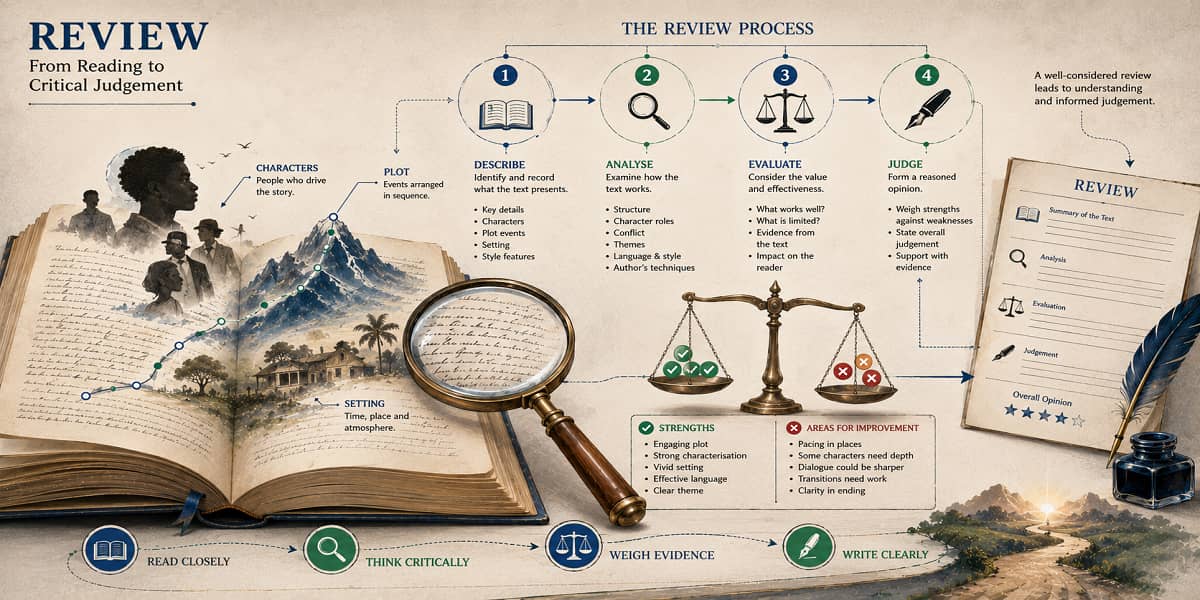
The ideas should build towards a conclusion. Information about the writer and content provides context. Discussion of style and literary elements provides analysis. Strengths and weaknesses provide evaluation. Consideration of purpose helps interpret the work. The final opinion brings the discussion together.
The resulting movement is:
Context → Description → Analysis → Evaluation → Judgement.
Reviewing Without Losing Fairness
Personal taste inevitably influences literary responses. One reader may find a feature especially effective while another may not.
That is why a review benefits from explanation. Saying what you like or dislike is valid as part of a review, but explaining the reason gives the response greater critical value.
An Extended Review Task
The weekly material identifies Kaya Girl by Mamle Wolo as a possible text for an extended review, while also allowing learners to choose another text.
For an extended review, apply the full framework rather than concentrating on only one aspect of the work.
Begin with the writer and subject matter. Move into style and important features. Discuss strengths and weaknesses. Consider what the writer seeks to achieve. Finish with a reasoned overall opinion.
Review Writing as Preparation for Literary Analysis
Review writing requires several habits that are valuable in literary study: close reading, identification of important features, interpretation, evaluation and reasoned judgement.
The ability to review therefore strengthens the reader’s ability to move from simply knowing what happens in a text to explaining how the text works and what significance it may have.
A Useful Final Test
Before considering a review complete, ask:
- Have I identified the writer?
- Have I explained what the work is about?
- Have I considered its style?
- Have I discussed what I like?
- Have I discussed what I dislike?
- Have I considered what the writer seeks to achieve?
- Have I explained my overall opinion?
- Have I supported my judgements with observations from the work?
Final Takeaway
A review is an invitation to look at literature more closely.
It begins with understanding the work, but it does not stop there. The reviewer considers its style, characters, plot, setting, impact, memorable moments, strengths and weaknesses. The reviewer also considers what the writer seeks to achieve and then reaches an overall judgement.
For peer work, this process becomes a conversation between readers and writers. For novels, it becomes a way of helping other readers understand both the work and your response to it.
The essential habit is simple:
Do not merely say whether a text is good or bad. Explain what it does, how it does it, what works, what could be improved, and why you have reached your judgement.
Access NaCCA-aligned Support Packs
Download your structured NaCCA-aligned Teacher Support Pack and Student Learning Pack, designed for clarity, practicality, and reliable teaching and learning.