Time Periods, Product Measures and Methods of Production Explained for SHS 2 Economics (Sem. 1 – Week 7)
Every firm faces a basic production question: how can inputs be organised to produce output? The answer depends on the time available, the behaviour of output as inputs change, and the production method being used.
Why Time Matters in Production
Economists distinguish between the short run and the long run not simply by counting months or years, but by considering whether inputs can be changed.
In the short run, at least one factor of production is fixed. A firm may increase labour or raw materials while its existing building or machinery remains unchanged. In the long run, all factors are variable, allowing the firm to alter its production capacity.
Three Ways to Read Production Data
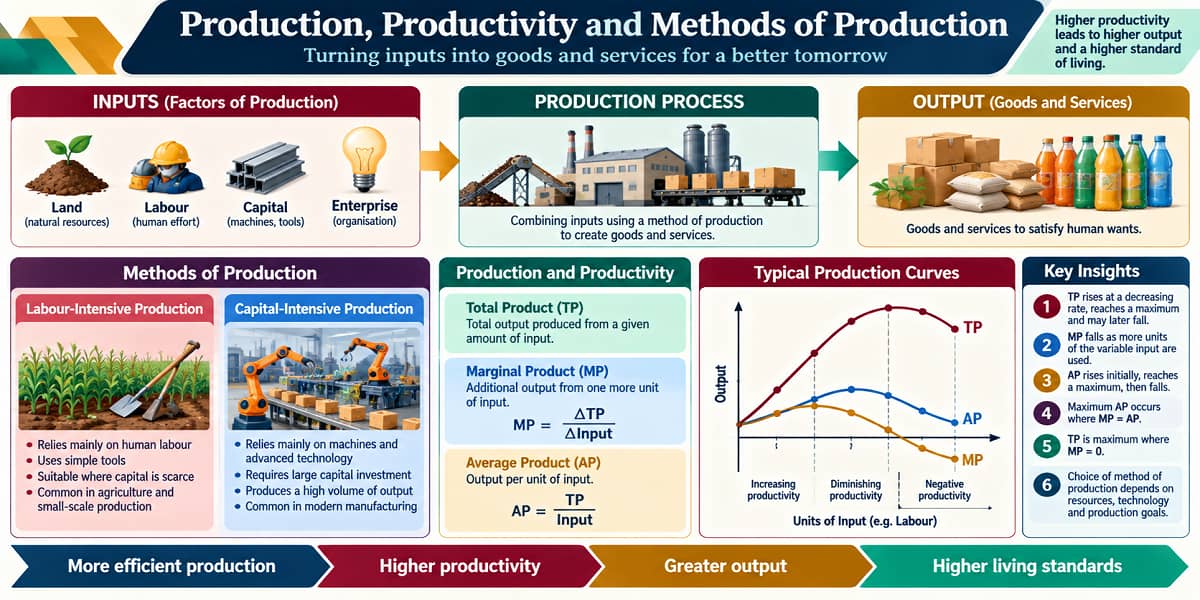
Total Product (TP) tells us the total output produced. Marginal Product (MP) tells us how much additional output results from an extra unit of variable input. Average Product (AP) tells us the output produced per unit of variable input.
| Measure | Meaning | Formula |
|---|---|---|
| TP | Total output | Sum of marginal products |
| MP | Additional output from an extra unit of variable input | ΔTP ÷ ΔQ |
| AP | Output per unit of variable input | TP ÷ Q |
A Small Change in Input Can Tell a Bigger Story
Consider output rising from 60 units when 4 workers are employed to 70 units when 5 workers are employed.
MP = (70 − 60) ÷ (5 − 4) = 10
The average product at 5 workers is:
AP = 70 ÷ 5 = 14
These measures allow us to examine not only how much a firm produces, but also what happens when the quantity of a variable input changes.
The Three Stages of Production
The behaviour of TP, MP and AP divides production into three broad stages.
- Increasing returns: TP rises at an increasing rate while MP and AP rise.
- Decreasing returns: TP continues to rise, but more slowly. MP declines while remaining positive, and AP declines after reaching its maximum.
- Negative returns: TP falls and MP becomes negative. AP continues to decline.
The data illustrate this pattern. When labour rises from 6 to 7, total product remains at 75 and MP becomes zero. When labour rises from 7 to 8, TP falls from 75 to 70 and MP becomes −5.
Productivity Beyond the Number of Workers
The production analysis also introduces Total Factor Productivity (TFP), expressed here as:
TFP = TP ÷ (L + K)
For example, with 70 units of total product, 5 units of labour and 10 units of capital:
TFP = 70 ÷ (5 + 10) = 4.67
This measure captures output in relation to the labour and capital quantities used in production.
Two Broad Production Methods
Firms also differ in the way they combine labour and capital. A labour-intensive method relies more heavily on human labour, while a capital-intensive method relies more heavily on machinery, equipment and technology.
| Labour-Intensive | Capital-Intensive | |
|---|---|---|
| Main reliance | Human labour | Machinery and technology |
| Capital investment | Lower | Higher |
| Flexibility | More adaptable to demand and customisation | Better suited to mass production |
| Typical scale | Small to medium-scale | Large-scale |
| Examples | Agriculture, textiles, handicrafts | Automobiles, oil refining, electronics |
Examples given for labour-intensive production include manual agricultural activities, textiles, pottery, jewellery and traditional crafts. Capital-intensive examples include automated automobile production, oil refining and electronic-device production.
The Economic Idea to Remember
Production is not just about counting output. It is about understanding the relationship between inputs, output, time and production methods. The short run and long run explain how flexible inputs are. TP, MP and AP reveal how output responds to changes in variable inputs. The three stages of production show how that response changes, while labour-intensive and capital-intensive methods describe different ways of organising production.
Quick Review
- Short run: at least one factor is fixed.
- Long run: all factors are variable.
- TP: total output.
- MP: additional output from an additional unit of variable input.
- AP: output per unit of variable input.
- Negative MP: TP is declining.
- Labour-intensive: greater reliance on human labour.
- Capital-intensive: greater reliance on machinery, equipment and technology.
Access NaCCA-aligned Support Packs
Download your structured NaCCA-aligned Teacher Support Pack and Student Learning Pack, designed for clarity, practicality, and reliable teaching and learning.