Cost: Concepts, Calculations and Cost Curves
1. What Does Cost Mean?
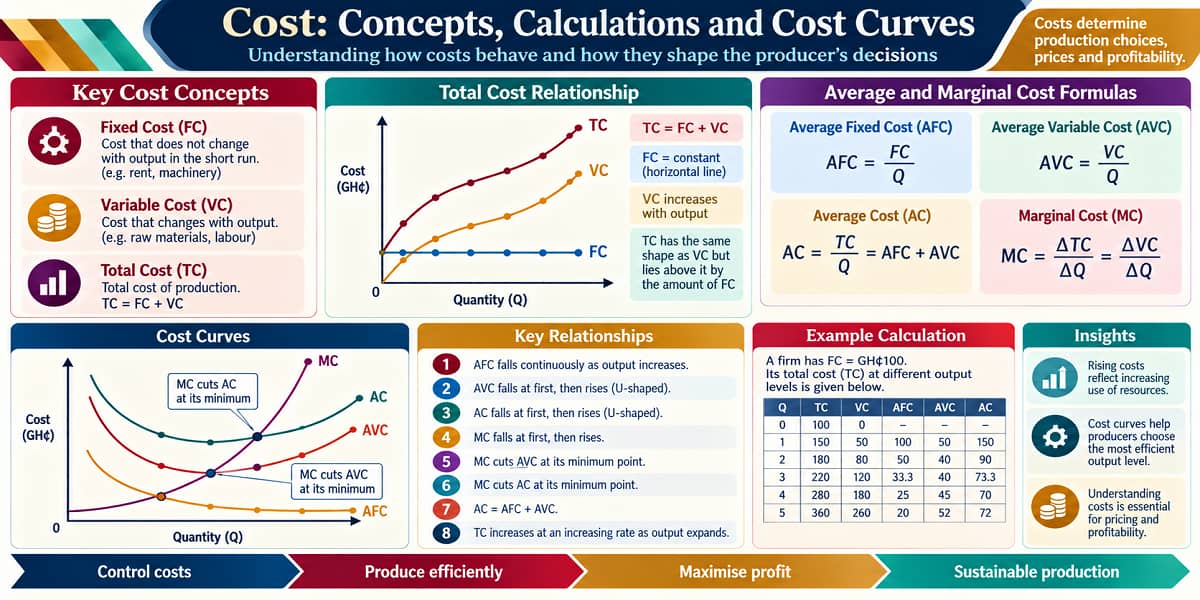
Cost is the monetary value spent by a firm or individual to produce goods or services. In production, understanding cost helps a firm determine how much it spends at different levels of output.
2. The Main Types of Cost
Fixed Cost (FC)
Fixed costs do not change with the level of output. Examples include rent, salaries of permanent staff, insurance and depreciation of equipment.
Variable Cost (VC)
Variable costs change with the level of output. Examples include raw materials, direct labour and production-related utilities.
Total Cost (TC)
Total cost is the sum of fixed and variable costs:
TC = TFC + TVC
3. Other Important Costs
| Cost | Meaning | Example |
|---|---|---|
| Opportunity cost | Cost of foregoing the next best alternative. | Income sacrificed by choosing one activity instead of another. |
| Sunk cost | A cost already incurred that cannot be recovered. | Past advertising expenditure. |
| Explicit cost | Direct cash payments for production inputs. | Wages, rent and materials. |
| Implicit cost | Non-cash opportunity cost of using resources owned by the firm. | Owner’s time or use of an owned building. |
| Economic cost | The sum of explicit and implicit costs. | Cash payments plus opportunity costs of owned resources. |
4. Costs Over Different Time Horizons
In the short run, at least one factor of production is fixed. In the long run, all factors are variable, so firms can adjust their production capacity.
| Short-Run Costs | Long-Run Costs |
|---|---|
| At least one factor is fixed. | All factors are variable. |
| Production capacity is constrained. | Production capacity can be fully adjusted. |
| Fixed costs exist. | There are no fixed costs. |
5. Average and Marginal Costs
Average Fixed Cost (AFC)
Average fixed cost is fixed cost per unit of output.
AFC = TFC ÷ Q
As output increases, AFC falls because the fixed cost is spread over more units.
Average Variable Cost (AVC)
Average variable cost is variable cost per unit of output.
AVC = TVC ÷ Q
The AVC curve is typically U-shaped. It falls initially and later rises.
Average Cost (AC)
Average cost is total cost per unit of output.
AC = TC ÷ Q
It can also be expressed as:
AC = AFC + AVC
Marginal Cost (MC)
Marginal cost is the additional cost resulting from producing one more unit of output.
MC = ΔTC ÷ ΔQ
Therefore:
MC = (TC2 − TC1) ÷ (Q2 − Q1)
6. Work Through a Cost Calculation
Consider a small bakery producing 1,000 units in a month.
Its fixed costs are:
- Rent = GH₵1,000
- Two employee salaries = GH₵4,000
- Insurance = GH₵500
- Equipment lease = GH₵300
- Fixed utilities = GH₵200
TFC = GH₵1,000 + GH₵4,000 + GH₵500 + GH₵300 + GH₵200 = GH₵6,000
Variable cost per unit is:
GH₵1.00 + GH₵0.20 + GH₵0.05 + GH₵0.50 = GH₵1.75
For 1,000 units:
TVC = GH₵1.75 × 1,000 = GH₵1,750
TC = GH₵6,000 + GH₵1,750 = GH₵7,750
Now calculate the average costs:
AFC = GH₵6,000 ÷ 1,000 = GH₵6.00
AVC = GH₵1,750 ÷ 1,000 = GH₵1.75
AC = GH₵7,750 ÷ 1,000 = GH₵7.75
7. Complete the Cost Table
| Q | TFC | TVC | TC | AFC | AVC | MC | ATC |
|---|---|---|---|---|---|---|---|
| 0 | 1,000 | 0 | 1,000 | — | — | — | — |
| 1 | 1,000 | 200 | 1,200 | 1,000 | 200 | 200 | 1,200 |
| 2 | 1,000 | 380 | 1,380 | 500 | 190 | 180 | 690 |
| 3 | 1,000 | 540 | 1,540 | 333.33 | 180 | 160 | 513.33 |
| 4 | 1,000 | 680 | 1,680 | 250 | 170 | 140 | 420 |
| 5 | 1,000 | 800 | 1,800 | 200 | 160 | 120 | 360 |
| 6 | 1,000 | 900 | 1,900 | 166.67 | 150 | 100 | 316.67 |
| 7 | 1,000 | 980 | 1,980 | 142.86 | 140 | 80 | 282.86 |
| 8 | 1,000 | 1,040 | 2,040 | 125 | 130 | 60 | 255 |
| 9 | 1,000 | 1,080 | 2,080 | 111.11 | 120 | 40 | 231.11 |
| 10 | 1,000 | 1,120 | 2,120 | 100 | 112 | 40 | 212 |
Example: Finding Marginal Cost
At Q = 4, total cost is GH₵1,680. At Q = 3, total cost is GH₵1,540.
MC = (1,680 − 1,540) ÷ (4 − 3)
MC = GH₵140
8. Remember the Relationships
- TC = TFC + TVC
- AFC = TFC ÷ Q
- AVC = TVC ÷ Q
- AC = TC ÷ Q = AFC + AVC
- MC = ΔTC ÷ ΔQ
- As output increases, AFC decreases.
- MC intersects AVC and AC at their lowest points in the standard cost-curve relationship presented in the topic.
9. Quick Check
- What is fixed cost?
A cost that does not change with the level of output. - What is variable cost?
A cost that changes with the level of output. - If TFC = GH₵1,000 and TVC = GH₵380, what is TC?
GH₵1,380. - If TC rises from GH₵1,540 to GH₵1,680 when output rises from 3 to 4, what is MC?
GH₵140. - Why does AFC fall as output increases?
The fixed cost is spread over a larger number of units.
10. Summary
Cost analysis shows how much a firm spends at different levels of production. Fixed costs remain unchanged with output, while variable costs change with output. Their sum gives total cost. AFC, AVC and AC measure cost per unit, while MC measures the additional cost of producing another unit. These measures can be calculated and represented through cost curves.
Access NaCCA-aligned Support Packs
Download your structured NaCCA-aligned Teacher Support Pack and Student Learning Pack, designed for clarity, practicality, and reliable teaching and learning.