Literary Adaptation, Editing and Reviewing Short Stories Explained for SHS 2 Literature-in-English (Sem. 1 – Week 8)
When a Story Changes: The Creative Process Behind Literary Adaptation
Stories do not always remain in the form in which they were originally created. A novel can become a film, a play can be presented on television, and a familiar story can be retold from the perspective of another character. Even a story that remains in written form can undergo significant changes when a writer decides to explore a different setting, introduce new characters or present an alternative ending.
This creative process is known as literary adaptation. It allows writers to transform existing works for different purposes, environments and audiences while considering the important themes and storylines that give the original work its identity.
Adaptation also introduces an important responsibility. Changing a story requires more than introducing new ideas. The writer must examine whether the changes are coherent, meaningful and appropriate to the intended narrative.
This is where editing and reviewing become essential. They help writers examine their creative decisions, improve the organisation of their stories and produce work that communicates effectively.
1. What Happens When an Existing Story Is Adapted?
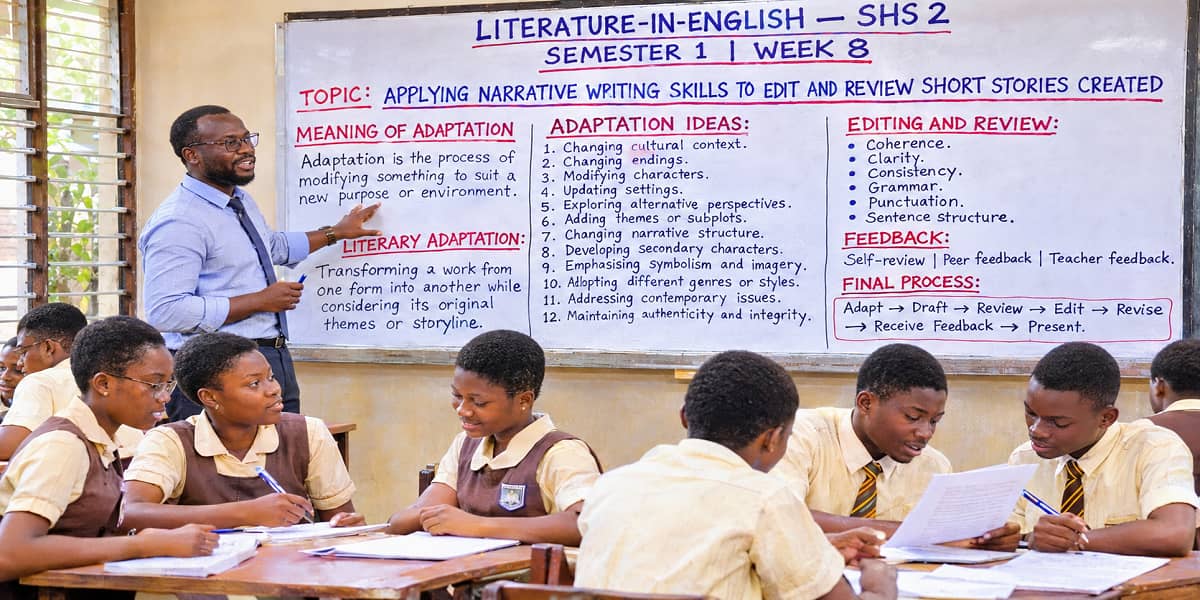
Adaptation refers to modifying something to suit a new purpose or environment. In literature and the arts, it involves transforming a work from one form into another.
A novel, for example, may be transformed into a film, television series or stage production. Films and action cartoons may also be adapted into video games.
Each medium communicates differently. A novel depends largely on written language, descriptions and narration. A film uses visual images, sound, dialogue and action. A stage production relies on performance, dialogue, movement and the arrangement of the stage.
Consequently, an adaptation may require changes to the way information is communicated. A lengthy description in a novel might be represented through a visual scene in a film.
However, changing the medium does not necessarily mean abandoning the original story. Important themes or elements of the storyline may be retained while the presentation is modified.
2. Adaptation Is a Creative Decision, Not Simply a Copying Exercise
One of the most important considerations in adaptation is deciding which elements should change and which should remain.
A writer may want to introduce a new cultural environment, explore a different character’s experiences or present an alternative resolution to an existing conflict.
These decisions can produce a different emotional experience and encourage audiences to interpret the story in new ways.
For instance, changing a happy ending into a sad ending may alter how readers understand the consequences of the characters’ actions. Presenting events from another character’s viewpoint may also reveal information that was less visible in the original version.
Adaptation therefore involves interpretation. The writer must understand the existing work sufficiently to identify the opportunities and consequences of changing it.
3. Fourteen Creative Directions for Transforming a Story
There are several ways to approach adaptation. Each offers a different opportunity to reshape a narrative.
1. Swapping Cultural Context
Relocate the story to another cultural environment. This changes the circumstances, societal expectations and experiences that influence the characters’ behaviour and relationships.
2. Changing Endings
Present an alternative conclusion. A happy ending may become sad, or a difficult ending may be replaced with a more positive resolution. Such changes influence emotional impact and interpretation.
3. Modifying Characters
Change character traits, motivations or relationships to explore different aspects of their personalities and create new developments in the narrative.
4. Updating Settings or Time Periods
Move the story to another historical period or modernise its environment to reflect contemporary circumstances.
5. Exploring Alternative Perspectives
Retell the story through another character or introduce multiple narrators. Different viewpoints can reveal experiences and interpretations that were previously less prominent.
6. Integrating More Themes or Subplots
Introduce additional ideas, conflicts or secondary storylines that complement the original narrative and provide greater depth.
7. Experimenting with Narrative Structure
Use flashbacks, multiple timelines or non-linear storytelling to change the way readers encounter the events.
8. Developing Secondary Characters
Give greater importance to characters who previously played minor roles or introduce new characters to support the main storyline.
9. Emphasising Symbolism or Imagery
Use symbols, metaphors and imagery to communicate deeper meanings and strengthen the themes of the adapted work.
10. Adopting Different Genres or Styles
Transform a story into another genre, such as changing a drama into a comedy, or use a different narrative approach such as stream-of-consciousness narration or an epistolary format.
11. Addressing Contemporary Issues
Use an adaptation to explore social, political or cultural issues that are relevant to modern audiences.
12. Maintaining Authenticity and Integrity
Ensure that the changes remain meaningfully connected to the original work’s important themes, messages and spirit.
13. Editing and Revision
Examine the adapted work for coherence, clarity and consistency. Correct problems involving grammar, punctuation and sentence structure.
14. Feedback and Revision
Invite constructive comments from peers, teachers or writing groups. Use relevant suggestions to refine the narrative and improve its intended impact.
These approaches demonstrate that adaptation can involve small adjustments or substantial transformations. The most important consideration is whether the changes contribute meaningfully to the new work.
4. The Importance of Cultural and Contemporary Context
Changing a story’s cultural context can influence almost every aspect of its development.
Characters may respond differently to situations because the social expectations and cultural circumstances surrounding them have changed. Relationships, motivations and conflicts may also develop differently.
Updating the historical period can introduce another set of considerations. A story moved into a contemporary environment may need changes that reflect the circumstances of that period.
Addressing contemporary issues provides an opportunity to connect an existing narrative with the experiences and concerns of modern audiences.
However, these changes should not be introduced without considering their effect on the storyline. They should contribute to the narrative rather than appear as unrelated additions.
5. Changing the Viewpoint Can Change the Entire Experience
Perspective determines how readers receive information about the events and characters in a story.
When a narrative is presented through one character, readers encounter events through that character’s viewpoint. Retelling the same events through another character can produce a different interpretation.
An individual who appears unimportant in one version may become central in another. A character’s decisions may also appear differently when the reader understands their motivations and experiences.
Multiple narrators provide further opportunities to explore contrasting viewpoints.
This approach can deepen the narrative by allowing readers to consider different experiences surrounding the same events.
6. Preserving Authenticity While Encouraging Innovation
Creative freedom is an important part of adaptation, but it should be balanced with consideration for the original work.
Authenticity involves maintaining a meaningful connection to the original work’s important themes, messages and spirit.
Integrity involves ensuring that the changes respect the essential identity of the original material.
This does not mean that every detail must remain unchanged. Adaptation allows modification, but the writer should understand why particular changes are being made and how they affect the resulting story.
A useful approach is to identify the central elements of the original narrative before deciding which aspects can be transformed.
When the changes are examined carefully, creative innovation can coexist with respect for the original work.
7. The Relationship Between Editing, Revision and Reviewing
Completing the first draft is not the final stage of writing. A story may contain good ideas but still require improvement before it communicates effectively.
Editing focuses on correcting and refining written expression. It involves examining grammar, punctuation, sentence construction and readability.
Revision focuses on improving the content and organisation of the narrative. This may involve changing events, developing characters, adjusting the storyline or removing unnecessary sections.
Reviewing involves examining the completed work critically to determine whether it is coherent, clear, consistent and effective.
These activities support one another. A writer may identify a weakness during review, make a substantial change through revision and then edit the new passages for correctness.
8. Six Areas That Deserve Careful Attention
Reviewing a short story requires attention to more than spelling and punctuation.
Coherence
Events and ideas should connect logically. Readers should understand how the developments relate to one another.
Clarity
Expressions should communicate the intended meaning. Unclear sentences and poorly explained events should be improved.
Consistency
Characters, settings and narrative details should remain consistent throughout the story.
Grammar
Examine sentence construction, agreement and other grammatical features that affect correctness.
Punctuation
Check full stops, commas, quotation marks and other punctuation marks. Their correct use helps readers understand the intended meaning.
Sentence Structure and Flow
Examine how sentences and paragraphs connect. Appropriate sentence variation and logical transitions can improve readability.
9. Why Another Reader Can Improve Your Writing
Writers are often familiar with their own stories and may overlook weaknesses that are obvious to another reader.
Feedback introduces another perspective. A reader may identify an unexplained event, an inconsistent character decision or a passage that is difficult to understand.
Self-review
The writer reads the story again and evaluates its strengths and weaknesses independently.
Peer feedback
Classmates or members of a writing group examine the narrative and suggest improvements.
Teacher feedback
A teacher can identify weaknesses involving organisation, language use, coherence and the overall development of the story.
Constructive feedback should be specific and helpful. Comments should identify the problem and, where possible, suggest a practical way of improving it.
The writer must then consider which suggestions are relevant and use them to refine the work.
10. Learning from Artistic Adaptation
Adaptation can also be understood through visual art and creative interpretation.
The discussion of the Museum of Contemporary Art in Sydney on pages 4–6 presents two contrasting artistic works: William Strutt’s Black Thursday, February 6th, 1851 and Serwah Attafuah’s Between this World & the Next.
The accompanying discussion connects the works through adaptation, contrasting historical experiences and contemporary artistic interpretation.
Strutt’s work is presented in relation to colonial history and the devastating effects of the 1851 bushfires. Attafuah’s digital artwork imagines a near-future Ghana through an Afrofuturistic perspective, incorporating themes of historical memory, land rights, climate impact, e-waste and female power.
The comparison demonstrates how artistic expression can revisit historical experiences and reinterpret them through new cultural and creative perspectives.
It also illustrates that adaptation is not limited to converting a novel into a film. It can involve responding to existing ideas, images and historical experiences through a different artistic vision.
11. Turning Adaptation Ideas into a New Short Story
Once an adaptation direction has been selected, the writer needs to organise the new storyline.
Identify the original material: Establish the characters, setting, storyline and important themes.
Choose the intended changes: Decide which elements will be modified and why.
Develop the alternative narrative: Consider how the changes affect the characters, events and relationships.
Organise the story: Arrange the new developments so that the narrative remains understandable.
Examine authenticity: Consider whether the adaptation maintains a meaningful relationship with the original work.
Review the completed draft: Examine the story for coherence, clarity and consistency before correcting grammatical and punctuation errors.
Mind maps, graphic organisers and Venn diagrams can help writers compare original and adapted elements and organise their creative decisions.
12. Sharing Adapted Stories and Reflecting on the Process
A literary gallery provides an opportunity to display completed adapted stories and allow others to examine them.
Presentations can include reflections explaining the changes introduced, the reasons behind those decisions and the challenges encountered during the process.
Writers can also explain how feedback influenced the final version and what they learned from reviewing their own work.
This exchange encourages collaborative learning and exposes readers to different interpretations of the same creative material.
Conclusion: Better Stories Require Both Creativity and Critical Review
Literary adaptation provides opportunities to transform existing stories through changes in cultural context, characters, endings, settings, perspectives, narrative structures and genres.
However, successful adaptation requires more than imagination. Writers must consider authenticity, integrity and the logical relationship between the original work and the new narrative.
Editing, revision and feedback help ensure that the resulting story is clear, coherent and consistent. They allow writers to identify weaknesses, make improvements and communicate their ideas more effectively.
Ultimately, a strong adapted story combines creative interpretation with careful examination. The willingness to reconsider decisions, receive constructive feedback and improve written work is an important part of developing as a writer.
Access NaCCA-aligned Support Packs
Download your structured NaCCA-aligned Teacher Support Pack and Student Learning Pack, designed for clarity, practicality, and reliable teaching and learning.