How to Critique Prose Texts and Turn Your Analysis into a Strong Essay – SHS 2 Literature-in-English (Sem. 1 – Week 6)
Reading Beyond the Story: Why Criticism Matters
Finishing a novel or short story is not the end of reading. It can be the beginning of a more demanding activity: asking how the story works, why its details matter and whether the writer has communicated ideas effectively. A reader may remember a dramatic event, admire a character or question an ending. A literary critic takes those reactions and tests them against the actual writing.
This is the purpose of a critique. It is a detailed formal analysis and evaluation of a literary work. The critic examines and interprets the work, then draws conclusions based on those findings. A good critique is neither an advertisement for a book nor an attempt to find fault with everything in it. It is a reasoned assessment that recognises strengths, identifies weaknesses and explains the significance of both.
The ability to critique prose is valuable because it changes the way people read. Instead of accepting every event or statement at face value, readers learn to ask questions, notice patterns and consider how meaning is created. The same process strengthens writing: an essay becomes more convincing when its claims are supported by evidence and its ideas are organised into a coherent argument.
From First Impressions to Careful Judgement
Imagine reading a story in which a character leaves home after an argument. You might immediately feel that the character is stubborn. But is that judgement justified? Perhaps earlier events show that the character has been ignored, or perhaps the argument reveals a genuine misunderstanding. A critic returns to the details and considers the character’s motivations, conflict and development before reaching a conclusion.
This illustrates the difference between reaction and analysis. A reaction records what a reader feels. Analysis investigates why the text produces that response. Evaluation then judges how successfully the writer has achieved the effect.
The most reliable critiques use two forms of textual evidence. Explicit evidence is information stated directly: an action, a description, a statement or an event presented in the prose. Inferential evidence is meaning reached by interpreting clues. A character who repeatedly avoids a particular subject may be uncomfortable about it, but that interpretation must be tested against the surrounding details.
Evidence should be relevant, accurate and sufficiently detailed. A critic should not select a sentence simply because it appears to support a preferred opinion. The evidence must genuinely connect to the point being made. Thorough criticism considers all the important relevant details, not just one convenient example. This is what makes a critique strong and exhaustive without turning it into a collection of copied passages.
Six Movements in a Thorough Prose Critique
1. Understand the whole work before judging it
The first reading should establish the story’s general shape. Identify the plot, main characters, setting and central situation. Notice the relationships and conflicts that appear to drive the events. A reader who judges a character after one isolated action may misunderstand the significance of that action when later events are considered.
A second reading should be more selective and investigative. Take notes on themes, narrative devices and language. Mark important decisions, striking descriptions, changes in atmosphere and moments that seem to carry special meaning. Ask what makes the story memorable. A useful reading notebook can separate direct observations from questions and possible interpretations.
This distinction matters. “The narrator says that the room is empty” is an observation if the text states it. “The empty room represents the character’s loneliness” is an interpretation that needs further support. Keeping the two separate helps prevent an early impression from becoming an unquestioned conclusion.
2. Examine the architecture of the story
Plot is more than a list of events. It concerns how the events are arranged and how one development leads to another. Consider the familiar sequence of exposition, rising action, climax, falling action and resolution. The exposition establishes the initial situation; rising action develops complications; the climax marks a major turning point; falling action presents consequences; and the resolution brings the main situation towards a close.
Ask whether the events build tension effectively and whether important developments are prepared by what comes before them. A surprising event can be powerful, but if it has no meaningful connection to the rest of the story, readers may find it unconvincing. The critic should explain the relationship between structure and effect rather than simply label the stages.
Character analysis is equally important. Examine what characters want, what stands in their way and how their choices reveal their motivations. Consider their conflicts, relationships and growth. Do their decisions make sense in the circumstances the writer has established? Are changes in behaviour convincing? Can readers understand the pressures influencing them?
Setting also deserves interpretation. It includes the time and place of the action and the atmosphere created through description. A setting may influence what characters can do, shape their relationships or intensify a conflict. The critic should explain its significance rather than merely identify a location.
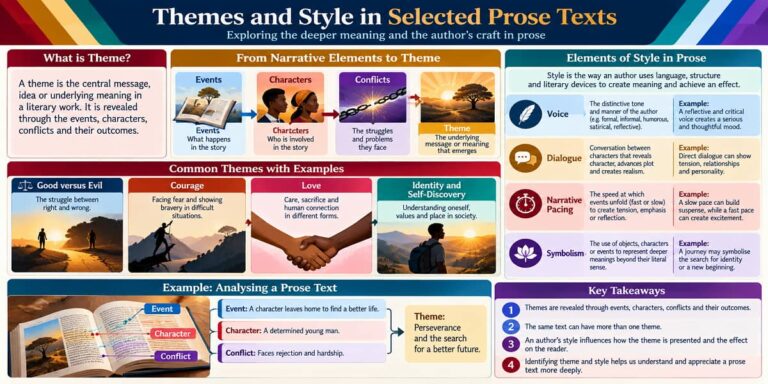
Themes bring these elements into a larger pattern of meaning. Identify the central ideas explored by the work and consider how effectively they are developed through events, characters and setting. A theme is not established by finding one sentence that sounds important. It emerges through the work’s treatment of an idea.
3. Investigate how the story is narrated
Narrative devices influence the information readers receive and the way they experience events. Examine the narrative perspective: first person, second person or third person. Ask whose account shapes the story and how that perspective affects understanding and engagement. A particular point of view may give close access to one character’s experience while limiting what the reader can know about others.
Symbolism, imagery and sensory detail also deserve attention. A symbol may suggest an idea beyond its literal presence, but its meaning should be interpreted in context. Imagery can make a scene vivid and contribute to mood or tone. Sensory descriptions may help readers imagine a place or share something of a character’s experience.
Look as well for foreshadowing, flashback, irony and other techniques. A flashback can introduce earlier events; foreshadowing can prepare readers for later developments; irony can create a difference between expectation and outcome or between what a character knows and what the reader understands. The critic’s task is to explain how a device functions in the particular work, not to assume that naming it is enough.
4. Listen to the writer’s style
Style is visible in choices of language and expression. Examine diction: are the words appropriate to the subject, characters and situation? Consider the variety and complexity of sentences and their contribution to flow and readability. Notice tone and voice, asking what attitude the writing communicates and how the narrative presents its subject.
These features should be evaluated in context. A short sentence may make a moment feel abrupt, but that effect depends on the passage and its surrounding sentences. A descriptive passage may slow the action while making the setting more vivid. Rather than using fixed rules, explain what the writer’s choices achieve in the text under discussion.
5. Judge the effect of the whole work
After examining individual elements, step back and assess the overall impact. Did the story hold your attention? Did it create an emotional response or encourage deeper thought? Are the ideas clear and coherent? Do the events connect logically? Does the work offer an original perspective or creative insight?
A balanced critic can admire one aspect while questioning another. A story may develop its central theme effectively but leave a character’s final decision insufficiently explained. Its setting may be convincing even if some events feel disconnected. Such distinctions make evaluation more useful than a simple declaration that a work is excellent or poor.
6. Formulate a balanced critique
The final step is to organise the findings into a clear evaluation. Explain the work’s strengths, identify areas that need improvement and state your overall judgement. Constructive criticism is specific. Instead of saying, “The character is not good,” explain which action or change is unconvincing and what further development might make it more believable.
A strong critique should be fair. It should not ignore evidence that complicates the critic’s position. If a character’s silence could suggest fear but could also indicate anger, consider the surrounding events before deciding which interpretation is better supported. Acknowledging complexity often makes an argument more persuasive, not less.
How Evidence Becomes an Argument
One practical method is to build each analytical point through three connected moves: make a claim, identify evidence and explain its significance. The claim states the interpretation. The evidence identifies the detail that supports it. The explanation shows how the detail connects to the claim and to the larger meaning of the work.
Consider an invented example. A character returns a lost purse even though nobody has seen the character find it. A critic may claim that the character values honesty. The act of returning the purse is explicit evidence. The explanation is that the character chooses to return something valuable without relying on public praise or supervision. The argument is more convincing than simply describing the character as “good”.
Now consider an inference. A character repeatedly avoids questions about an earlier event. A reader may infer discomfort or secrecy. The critic should identify the repeated behaviour and consider the surrounding circumstances. The wording should reflect the status of the claim: “This behaviour may suggest…” is more accurate than presenting an unstated emotion as a confirmed fact.
From Critique to a Complete Essay
Analysis becomes a complete essay when it is arranged into an introduction, a body and a conclusion. These sections are not merely formal requirements; they help readers follow the argument from its starting point to its final judgement.
The introduction: establish the direction
Begin by naming the author and the work. Give a brief summary or description of the work as a whole. Then write a focusing sentence that indicates the element or elements you intend to examine. Include your overall impression so that readers understand the direction of your evaluation. Keep the summary selective: it should orient the reader, not replace the critique.
The body: develop the case
The body contains the detailed analysis. It may describe the plot and structure, analyse character development and motivation, interpret the setting, examine themes, discuss narrative devices and assess the author’s writing style. Relevant evidence should appear wherever a judgement is made.
Each paragraph should have a clear purpose. A paragraph on character development might explain a character’s motivation, identify an important decision and evaluate whether the change is convincing. A paragraph on setting might explain how time, place and atmosphere enhance the story. A paragraph on style might examine diction, sentence structure, voice or tone. Transitions help connect these paragraphs so that the essay reads as one sustained argument.
The conclusion: make the final evaluation
Summarise the most important findings and restate your overall evaluation. Include the work’s strengths and areas that need improvement within the context of your discussion. You may offer final thoughts or recommendations that follow from the evidence. Avoid introducing a major new argument at this stage. The conclusion should complete the reasoning already developed in the body.
Why Structure Improves Critical Writing
Without a clear structure, even thoughtful observations can become difficult to follow. A writer may move from plot to setting, then to language and back to plot without showing how the ideas relate. The introduction gives readers a direction; the body supplies the analysis; and the conclusion shows what the analysis establishes.
Planning also helps a critic give attention to the most significant features. Not every detail deserves equal space. The discussion should reflect the work and the focus of the essay. If character development is central to the argument, it may require more detailed treatment than a minor descriptive feature. The aim is not to mention every element mechanically but to develop a complete and balanced assessment.
Before drafting, arrange your notes under the three essay sections. Under the introduction, record the author, title, brief description, focus and overall impression. Under the body, group evidence according to plot, characters, setting, themes, narrative devices and style. Under the conclusion, record the main strengths, weaknesses and final judgement. This simple organisation makes it easier to identify missing evidence before the essay is written.
A Short Reading Exercise
Read this invented passage:
When Ama reached the meeting place, the others had already left. A folded note lay beneath the wooden bench. She recognised the handwriting but stood still for a moment before opening it. The evening wind moved the dry leaves across the empty path. “I should have spoken earlier,” she whispered. She placed the note carefully in her bag and walked home, knowing that the next conversation would not be easy.
Some information is explicit: Ama finds a note beneath the bench, recognises the handwriting and places the note in her bag. Other conclusions are inferential. Her hesitation may suggest worry or uncertainty. The empty path and moving leaves may contribute to a lonely or reflective atmosphere. The final sentence indicates that a difficult conversation is still ahead.
A careful critique would not claim to know exactly what Ama feels unless the passage establishes it. Instead, it would connect a possible interpretation to her pause, her whispered words and her knowledge that the next conversation will be difficult. This small example demonstrates why evidence and explanation belong together.
Critical Reading as a Wider Literacy Skill
The ability to critique prose has value beyond the literature classroom. It encourages readers to distinguish direct information from interpretation, test claims against evidence and consider whether conclusions are justified. These habits are useful whenever people encounter written arguments, narratives or explanations.
It also develops a more responsible approach to disagreement. A critic can identify a weakness without dismissing the entire work, and can recognise a strength without pretending that the work is flawless. This balance requires attention, fairness and clear reasoning. It also reminds writers that an argument is only as persuasive as the evidence and explanation supporting it.
For students, the most effective practice is sustained reading followed by organised analysis. Read the complete work, return to important passages, record relevant details and test interpretations against the text. Then shape the findings into an essay whose paragraphs build towards a clear conclusion. A strong critique is not produced by complicated vocabulary alone. It grows from close attention to the work and disciplined explanation of what its details mean.
Conclusion: Read Closely, Argue Fairly
Critiquing prose involves understanding the whole story, examining its main elements, investigating narrative devices, evaluating writing style, assessing overall impact and formulating a balanced judgement. Strong criticism uses both explicit and inferential evidence, explains the significance of details and recognises strengths as well as areas for improvement.
A complete critique essay gives that thinking a clear form: an introduction that establishes the work and focus, a body that develops the analysis, and a conclusion that presents the final evaluation. When readers learn to connect claims with evidence and explanation, they move beyond simply responding to stories. They become more thoughtful interpreters of literature and more confident writers of reasoned arguments.
Access NaCCA-aligned Support Packs
Download your structured NaCCA-aligned Teacher Support Pack and Student Learning Pack, designed for clarity, practicality, and reliable teaching and learning.