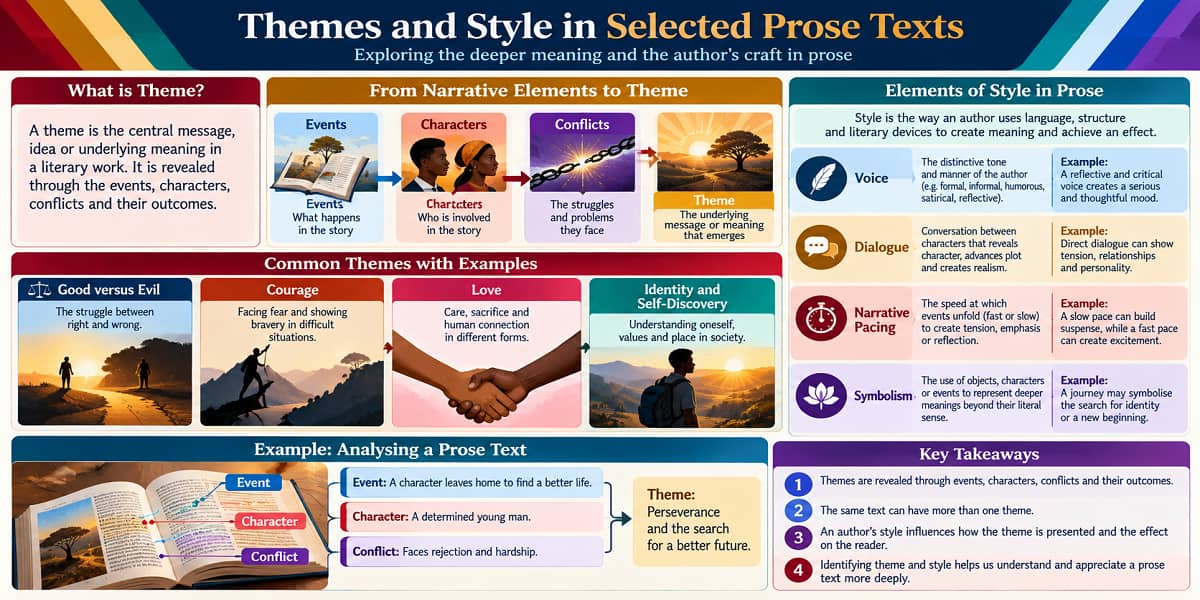
Themes and Style in Selected Prose Texts Explained for SHS 2 Literature-in-English (Sem. 1 – Week 2)
A powerful prose work gives readers more than a sequence of events. Beneath the action are recurring ideas, while behind the words is a recognisable way of writing. These two dimensions—theme and style—help us understand why a prose text has meaning and impact.
Theme: The Idea Beneath the Events
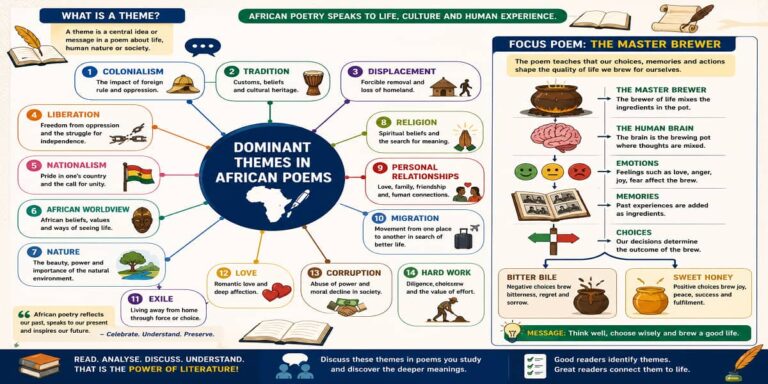
A theme is a central idea, topic or underlying message that recurs throughout a written work. A single prose text can develop several themes.
The important point is that a theme is developed through the narrative. It becomes visible in what characters do, the conflicts they face, the events that occur and the consequences that follow.
Four Themes to Recognise
| Theme | What it explores | Selected prose example |
|---|---|---|
| Good versus Evil | The struggle between good and harmful forces. | To Kill a Mockingbird |
| Courage | Standing for what is right despite risk. | To Kill a Mockingbird |
| Love | Love as a source of healing and strength, but also heartache and conflict. | Redemption Road |
| Identity and Self-Discovery | How cultural, social and personal identity develops through experience. | So The Path Does Not Die |
Theme Is Developed, Not Merely Announced
Consider courage. A writer does not need to announce, “This story is about courage.” Instead, courageous choices, risks and consequences can repeatedly appear throughout the narrative until the idea becomes clear.
This is why literary analysis should connect a theme to specific incidents and events.
Style: The Author’s Distinctive Fingerprint
Style is the distinctive way an author uses language to convey a story, ideas and emotions. It can include diction, syntax, tone, point of view, sentence length and literary devices.
Four important aspects highlighted this week are voice, dialogue, narrative pacing and symbolism.
Voice
Voice gives writing its distinctive personality. It contributes to whether an author’s writing feels reflective, authentic, hopeful, descriptive, culturally rich or otherwise recognisable.
In Redemption Road, the voice is described through qualities such as empathy, reflection, authenticity, hope, resilience and vivid description.
Dialogue
Dialogue is character speech. It can reveal background, personality and relationships while helping to advance plot, conflict and resolution.
In The Path of Lucas: The Journey of Life Endured, dialogue contributes to character development, authenticity and realism.
Narrative Pacing
Pacing is the speed at which a story unfolds. Writers can change the pace through sentence length, dialogue, detail, tension and the organisation of events.
In So The Path Does Not Die, pacing is managed through alternating timelines, varying narrative speed, descriptive passages, tension and resolution.
Symbolism
Symbolism allows something to represent an idea beyond its literal meaning. It adds layers to a narrative and can influence how readers interpret events and characters.
Examples identified in To Kill a Mockingbird include the mockingbird, Radley House, camellias, knot-hole in the tree and Atticus’s glasses.
Theme and Style Are Connected
Theme and style should not be treated as completely separate ideas. The theme concerns what the work explores; style concerns how the author communicates it.
| Ask about Theme | Ask about Style |
|---|---|
| What central idea keeps returning? | How does the author express it? |
| Which events support the idea? | What does the author’s voice reveal? |
| How do characters and conflicts develop it? | How do dialogue and pacing affect the narrative? |
| What message emerges? | Do symbols add deeper meaning? |
A Practical Example
Suppose a character repeatedly takes risks to defend justice. The recurring idea may support the theme of courage. If the author then uses dialogue to reveal the character’s determination and symbolism to deepen the idea, style is helping to communicate the theme.
This is the kind of connection that turns a simple observation into literary analysis.
Four Questions for Better Analysis
- What idea keeps recurring?
- Which events or characters develop that idea?
- How does the author write about it?
- What effect does that style have on the narrative?
Try It Yourself
A prose text repeatedly presents a character struggling to understand where they belong between two cultures.
Possible theme: Identity and Self-Discovery.
A different passage moves quickly through a tense confrontation, using short exchanges between characters.
Possible style features: Dialogue and rapid narrative pacing.
The Main Idea
To analyse prose effectively, look beneath the surface of the plot. Themes reveal recurring ideas and messages; style reveals the author’s distinctive method of communicating them. When both are supported with evidence from the narrative, reading becomes deeper and more purposeful.
Access NaCCA-aligned Support Packs
Download your structured NaCCA-aligned Teacher Support Pack and Student Learning Pack, designed for clarity, practicality, and reliable teaching and learning.