Steps of Critiquing Prose Texts and Developing Complete Critique Essays
1. Begin with a Reader’s Question
Think about a prose story you have read. Perhaps its ending surprised you, a character’s decision made you angry, or a particular description stayed in your mind long after you finished reading. You may have enjoyed the story, disliked part of it, or found some sections difficult to understand. These reactions are useful starting points, but they are not yet a complete literary critique.
A critique goes further than saying that a story is good, boring, interesting or confusing. It is a detailed, formal analysis and evaluation of a work of literature. A critic examines how a work is constructed, interprets what it communicates and draws conclusions from the details found in the text. A strong critique explains both what the writer has done and how effectively the writer has done it.
For example, instead of writing, “The setting is interesting,” a critic might explain that the descriptions of the setting create an atmosphere of uncertainty and help readers understand why the characters behave cautiously. The second comment identifies a feature, explains its effect and connects the observation to the story.
In this lesson, you will learn a systematic way to examine prose, support your judgements with strong textual evidence and turn your analysis into a complete essay. The central principle is simple: every important judgement should be supported by details from the text.
2. What Makes a Critique Convincing?
A convincing critique combines careful reading, interpretation and fair evaluation. It does not merely retell the plot, list characters or express personal feelings. It uses details from the work to explain how the different parts contribute to the whole.
Two kinds of textual material are especially important:
- Explicit evidence: information stated directly in the prose. This may include a character’s words, an action described by the narrator, a detail about the setting or an event presented clearly in the plot.
- Inferential evidence: meaning that a reader works out from clues in the text. It is not always stated directly. A character’s repeated silence, for instance, might suggest fear, resentment or uncertainty, depending on the surrounding details.
An inference must grow from evidence. It is not a guess that can be made without explanation. If you argue that a character is afraid, identify the words, actions or circumstances that lead you to that interpretation. If more than one interpretation is possible, explain why yours is reasonable in the context of the story.
Strong evidence is relevant to the point being discussed, accurate and sufficiently detailed. Exhaustive evidence means examining the available relevant details thoroughly rather than selecting only one convenient example. It does not mean copying every sentence in the story. Choose enough evidence to establish and develop your argument.
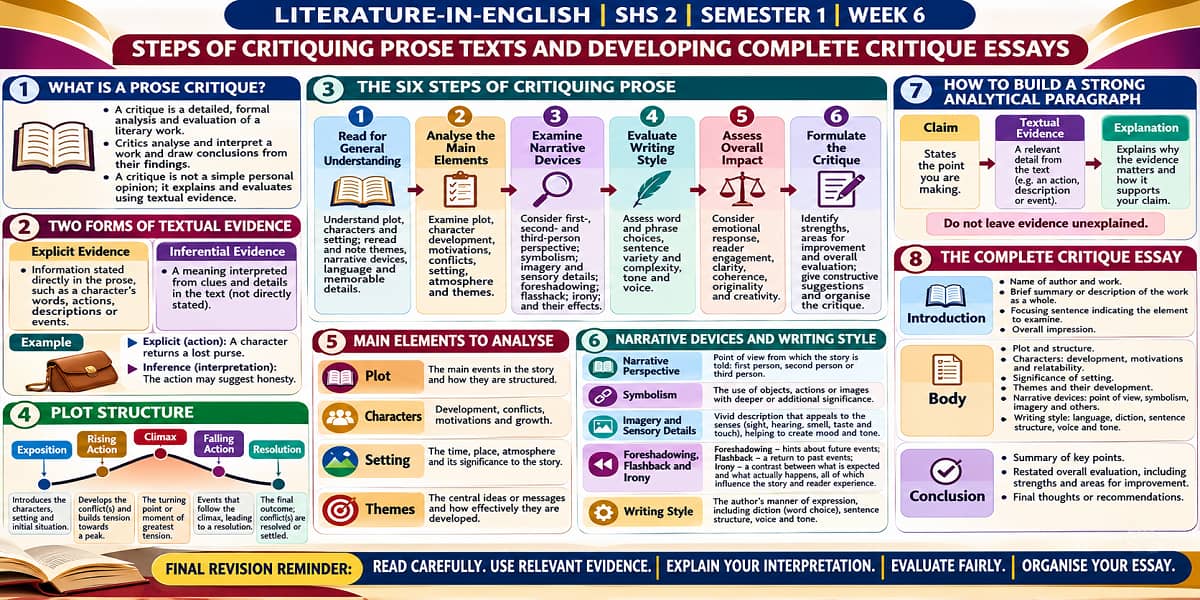
3. The Six Steps in Critiquing a Prose Text
The six steps below provide an orderly route from first reading to final evaluation. They are connected: what you notice during reading becomes the evidence you analyse, and your analysis supports the judgement you eventually write.
Step 1: Read for General Understanding
Begin by reading the prose text to understand the story as a whole. Do not rush to judge it after a few paragraphs. Establish what happens, who is involved, where and when the events take place, and what central situation or conflict holds the story together.
During this first reading, concentrate on the broad movement of the narrative. Identify the main characters and their relationships. Notice the setting and the general atmosphere. Ask yourself what problem, desire or conflict appears to drive the events. At this stage, your aim is to understand the work before examining its details closely.
Read the text again, this time taking notes on features that stand out. You might mark a character’s important decision, a change in the atmosphere, a repeated image, a surprising event or a sentence that seems especially significant. Notice the themes, narrative devices and language. Ask: What creates a memorable impact? Which parts appear especially effective, and which parts need closer examination?
Example: During a first reading, you may understand that a story concerns a disagreement between two friends. On a second reading, you may notice that the narrator repeatedly describes one friend avoiding eye contact. That detail gives you something specific to investigate rather than relying only on your general impression.
Keep your early reactions as questions or observations. Do not treat them as final conclusions before you have examined the whole text.
Step 2: Analyse the Main Elements
After understanding the story generally, examine its main elements. Begin with the plot and its structure. Identify the important events and consider how they are arranged. A story may move through exposition, rising action, climax, falling action and resolution.
| Plot stage | What to examine | Question to ask |
|---|---|---|
| Exposition | The opening information about the situation, characters and setting. | What does the reader need to know at the beginning? |
| Rising action | Events and complications that develop the central conflict. | How does the problem become more serious? |
| Climax | A major turning point or moment of greatest tension. | Which event changes the direction of the story? |
| Falling action | Events following the turning point as its consequences unfold. | How do the characters and circumstances respond? |
| Resolution | The way the main conflict or situation is concluded. | What is settled, and what remains unresolved? |
Next, examine the characters. Consider their motivations, conflicts, relationships and development. Ask what a character wants, what prevents the character from achieving it and whether the character changes as events unfold. Consider whether the character’s actions are consistent with the personality and circumstances presented in the story.
Then examine the setting. Consider the time, place and atmosphere created by the writer. Do not simply name where the story happens. Explain why the setting matters. It may shape the characters’ choices, create a particular mood or make an event more understandable. Use descriptions and events in the prose to support your interpretation.
Finally, identify the central themes. A theme is an important idea or insight explored through the story. Consider what the writer appears to communicate about human experience, relationships or the situation presented. Evaluate how effectively the theme is developed through plot, character, setting and other elements. A theme should be explained through the whole work, not assigned on the basis of one isolated sentence.
Step 3: Examine the Narrative Devices
Narrative devices are techniques through which a story is presented and its meaning developed. Examine the narrative perspective and consider how it influences what readers know and how they respond. Is the story told in the first person, second person or third person? If the narrator uses a particular perspective, what does that allow the reader to understand? What information might remain outside the reader’s view?
Look for symbolism and consider what an object, action or image may represent beyond its immediate appearance. Interpret the symbol in relation to the themes or characters. Avoid claiming that an object has a particular symbolic meaning unless the events, descriptions or repeated use of the object support that reading.
Examine imagery and sensory details. Notice descriptions that appeal to sight, sound, smell, taste or touch. Explain how these details contribute to the mood and tone. A description may help readers imagine a place, feel tension or understand a character’s experience.
Also look for foreshadowing, flashback, irony and other narrative techniques used in the text. Consider how they affect the sequence of information, create expectations, reveal earlier events or shape the reader’s experience. The important task is not merely to name a device. Explain what it contributes to the particular story.
Example: Suppose a narrator tells a story using “I”. You can identify the first-person perspective from the narrator’s language. To critique it, go further: explain what the narrator allows readers to know, how personal observations influence the account and whether the reader receives a complete view of events. Your evaluation should refer to the actual narrative rather than assume that every first-person narrator is reliable or unreliable.
Step 4: Evaluate the Writer’s Style
Writing style concerns the choices through which the author expresses ideas. Examine the appropriateness of the words and phrases used. Are the descriptions precise? Does the language suit the characters and situations? Does the choice of words help communicate the intended mood or meaning?
Consider sentence variety and complexity. Short sentences may make a moment feel abrupt or intense, while longer sentences may allow an idea or description to unfold. However, do not assume that one sentence type always produces the same effect. Explain how the writer’s actual choices work in the passage you are discussing.
Examine tone and voice as well. Tone concerns the attitude communicated through the writing, while voice is the distinctive manner in which the narrative or writer speaks. Ask what the language conveys and whether the tone remains suitable as the story develops. Support your judgement with examples of diction, sentence construction or description.
Step 5: Assess the Overall Impact
Bring your observations together and consider the effect of the complete work on its reader. Did the story engage your attention? Did it create an emotional response or encourage deeper thought? Did its ideas develop clearly and coherently? Consider whether the events and arguments are logically connected and easy to follow.
Also examine originality and creativity. Does the work offer an interesting perspective or a fresh insight? Are its important elements brought together effectively? A balanced assessment recognises strengths while also identifying weaknesses. You may appreciate the character development but find that a particular change is insufficiently explained. You may find the setting convincing but feel that some events do not connect clearly. Each judgement must be explained with relevant evidence.
Step 6: Formulate the Critique
Now organise your findings into a coherent evaluation. Identify the work’s strengths, areas that need improvement and your overall judgement. Give constructive feedback by explaining which elements are effective and why. Where you identify a weakness, state the problem clearly and offer a specific suggestion where appropriate.
For example, “The story is poorly written” is too general to help a reader understand your criticism. A more useful comment would identify a particular weakness, such as an important character’s decision that is not sufficiently prepared by earlier events, and explain how additional development could make the change more convincing.
Arrange your ideas in a logical order. Your final critique should have an introduction, a body and a conclusion. The introduction identifies the work and establishes your overall direction. The body develops your analysis and evidence. The conclusion brings together your findings and presents your final evaluation.
4. Turning Evidence into Analysis
A useful way to develop a paragraph is to move from a claim to evidence and then to explanation. First state the point you want to make. Next identify a relevant detail from the prose. Then explain what the detail suggests and how it supports your judgement. This prevents a paragraph from becoming a collection of quotations or unsupported opinions.
Consider this invented practice situation: a story shows a character returning a lost purse even though nobody has seen the character find it. A possible claim is that the character values honesty. The action of returning the purse is explicit evidence. The explanation is that the character chooses to do what is right without expecting public recognition. This interpretation is stronger than simply saying, “The character is good,” because it shows how the action supports the judgement.
Inferential evidence works in a similar way. Suppose a character repeatedly avoids answering questions about an earlier event. You might infer that the character feels uncomfortable or is hiding something. To make the interpretation convincing, identify the repeated behaviour and examine what happens before and after it. If the story provides another explanation, acknowledge it rather than ignoring it.
5. Developing a Complete Critique Essay
Once the critique has been planned, arrange it as a complete essay. The essay has three main parts: introduction, body and conclusion. Each part has a distinct responsibility, but all three should contribute to one central evaluation.
A. The Introduction
The introduction should identify the author and the literary work. Give a brief description or summary of the work as a whole so that the reader understands what is being discussed. Then include a focusing sentence that indicates the element or aspects you intend to examine. End the introduction with your overall impression of the work or a clear statement of your evaluative direction.
Keep the summary brief. The purpose is to introduce the work, not retell every event. A focusing sentence helps the reader understand the direction of the essay. If your discussion will examine character development, setting and narrative devices, make that direction clear.
B. The Body
The body develops the critique through organised paragraphs. It should cover the relevant elements of the prose text in sufficient detail. The following guide helps you plan what to discuss:
| Area of discussion | What the essay should examine |
|---|---|
| Plot and structure | Describe the important events and explain how the arrangement of events develops the story. |
| Characters | Analyse development, motivations, conflicts and how readers may relate to the characters. |
| Setting | Interpret the significance of time and place and explain how the setting enhances the story. |
| Themes | Identify the important ideas and evaluate how effectively the writer develops them. |
| Narrative devices | Analyse techniques such as point of view, symbolism and imagery, and explain their effects. |
| Writing style | Assess language, diction, sentence structure, voice and tone. |
Do not force every possible observation into one paragraph. Give each major point enough space to be explained. A paragraph about setting, for example, should identify a relevant feature of the setting, provide textual evidence and explain its significance. A paragraph about character development should focus on the character’s actions, motivations or changes rather than drift into an unrelated discussion of language.
Use transitions to show how your ideas are connected. Your paragraphs should build a coherent argument rather than appear as unrelated notes. The amount of attention given to each element should depend on its relevance to the work and to the focus of your critique.
C. The Conclusion
The conclusion brings the discussion to a meaningful close. Summarise the key points without repeating the entire essay. Restate your overall evaluation, including the important strengths and areas that need improvement. Keep the judgement within the context of the work you have analysed. You may also offer final thoughts or recommendations that follow logically from your discussion.
Do not introduce a major new argument in the conclusion. It should leave the reader with a clear understanding of your final assessment and the reasons behind it.
6. A Short Model of the Essay-Building Process
Imagine that you have completed a critique of a prose text in which the central character faces a difficult choice. Your notes identify a clearly developed conflict, a setting that increases tension, and a character whose final decision is not fully prepared by earlier events. You have also noted language that helps create the atmosphere.
Your introduction would name the author and work, briefly identify the central situation and state that the essay will examine conflict, setting, character development and language. Your body would discuss each point in organised paragraphs, using relevant details from the text. You would explain how the conflict develops, why the setting matters, what the character’s actions reveal and how the language affects the reader. You would also evaluate the weakness in the character’s final decision, explaining why more development would make it convincing.
Your conclusion would bring together the strengths and weakness and state your overall judgement. Notice that the essay does not merely list the elements. It explains their contribution to the story and evaluates how successfully they work together.
This is the difference between notes and a complete critique essay: notes collect observations, while the essay organises those observations into a reasoned and supported argument.
7. Your Turn: Guided Practice
Read the short practice passage below. It is an invented passage for practising the method, not a prescribed prose text.
When Ama reached the meeting place, the others had already left. A folded note lay beneath the wooden bench. She recognised the handwriting but stood still for a moment before opening it. The evening wind moved the dry leaves across the empty path. “I should have spoken earlier,” she whispered. She placed the note carefully in her bag and walked home, knowing that the next conversation would not be easy.
Practice 1: Identify Explicit Details
- Where does Ama find the note?
- What does Ama say to herself?
- What does she do with the note?
Suggested answers: Ama finds the note beneath a wooden bench. She whispers, “I should have spoken earlier.” She places the note carefully in her bag.
Practice 2: Make and Support an Inference
- What might Ama’s hesitation before opening the note suggest?
- Which details support your interpretation?
- Why should you avoid presenting your interpretation as a fact stated directly by the narrator?
Suggested answers: Her hesitation may suggest worry, uncertainty or emotional discomfort. The evidence includes her pause before opening the note, her recognition of the handwriting and her statement that she should have spoken earlier. These details support an inference, but the narrator does not directly name her emotion. A careful critic therefore uses wording such as “may suggest” and explains the evidence.
Practice 3: Examine the Setting and Language
- Identify two details that establish the setting.
- What atmosphere might the empty meeting place and evening wind create?
- How does the final sentence suggest that the conflict is not completely settled?
Suggested answers: The wooden bench and the evening wind moving dry leaves are setting details. The empty path and evening wind may create a lonely, uncertain or reflective atmosphere. The final sentence says that the next conversation will not be easy, suggesting that an unresolved difficulty remains.
Practice 4: Plan a Critique Essay
Prepare a brief essay plan using the three-part structure. Your plan should identify the work being discussed, state the main focus, organise the points for the body and indicate the final evaluation.
Suggested plan:
- Introduction: Introduce the practice passage and focus on Ama’s hesitation, the setting and the suggestion of unresolved conflict.
- Body paragraph 1: Analyse Ama’s actions and words, using her pause and whispered statement as evidence of possible emotional discomfort.
- Body paragraph 2: Examine the empty meeting place, wooden bench and evening wind, explaining how the details create an atmosphere of uncertainty.
- Body paragraph 3: Discuss the final sentence and explain how it leaves the reader expecting a difficult conversation.
- Conclusion: Evaluate how the character’s actions, setting and ending work together to suggest an unresolved situation.
8. Independent Application and Self-Check
Choose a prose text you have read and prepare a critique using the six steps. Read it carefully, analyse its main elements, examine narrative devices, evaluate the writing style, assess its overall impact and formulate your judgement. As you work, collect both explicit and inferential evidence. Make sure every inference can be traced to details in the text.
Then turn your critique into a complete essay. Check that the introduction identifies the author and work, gives a brief description, states the focus and communicates your overall impression. Check that the body discusses the relevant plot, characters, setting, themes, narrative devices and writing style. Check that the conclusion summarises the main findings, restates your evaluation and gives final thoughts or recommendations.
Before submitting your work, ask yourself:
- Have I understood the whole story before judging individual parts?
- Are my comments about plot, characters, setting and themes supported by relevant details?
- Have I examined the effects of narrative devices and writing style rather than simply naming them?
- Have I distinguished what the text states directly from what I infer?
- Have I explained the evidence instead of leaving quotations or examples to speak for themselves?
- Have I recognised both strengths and areas that need improvement?
- Does my essay have a focused introduction, a developed body and a meaningful conclusion?
9. Lesson Summary
Critiquing prose is a systematic process of analysis and evaluation. Begin with general understanding, then examine the plot, characters, setting and themes. Study narrative devices and writing style, assess the overall impact and formulate a balanced critique. Throughout the process, use strong and thorough textual evidence drawn from both explicit details and reasonable inferences.
A complete critique essay presents the findings in three connected parts. The introduction identifies the author and work, briefly describes it, states the focus and gives an overall impression. The body analyses the relevant elements and supports its judgements with evidence. The conclusion summarises the main points, restates the evaluation and offers final thoughts or recommendations.
Remember: a thoughtful critic does not merely announce an opinion. A thoughtful critic shows the reader how the text supports that opinion.
Access NaCCA-aligned Support Packs
Download your structured NaCCA-aligned Teacher Support Pack and Student Learning Pack, designed for clarity, practicality, and reliable teaching and learning.