Voice, Argumentative and Persuasive Writing, and Imagery Explained for SHS 2 English Language (Sem. 1 – Week 12)
English Is More Than Correct Sentences
English becomes powerful when we understand not only what words mean, but what they do. A sentence can direct attention towards the person performing an action or towards the person or thing affected by it. A speech can present a carefully reasoned position or encourage an audience to support a cause. A poem, play or story can make readers imagine a place, hear a sound or feel the emotion of a character through carefully selected descriptions.
These are not unrelated language skills. They show how writers and speakers make decisions to achieve different purposes. In this discussion, we explore three important areas of English Language: active and passive voice, argumentative and persuasive speech writing, and imagery in narrative, drama and poetry.
1. Active and Passive Voice: Who Is at the Centre of the Sentence?
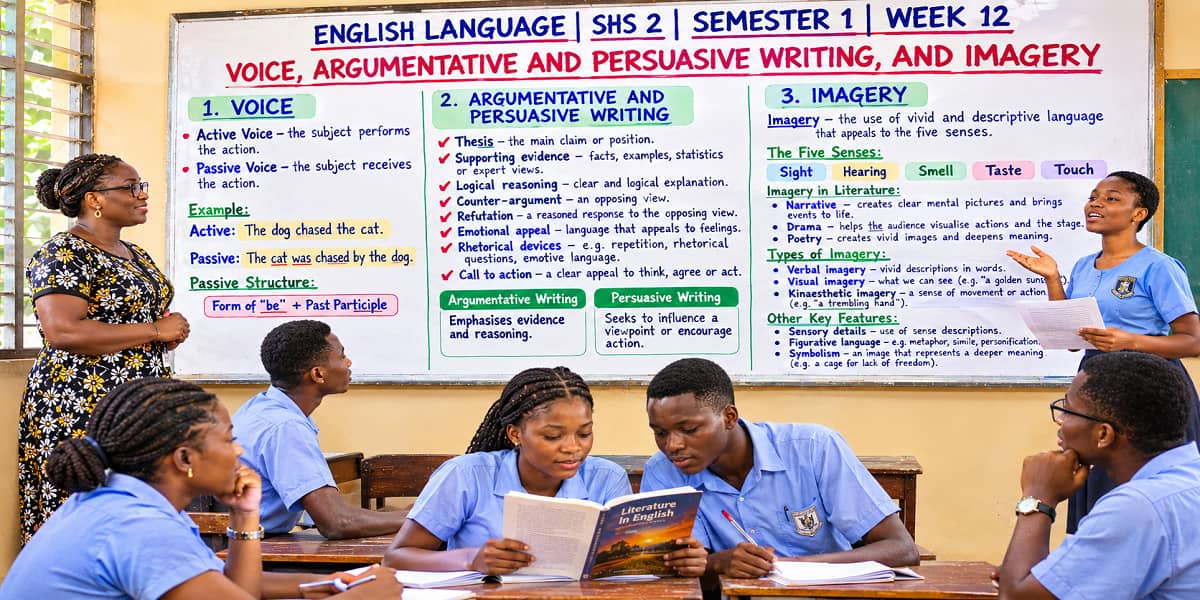
Consider two sentences: “The dog chased the cat” and “The cat was chased by the dog.” Both describe the same action, but they do not present the information in the same order. In the first sentence, attention begins with the dog, the one performing the action. In the second, attention begins with the cat, the one receiving the action.
This difference is the central idea behind voice. In grammar, voice describes the relationship between the subject and the action expressed by the verb. English has two main voices: active and passive.
When the subject performs the action
In the active voice, the subject performs the action. The usual structure is subject, verb and object. In “The gardener waters the plants,” the gardener is the subject and performs the action of watering. The plants receive the action.
Active voice is often direct and straightforward. It makes the doer of an action clear, which is useful when the person or thing responsible for an event is important to the message. Consider “The teacher explains the lesson” or “Mrs. Mensah bakes bread.” The reader can quickly identify who performs the action.
When the receiver becomes the subject
In passive voice, the subject receives the action. The object of the active sentence becomes the grammatical subject of the passive sentence. A form of the verb be is used with a past participle. The person or thing performing the action may be named after by, but it can also be omitted.
For example, “The gardener waters the plants” becomes “The plants are watered by the gardener.” The plants now occupy the subject position, even though they do not perform the watering. The gardener remains the agent, or doer, of the action.
| Active sentence | Passive sentence | Change in focus |
|---|---|---|
| The student wrote the report. | The report was written by the student. | The report becomes the grammatical subject. |
| The children ate the cake. | The cake was eaten by the children. | The cake receives attention first. |
| The workers repaired the road. | The road was repaired by the workers. | The road is placed at the centre. |
The change in voice does not simply involve moving words around. The grammatical role of the subject changes. In active voice, the subject performs the action. In passive voice, the grammatical subject receives it.
A practical way to recognise voice
Start by finding the main verb. Then identify the subject and ask whether it performs or receives the action. Finally, examine the verb phrase. A form of be followed by a past participle is a common sign of passive voice. Examples of forms of be include am, is, are, was, were, be, being and been. Past participles include written, eaten and chased.
Compare “The report was written by the student” with “The teacher was tired.” The first is passive because the report receives the action of writing. The second contains was, but it does not describe an action being received by the subject. Therefore, the presence of a form of be alone is not enough to identify passive voice.
Sometimes a passive sentence does not mention the agent. “The project was completed on time” tells us what happened to the project without stating who completed it. This is still passive because the project receives the action.
Why the distinction matters
Recognising voice helps readers understand how information is presented. It also helps writers make deliberate sentence choices. If the doer matters, an active sentence can make responsibility clear. If the receiver or result deserves attention, a passive sentence can place it first. The important skill is not to label one voice as always better, but to recognise the difference and use the structure that communicates the intended meaning.
2. Speech Writing: Moving an Audience Through Ideas
A speech is written to be heard. Unlike a text that may be read slowly and revisited, a speech usually reaches its audience as the speaker delivers it. This makes organisation, clarity and audience awareness especially important.
Speech writing is the process of arranging thoughts, ideas and information into a coherent text intended for oral delivery. The writer must consider what the audience knows, what it cares about and what the speech is expected to achieve. A speech may inform, persuade, entertain or inspire.
Begin with the audience and purpose
A speech that works for one audience may not work equally well for another. Audience awareness involves considering listeners’ interests, knowledge, expectations and background. The language, examples and tone should suit those listeners.
The purpose must also be clear. A speech intended to inform should explain its subject. A persuasive speech should guide listeners towards a position or action. An inspiring speech should give the audience a reason to feel encouraged. When the purpose is unclear, the speech can lose direction.
Build a structure listeners can follow
An effective speech has a beginning, middle and end. The introduction attracts attention and introduces the topic. A question, quotation, anecdote, vocative or statistic can serve as a hook. The body develops the main points in a logical order, while transitions help listeners follow the movement from one idea to another. The conclusion brings the message together and may end with a strong statement or call to action.
Speech writing also uses a conversational tone. Personal pronouns such as I, you and we can create a feeling of direct engagement. Sentences should be clear and concise because the audience needs to understand them as they are spoken. Writers should consider pauses, pacing, emphasis, gestures and changes in tone. Revising and practising the speech can improve its clarity and delivery.
Argumentative writing: make a case
An argumentative essay takes a position on an issue and supports that position with reasons and evidence. Its aim is to convince readers that the argument is valid or deserves consideration. It is not simply a collection of personal opinions. The writer needs a clear thesis, evidence and logical reasoning.
Evidence may include facts, statistics, quotations and relevant examples. The writer connects that evidence to the main claim through reasoning. An organised introduction, body and conclusion help readers follow the argument. Transitional words and phrases show how ideas relate to one another.
A strong argumentative writer also recognises that other people may disagree. A counter-argument presents an opposing view. The writer can then respond through refutation, using evidence and reasoning to explain why the opposing claim is weak, incomplete or less convincing. This approach makes an argument more thoughtful because it considers more than one side of an issue.
Different forms of argumentative essays
Argumentative writing can be organised around different purposes. A position argument defends a clear stance. A proposal argument recommends a solution to a problem. An evaluation argument examines the advantages and disadvantages of an issue. A causal argument explores causes and effects, while a comparative argument examines similarities and differences.
An analytical argument breaks an issue into parts for examination. A rebuttal argument responds to an opposing claim. A policy argument supports or challenges a policy or legislation. A philosophical argument explores fundamental questions about existence, reality or knowledge. A persuasive argument seeks to influence an audience’s viewpoint or encourage a particular action.
Persuasive writing: connect with values and action
Persuasive writing aims to convince readers to adopt a point of view, take a specific action or support a cause. It can use evidence and logical reasoning, but it may also make stronger use of emotions, values, storytelling and rhetorical language.
A persuasive writer needs a clear central claim and convincing supporting points. The tone should be confident, assertive and respectful. A call to action tells the audience what response is being encouraged. Without a clear purpose, persuasive language can sound forceful without giving readers a meaningful reason to agree.
Four techniques commonly used in persuasive writing are the bandwagon effect, social proof, reciprocity and repetition. The bandwagon effect encourages people to follow the crowd. Social proof uses testimonials or other social evidence. Reciprocity offers something in return for an action. Repetition reinforces important words or phrases so that the central message remains memorable.
Argumentative and persuasive writing: related, but not identical
Both forms aim to convince, but their emphasis can differ. Argumentative essays are typically more formal and academic. They focus on the validity of a position through evidence and logical reasoning, and they often use a more objective tone. Persuasive writing can be more personal and emotive. It may appeal directly to an audience’s values and feelings, and it often seeks a particular response or action.
| Question | Argumentative approach | Persuasive approach |
|---|---|---|
| What is the aim? | Establish the strength or validity of a position. | Encourage agreement, support or action. |
| What carries the case? | Evidence and logical reasoning. | Evidence, reasoning, values and emotional appeal. |
| What tone is common? | Formal and often objective. | Confident, assertive and respectful; may be more personal. |
| How are opposing views treated? | They are acknowledged and answered through reasoning. | They may be acknowledged and answered as part of persuading the audience. |
These differences are useful guides rather than a claim that the two forms never share techniques. A persuasive speech can use evidence, and an argumentative essay can use carefully chosen language to hold a reader’s attention. The writer’s purpose and overall approach determine the emphasis.
From an issue to a speech
Imagine preparing a speech on whether learners should read beyond their classroom textbooks. First, identify the audience and decide what you want them to think or do. Then state a position. You might argue that wider reading should be encouraged because it develops knowledge, strengthens language and exposes learners to different ideas.
Organise each reason into a clear point. Explain it and support it with relevant evidence or an example. Consider an objection: some learners may have limited time for additional reading. A response could acknowledge the concern and suggest that reading can be organised into manageable periods. End by restating the importance of wider reading and inviting the audience to make it a regular habit.
This process shows why a good speech is more than a collection of impressive phrases. Its ideas need a clear direction, a logical sequence and a conclusion that connects to its purpose.
3. Imagery: Making Readers Experience a Text
Language can report that a character entered a room, or it can help readers imagine the room, the character’s movements and the feeling of the moment. This second possibility is central to imagery.
Imagery is a literary device that uses language to create vivid sensory experiences. It can appeal to sight, hearing, smell, touch and taste. These details help readers imagine settings, characters and events more intensely. Imagery can also communicate emotions, establish atmosphere and make a literary work memorable.
Imagery in narrative
A narrative is a story or account of events arranged in a sequence. Its structure includes plot, characters, setting and conflict. Imagery works with these elements to create a richer reading experience.
Descriptions of a place can establish the setting and make the story’s world easier to imagine. Details about a character’s appearance, mannerisms and emotions can make that character feel more fully developed. Descriptions of actions and events can strengthen the plot, while sensory details can create an atmosphere that influences how readers respond.
Consider the excerpt from Buchi Emecheta’s Second Class Citizen. Adah prepares to go to school in a dress that is too big. She twists an old scarf around her waist to improve its appearance. She has no slate or pencil, so she remembers a small broken slate her father uses when sharpening a knife. She decides to take the small piece with her. Before leaving, she slips past two women who are deeply engaged in conversation.
The description of the scarf, the baggy dress and the small piece of slate allows readers to picture the scene. The comparison of the twisted scarf to a palm-tree climber’s rope makes the description more vivid. These details also reveal something about Adah. She is resourceful and determined to find a way to attend school despite what she lacks. Imagery therefore contributes to character development as well as visual description.
Imagery in drama
Drama tells a story through action, dialogue and performance. Imagery can help the audience understand the world of a play, the emotions of its characters and the significance of its events.
It can set the scene, establish mood, develop characters, enrich dialogue and create tension or conflict. Dramatic imagery may be verbal, visual or kinaesthetic. Verbal imagery uses language to create sensory experiences. Visual imagery may be created through costumes, sets, lighting and special effects. Kinaesthetic imagery uses movement, dance and physical action to communicate emotions and tell the story.
These forms can complement one another. A character’s words may describe a threatening environment, while lighting and movement reinforce the atmosphere. The audience receives meaning through language and performance together.
Imagery in poetry
Poetry often depends on imagery to communicate meaning, emotion and atmosphere. Poets use descriptions of nature, feelings, experiences and ideas to create vivid pictures. They may use images to establish tone, explore themes or represent abstract ideas through concrete objects and experiences.
Sensory details appeal to the five senses. Figurative language includes metaphors, similes and personification. Symbolism uses an object, colour or image to represent an idea or concept. These forms can overlap: a poet may use a sensory image that also carries symbolic meaning.
Reading the images in “The Weaver Bird”
Kofi Awoonor’s poem The Weaver Bird describes a bird that builds a nest in the household’s tree. The people watch the nest being built and the eggs being laid. The bird later returns “in the guise of the owner”, and the speaker describes its preaching. The poem also presents images of storms at sea, gulls, fishers drying nets by lantern light, a new horizon and old shrines defiled by the bird’s excrement.
These details give readers images they can picture. The nest and tree establish a concrete setting. The bird’s return as an apparent owner creates a striking image. The references to storms, gulls, nets and lantern light broaden the sensory world of the poem. The image of defiled shrines carries a force beyond the physical scene and invites attention to the poem’s larger ideas.
When analysing imagery, it is not enough to identify a descriptive phrase. A strong response explains the image, the sense or idea it evokes and its contribution to the poem’s atmosphere or meaning. Ask: What does the image make me imagine? What feeling does it create? Does it suggest an idea beyond its literal description?
4. The Common Thread: Purposeful Language Choices
Voice, speech writing and imagery show that effective English depends on making choices that suit a purpose. Voice determines the relationship between the subject and the action. Argumentative writing develops a position through evidence and reasoning. Persuasive writing combines reasons and appeals to influence an audience. Imagery uses sensory and figurative language to shape a reader’s experience.
These skills matter in different settings. A clear report benefits from accurate sentence structure. A debate depends on a well-organised case and a speaker who understands the audience. A story or poem becomes more engaging when its images help readers experience the world of the text.
They also remind us that good communication involves responsibility. An argument should be supported rather than built on unsupported claims. A persuasive speaker should address an audience respectfully. A writer should select images that contribute to the meaning of the work rather than distract from it.
5. Questions for Readers and Learners
- What makes a sentence passive? Its grammatical subject receives the action, and its verb phrase commonly contains a form of be followed by a past participle.
- Why might a writer use active voice? It places the doer of the action in the subject position and often presents the action directly.
- What is the main difference between argumentative and persuasive writing? Argumentative writing emphasises the validity of a position through evidence and reasoning; persuasive writing seeks to influence a viewpoint or encourage action and may make stronger use of emotional and value-based appeals.
- Why should a speech writer consider the audience? Audience awareness helps the writer choose appropriate content, language and tone.
- How does imagery contribute to a narrative? It can make the setting vivid, develop characters, enrich events and create atmosphere or mood.
- What should a reader explain when identifying imagery in a poem? The reader should explain the image created and how it contributes to the poem’s meaning, tone or atmosphere.
Conclusion: Read Closely, Speak Thoughtfully, Write with Purpose
Understanding English involves recognising the choices that shape communication. Active and passive voice show how sentence structure directs attention. Argumentative and persuasive writing show how ideas can be organised to defend a position or influence an audience. Imagery demonstrates how carefully chosen language can turn words into sensory experiences.
For students, these skills strengthen reading, writing and oral communication. For teachers and families, they provide useful ways to discuss how young people express ideas and interpret texts. For anyone who uses English in public communication, they offer a reminder that clarity, evidence, audience awareness and meaningful language choices matter.
The next time you read a sentence, listen to a speech or encounter a poem, look beyond the words themselves. Ask who is acting, what argument is being made, whom the speaker is addressing and what images the language creates. Those questions help transform language from a set of rules into a practical tool for understanding and expression.
Access NaCCA-aligned Support Packs
Download your structured NaCCA-aligned Teacher Support Pack and Student Learning Pack, designed for clarity, practicality, and reliable teaching and learning.