Producing Novel Summaries Based on Varied Themes and Narrative Writing Using Different Styles
Introduction: Understanding Stories and the Art of Writing
Stories communicate human experiences, relationships, conflicts, decisions and ideas. When reading a novel, a reader encounters characters, settings and events that combine to create meaning. Understanding a novel involves more than remembering what happened. It requires recognising important events, identifying themes and explaining how different parts of the story contribute to its overall meaning.
Two important literary skills are producing summaries of selected novels based on varied themes and creating narrative pieces using different writing styles. The first develops the ability to understand and communicate the essential content of a novel. The second develops the ability to construct stories and make deliberate choices about how information is presented.
These skills are closely connected. Understanding how a story develops helps a reader produce a meaningful summary. Recognising how writers use language and organise events also helps an individual create more effective narratives.
PART ONE: PRODUCING SUMMARIES OF SELECTED NOVELS BASED ON VARIED THEMES
1. Understanding a Novel Summary
A novel summary is a concise account of the essential characters, events, conflicts, themes and resolution of a novel. It communicates the central meaning of a longer story without reproducing every incident or unnecessary detail.
A good summary should enable another reader to understand the main characters, what drives the story, the important difficulties they encounter and how the story concludes.
Summarising is not the same as copying several paragraphs from a novel or describing every chapter separately. It involves selecting the information that is most important to understanding the complete story.
For example, when summarising a hypothetical story about friendship, the writer should identify the characters involved, explain the circumstances surrounding their relationship, highlight important events that test their friendship and describe the eventual outcome. Minor details that do not contribute significantly to the central story can be excluded.
2. Understanding Themes in Novels
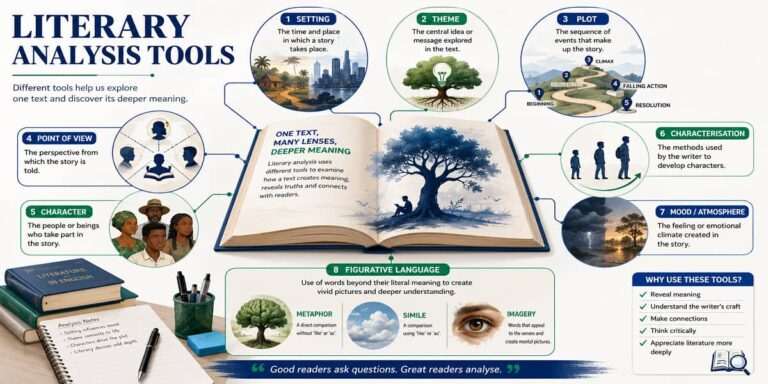
A theme is a central idea or concern explored through a literary work. It helps readers understand what a novel communicates beyond the events of its plot.
Possible themes include:
- Love: An idea concerning affection and relationships.
- Friendship: An idea concerning relationships between individuals.
- Identity: An idea concerning how individuals understand or establish who they are.
- Justice: An idea concerning fairness and the treatment of individuals.
- Overcoming adversity: An idea concerning difficulties and the efforts made to overcome them.
A theme should not be confused with a character, setting or plot event. A character participates in the story, the setting establishes the circumstances in which events occur, and the plot presents the sequence of events. The theme expresses an important idea explored through these elements.
| Literary element | Meaning | Guiding question |
|---|---|---|
| Character | A person represented in a story. | Who participates? |
| Setting | The environment and circumstances of the story. | Where and under what circumstances? |
| Plot | The sequence of significant events. | What happens? |
| Theme | A central idea explored in the novel. | What does the story explore? |
To identify themes, pay attention to recurring concerns, character decisions, relationships, conflicts and the consequences of important actions.
A theme becomes clearer when several events are considered together. One incident may introduce an idea, while subsequent events develop it further.
A novel may explore several themes simultaneously. For example, friendship and justice may both be important concerns in the same story. Readers should examine how these ideas are developed rather than assuming that every novel communicates only one central idea.
3. Active Reading: Preparing to Write a Summary
The first step in producing a reliable summary is active reading. Read the novel attentively and record information that contributes to understanding its meaning.
Pay attention to four important areas:
Characters
Identify the main characters. Consider their traits, motivations, relationships and contributions to the development of the story. Understanding what characters desire helps explain why particular events occur.
Setting
Observe the circumstances and environment in which the events take place. The setting provides context for understanding the characters and the situations they encounter.
Key Events
Record important incidents that move the plot forward, reveal character traits or contribute to the development of themes. Ask yourself why each event matters and how it influences what happens next.
Recurring Themes
Identify the central ideas that appear throughout the novel. Highlight or underline relevant passages and make notes about the events that support your interpretation.
These observations should be organised rather than left as disconnected pieces of information. Notes under headings such as characters, setting, events and themes make the next stage of summary writing easier.
4. Identifying the Main Themes
After reading attentively, examine the ideas communicated throughout the novel. Do not select a theme simply because it is familiar or interesting. Consider the actual development of the story.
Ask the following questions:
- What concerns appear repeatedly in the novel?
- Which characters experience or express these concerns?
- What important events reveal the ideas being explored?
- How do the characters’ actions contribute to these ideas?
- What do the developments suggest about the central themes?
A reader should be able to connect an identified theme to events and characters in the novel. For instance, if friendship is identified as a theme, examine the relationships represented in the story and the events that reveal their importance.
This prevents themes from becoming unsupported labels. A meaningful interpretation should emerge from the characters’ experiences and the development of the plot.
5. Outlining the Plot and Selecting Key Events
The plot is the arrangement of events that forms the story. Before writing a summary, create a basic outline of the major developments in their original order.
A useful outline should identify:
- The circumstances in which the story begins.
- The main characters and their situations.
- The events that introduce or develop the central conflict.
- The important decisions and actions of the characters.
- The developments leading towards the conclusion.
- The resolution or ending of the story.
Not every event deserves equal attention. Key events are incidents that drive the plot forward, reveal significant aspects of characters or contribute to the development of themes.
Consider a hypothetical story in which a character faces a serious difficulty. An event that changes the character’s circumstances may be essential because it influences subsequent decisions. A minor incident that does not affect the central development may be excluded.
Important rule: The selected key events must follow the same order in which they occur in the novel. Changing their sequence can distort the development of the plot and make the summary difficult to understand.
6. Writing the Summary
After identifying the characters, themes and significant events, organise the information into a concise account.
A useful summary should include:
- Main characters: Identify the individuals central to the story.
- Goals and motivations: Explain what drives the characters or the story.
- Conflicts: Identify the difficulties or obstacles that must be overcome.
- Important actions: Describe the decisions and events that influence the plot.
- Resolution: Explain how the story concludes.
The following six questions provide an additional guide:
| Question | What it establishes |
|---|---|
| Who are the main characters? | The individuals central to the story. |
| What do they desire? | Their goals and motivations. |
| What must they overcome? | The conflicts and obstacles. |
| What actions do they take? | Their responses and decisions. |
| What happens at the end? | The solution or resolution. |
| What effect does the writing have? | The reader’s response and possible improvements. |
A summary should be coherent and logically organised. Each sentence should contribute to understanding the novel. Avoid copying unnecessary details or allowing personal opinions to replace an accurate account of the story.
7. Model Application: Summarising a Novel Through a Theme
Consider a hypothetical novel in which friendship is the central theme. The following illustration demonstrates how information can be organised before writing the summary.
Theme: Friendship.
Characters: The individuals whose relationship develops throughout the story.
Conflict: Circumstances that test their relationship.
Key events: The beginning of the relationship, an incident that creates difficulty, the characters’ responses, actions that influence the relationship and the eventual outcome.
Summary approach: Begin by introducing the central characters and their relationship. Explain the important incident that creates difficulty. Describe the decisions and actions that influence the situation, maintaining the original sequence of events. Conclude by explaining the resolution and how the developments reveal the theme of friendship.
The theme guides the selection of information. The writer does not need to include every incident, only those that help explain the story and its central concern.
PART TWO: PRODUCING NARRATIVE PIECES USING DIFFERENT STYLES
8. Understanding Writing Styles
A writing style refers to the particular manner in which a writer presents information, explains ideas, describes experiences or develops a story.
Different styles create different experiences for readers. Some emphasise factual explanation, others create vivid mental pictures, tell developed stories or attempt to influence opinions.
Four commonly recognised writing styles are expository, descriptive, narrative and persuasive writing.
| Style | Primary purpose | Main characteristics |
|---|---|---|
| Expository | Explain information and ideas. | Facts and straightforward explanations. |
| Descriptive | Create a vivid mental picture. | Sensory details and imagery. |
| Narrative | Tell a story. | Characters, plot, setting and conflict. |
| Persuasive | Convince readers. | Arguments, rhetorical devices and emotional appeals. |
9. Expository Writing
Expository writing provides factual information and explains ideas, concepts or processes in a straightforward manner.
Its main purpose is to communicate information clearly by answering questions such as what, why and how. This style relies almost exclusively on facts rather than attempting to create a fictional story or persuade readers through emotional appeals.
For example, an explanation of how a particular process works would normally use expository writing. The writer presents relevant information in an organised manner so that readers can understand the subject.
Many forms of journalism fall within this category because they aim to expose facts and explain events.
10. Descriptive Writing
Descriptive writing focuses on vivid details that create a sensory experience for readers. Its purpose is to paint a picture in the reader’s mind of a person, place, object or event.
Writers use carefully selected words, imagery and literary devices to make descriptions more meaningful.
Three important literary devices include:
Simile
A comparison using words such as like or as.
Metaphor
A direct comparison in which one thing is presented as another.
Personification
Giving human qualities or actions to non-human things.
Descriptive writing can also appeal to the senses of sight, hearing, smell, taste and touch.
Consider the difference between simply describing someone as beautiful and providing details about thick, raven hair, melodic laughter and a distinctive manner of walking. These additional details help readers imagine the person more clearly.
11. Narrative Writing
Narrative writing tells a story through a sequence of events. It often involves a narrator who guides readers through the plot and interactions between characters.
Unlike a short descriptive passage, a narrative usually develops a more complete plot and gives attention to the psychology of characters, their relationships and the conflicts they experience.
Important considerations include:
Setting
Where and under what circumstances does the story occur? The setting establishes the environment in which the characters and events are presented.
Character Psychology
What motivates the characters and influences their behaviour? Understanding their thoughts, desires and responses helps explain their decisions.
Main Conflict
What difficulty or problem drives the events? The conflict provides an important reason for the story’s development.
Resolution
How does the story reach its conclusion? The resolution explains what happens as the central conflict develops towards its ending.
Timeline
In what order do the events occur? The timeline helps maintain a clear relationship between different developments in the story.
Relationships Between Characters
How are the characters connected, and how do these relationships influence the story? Their interactions can contribute to the development of the plot and its themes.
Novels and short stories are examples of narrative writing. Some poems also use narrative techniques.
12. Persuasive Writing
Persuasive writing aims to convince readers of a particular viewpoint or argument.
Writers may use rhetorical devices and emotional appeals to influence their audience. Politicians, salespeople, critics and other communicators use persuasive techniques.
Examples include editorials, advertisements, marketing materials and cover letters. The writer’s purpose is not merely to provide information but to encourage readers to consider or accept a particular position.
13. Understanding the Differences and Relationships Between the Styles
The four writing styles have different dominant purposes:
- Expository: Explains facts and ideas.
- Descriptive: Creates vivid mental pictures.
- Narrative: Develops and tells a story.
- Persuasive: Seeks to convince readers.
However, these approaches do not always exist independently within a complete piece of writing.
A narrative may contain descriptive passages that help readers imagine its setting. Characters may use persuasive language during disagreements. An explanatory passage may provide information necessary to understand an event.
The presence of one technique does not necessarily determine the dominant style of the entire work. The important consideration is the overall purpose of the writing and the way information is presented.
14. The Seven Stages of Producing a Narrative Piece
Effective narrative writing involves a sequence of activities through which an idea is developed, improved, evaluated and prepared for readers.
Stage 1: Drafting and Planning
Begin by thinking of ideas for the story. Identify the central idea and decide how you want to communicate it. You may prefer detailed descriptions, substantial dialogue or another suitable approach.
Next, prepare a plan showing the main parts of the story and how they will develop.
Stage 2: Writing the First Draft
Use your plan to begin writing. Introduce characters, develop events and communicate how the characters feel or respond.
Experiment with different approaches to make the story exciting, adventurous or mysterious.
Stage 3: Revising
Read the story again and examine whether it makes sense. Check whether the writing flows naturally from one part to another.
Improve the organisation, word choice, sentence length and use of imagery. Ensure that the selected writing style matches the experience you want to create.
Stage 4: Editing
Correct mistakes in spelling and sentence construction. Check that the sentences communicate the intended meaning clearly.
Examine consistency. The words and sentence patterns should remain appropriate to the chosen writing style throughout the piece.
Stage 5: Evaluation
Evaluate the completed story by considering its effectiveness. Ask yourself whether it makes sense, whether it is interesting to read and whether the chosen style suits the story.
Consider whether another person would wish to read it.
Stage 6: Publishing
Make the final adjustments and prepare the completed work for presentation. Feedback can be used to improve the final version.
The story may be printed or shared online so that other people can read and appreciate it.
Stage 7: Reflection
Think about what you learned during the writing process. Consider how using different styles influenced the story and the reader’s experience.
Reflection helps writers recognise their strengths, identify difficulties and consider how future writing can be improved.
PART THREE: APPLICATION AND PRACTICE
15. Applying the Skills to Literary Reading and Writing
The ability to summarise novels and recognise writing styles develops through regular reading and practical activities.
When reading different stories, observe how writers present events, describe characters and communicate ideas. Identify the styles used and consider how they influence your experience as a reader.
When examining novels or excerpts with others, identify the themes, supporting evidence, characters and important plot points. Use these observations to prepare concise summaries.
A gallery walk provides an opportunity to display completed summaries and examine the work of others. Comparing the summaries helps readers recognise similarities and differences in how information is selected and organised.
For narrative writing, select a style and develop a short piece of one or two paragraphs. Present the work and explain the reason for choosing that style. Constructive feedback can help improve clarity, creativity and consistency.
16. Practice Questions and Model Answers
Use the following questions to check your understanding. Attempt each question before reading its model answer.
Question 1: What is a novel summary?
Model Answer: A novel summary is a concise account of the essential characters, events, conflicts, themes and resolution of a novel.
Question 2: Identify four possible themes explored in novels.
Model Answer: Four possible themes are:
- Love.
- Friendship.
- Identity.
- Justice.
Overcoming adversity is another possible theme.
Question 3: Why should key events in a summary follow their original order?
Model Answer: Maintaining the original order preserves the development of the plot and prevents readers from misunderstanding the sequence of events.
Question 4: Differentiate between descriptive and expository writing.
Model Answer: Descriptive writing creates vivid mental pictures through details, imagery and literary devices. Expository writing presents factual information and explains ideas, concepts or processes in a straightforward manner.
Question 5: State four elements that should be considered when developing a narrative plot.
Model Answer: Four important considerations are:
- Setting.
- Character psychology.
- Main conflict.
- Resolution.
Timeline and relationships between characters are also relevant.
Question 6: State the seven stages of producing a narrative piece.
Model Answer:
- Drafting and planning.
- Writing the first draft.
- Revising.
- Editing.
- Evaluation.
- Publishing.
- Reflection.
Question 7: Why is evaluation important in narrative writing?
Model Answer: Evaluation helps the writer determine whether the story achieves its intended purpose, makes sense, engages readers and uses an appropriate writing style.
Question 8: How can descriptive techniques improve a narrative?
Model Answer: Descriptive techniques such as similes, metaphors, personification and sensory details help readers imagine characters, settings and events more vividly.
17. Extended Application Activities
Activity 1: Producing a Novel Summary
Select a novel you have read. Identify its main themes, characters and significant events. Outline the events in their original order, then use your outline to write a concise summary that communicates the essential story and its central themes.
Activity 2: Comparing Themes
Examine two novels and identify contrasting themes. Create a new summary that integrates the contrasting themes while maintaining an accurate account of the stories.
Activity 3: Experimenting with Narrative Styles
Select a scene from a story. Rewrite it using a different approach, such as changing from descriptive to narrative presentation or from narrative to conversational presentation. Explain how the change influences the reader’s experience.
Activity 4: Reflecting on Literary Understanding
Write a reflective account discussing how summarising novels and analysing themes have influenced your understanding of literary works.
Conclusion: Developing Stronger Reading and Writing Skills
Producing summaries of selected novels requires active reading, thematic identification, plot outlining, selection of significant events and concise presentation. A good summary preserves the essential meaning of the novel while avoiding unnecessary details.
Producing narrative pieces requires an understanding of different writing styles and a systematic approach to planning, drafting, revising, editing, evaluating, publishing and reflecting.
Expository writing explains, descriptive writing creates vivid impressions, narrative writing tells stories and persuasive writing seeks to convince readers.
These skills strengthen literary understanding and creative expression. Recognising how stories develop also helps writers make deliberate decisions about characters, events, language and presentation.
Final Self-Check
Confirm that you can:
- Explain the meaning and purpose of a novel summary.
- Identify themes and distinguish them from characters, settings and plot.
- Outline significant events in their original sequence.
- Write a concise summary containing the main characters, conflicts, themes and resolution.
- Distinguish the four writing styles and explain their purposes.
- Describe the seven stages of narrative production.
- Explain how word choice, sentence length and imagery contribute to writing style.
Final application: Select a novel you have read, identify its major themes and prepare a concise summary. Then develop a one- or two-paragraph narrative using a chosen writing style. Revise and edit your work, evaluate its effectiveness, share it with others and reflect on what you have learned.
Access NaCCA-aligned Support Packs
Download your structured NaCCA-aligned Teacher Support Pack and Student Learning Pack, designed for clarity, practicality, and reliable teaching and learning.