Sources Of Power, Qualities, Importance And Challenges Of Leadership
Introduction
Leadership is an important function of management that involves influencing, guiding, motivating, and directing people toward achieving organisational goals. Effective leadership helps organisations maintain productivity, teamwork, innovation, and positive organisational culture. Leaders use different sources of power and possess important qualities that enable them to influence others successfully.
Key Concepts
- Leadership: The ability to influence and guide people toward achieving organisational objectives.
- Power: The ability to influence others and achieve desired outcomes.
- Legitimate Power: Authority derived from an official position in an organisation.
- Expert Power: Influence gained from specialised knowledge, skills, and expertise.
- Referent Power: Influence based on admiration, trust, and respect for a leader.
- Reward Power: Influence based on the ability to provide rewards and incentives.
- Coercive Power: Influence based on the ability to impose sanctions or punishments.
- Informational Power: Influence gained from access to valuable information.
- Organisational Culture: Shared values, beliefs, and practices within an organisation.
- Conflict Resolution: The process of addressing disagreements and maintaining teamwork.
Explanation
Leadership involves influencing people to work willingly toward achieving organisational goals. Effective leaders motivate team members, guide activities, solve problems, and create positive working relationships.
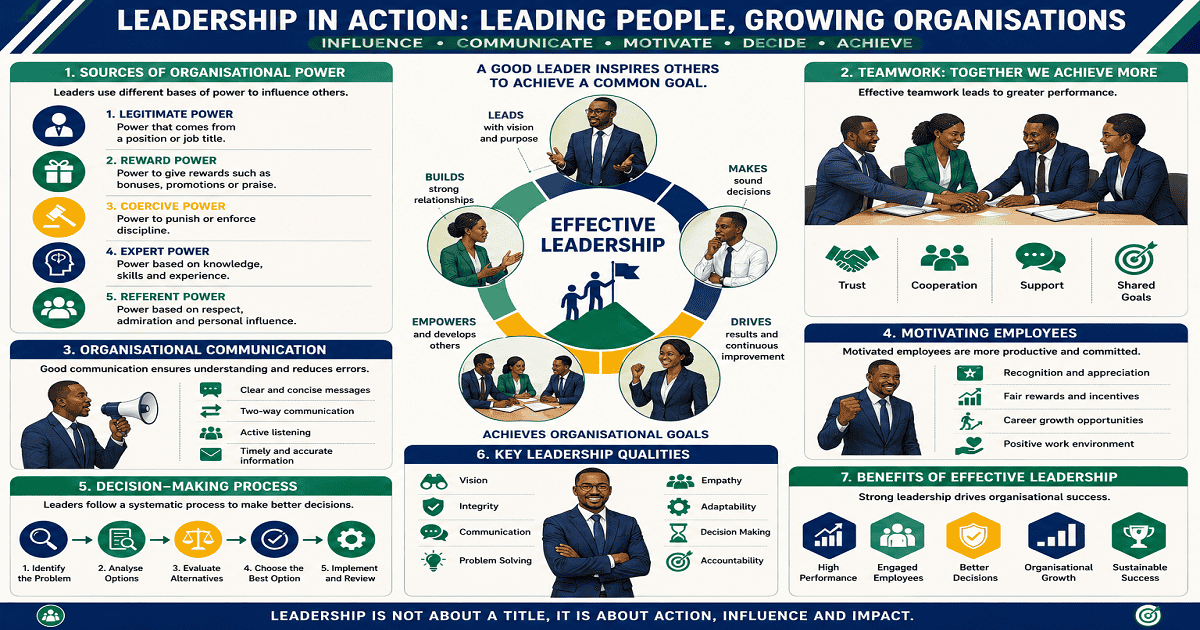
Leaders use different sources of power to influence their teams and achieve organisational objectives.
Legitimate power comes from a leader’s formal position or authority within an organisation. Employees obey instructions because the leader holds an official position.
Expert power is derived from knowledge, skills, and experience. Leaders with specialised expertise gain respect and trust from team members.
Referent power develops when followers admire and trust a leader’s personality, values, and behaviour. Such leaders become role models who inspire others.
Reward power involves motivating employees through promotions, salary increases, bonuses, or recognition for good performance.
Coercive power is based on the leader’s authority to apply sanctions, discipline, or punishment for non-compliance or poor performance.
Informational power comes from access to important or specialised information that influences organisational decisions.
Effective leadership requires important qualities and characteristics.
Good leaders show integrity by being honest, trustworthy, and ethical. They communicate clearly, listen carefully, and maintain confidence when making decisions.
Leaders should also be visionary by setting goals and guiding team members toward success. Empathy helps leaders understand the needs and challenges of employees.
Decision-making is another important leadership quality. Leaders gather information, analyse situations, and make responsible choices. Adaptability allows leaders to respond effectively to changing conditions and challenges.
Leaders inspire others through positive attitudes, encouragement, and recognition of achievements.
Effective leadership is important in organisations because it promotes goal achievement, employee motivation, talent development, teamwork, conflict resolution, and organisational growth.
Leaders help employees embrace change, manage crises, and solve organisational problems. They also promote positive organisational culture and ethical values.
However, leadership also involves challenges such as communication problems, conflict resolution, decision-making difficulties, crisis management, resistance to change, and managing time and responsibilities effectively.
Sources Of Power In Leadership
| Source Of Power | Description | Effect On Leadership |
|---|---|---|
| Legitimate Power | Derived from official authority | Encourages compliance |
| Expert Power | Based on knowledge and expertise | Builds trust and respect |
| Referent Power | Based on admiration and charisma | Inspires followers |
| Reward Power | Ability to provide incentives | Motivates employees |
| Coercive Power | Ability to impose punishment | Promotes discipline |
| Informational Power | Access to valuable information | Influences decisions |
Qualities Of A Good Leader
| Quality | Description | Importance |
|---|---|---|
| Integrity | Honesty and ethical behaviour | Builds trust |
| Confidence | Belief in abilities | Encourages followers |
| Communication | Clear expression and listening | Improves teamwork |
| Vision | Ability to set goals | Provides direction |
| Empathy | Understanding others’ feelings | Strengthens relationships |
| Adaptability | Responding to change effectively | Improves problem-solving |
Importance And Challenges Of Leadership
| Aspect | Explanation | Effect |
|---|---|---|
| Goal Achievement | Guides teams toward objectives | Improves productivity |
| Employee Motivation | Encourages commitment | Increases job satisfaction |
| Conflict Resolution | Addresses disagreements fairly | Promotes teamwork |
| Change Management | Helps employees adapt | Supports organisational growth |
| Communication Challenges | Poor communication causes misunderstandings | Reduces efficiency |
| Crisis Management | Unexpected organisational problems | Requires quick decisions |
Examples
Example 1
Problem: Identify the source of power used by a manager who motivates workers through bonuses and promotions.
- Identify the type of incentive provided.
- Determine how employees are influenced.
- Match the influence with the appropriate source of power.
Final Answer: The manager uses reward power because employees are motivated through incentives and rewards.
Example 2
Problem: Explain why communication is important in leadership.
- Identify the role of communication in organisations.
- Determine how communication affects teamwork.
- Explain the effect on productivity.
Final Answer: Good communication improves teamwork, prevents misunderstandings, and helps organisations achieve goals effectively.
Application and Activities
- Discuss examples of leadership power within organisations.
- Role-play leadership scenarios involving decision-making and communication.
- Analyse leadership challenges faced by businesses.
- Work in groups to identify qualities of effective leaders.
Practice Questions
- Define leadership and explain its importance.
- Differentiate between legitimate power and expert power.
- Discuss three challenges confronting leaders in organisations.
Summary
Leadership is the process of influencing people to achieve organisational goals. Leaders use different sources of power such as legitimate, expert, referent, reward, coercive, and informational power to influence others. Effective leaders possess qualities such as integrity, confidence, communication skills, empathy, adaptability, and vision. Leadership is important for goal achievement, employee motivation, teamwork, and organisational growth, although leaders also face challenges such as communication difficulties, conflict resolution, crisis management, and decision-making.
Access NaCCA-aligned Support Packs
Download your structured NaCCA-aligned Teacher Support Pack and Student Learning Pack, designed for clarity, practicality, and reliable teaching and learning.