Producing Novel Summaries Based on Varied Themes and Narrative Writing Using Different Styles Explained for SHS 2 Literature-in-English (Sem. 1 – Week 7)
Beyond Reading the Story: Discovering Meaning and Developing the Art of Writing
A novel can contain many characters, complicated relationships, different settings and numerous events. Yet, when a reader finishes the book, an important question remains: what is the story really communicating?
Answering this question requires more than remembering what happened. It involves understanding the characters, identifying important themes and recognising how individual events contribute to the overall meaning of the work.
Two important literary abilities are producing summaries of selected novels based on varied themes and creating narrative pieces using different writing styles.
The first develops the ability to interpret and communicate the essential content of a literary work. The second develops the ability to organise ideas, construct stories and use language deliberately.
These abilities are complementary. A person who understands how a story develops is better equipped to summarise it. Similarly, someone who understands how writers construct narratives can make more thoughtful decisions when creating original stories.
1. A Story Contains Events, but Its Meaning Extends Beyond Them
When discussing a novel, readers often begin by describing what happened. They mention the main characters, important incidents and the ending. Although this is useful, it does not necessarily explain the deeper meaning of the work.
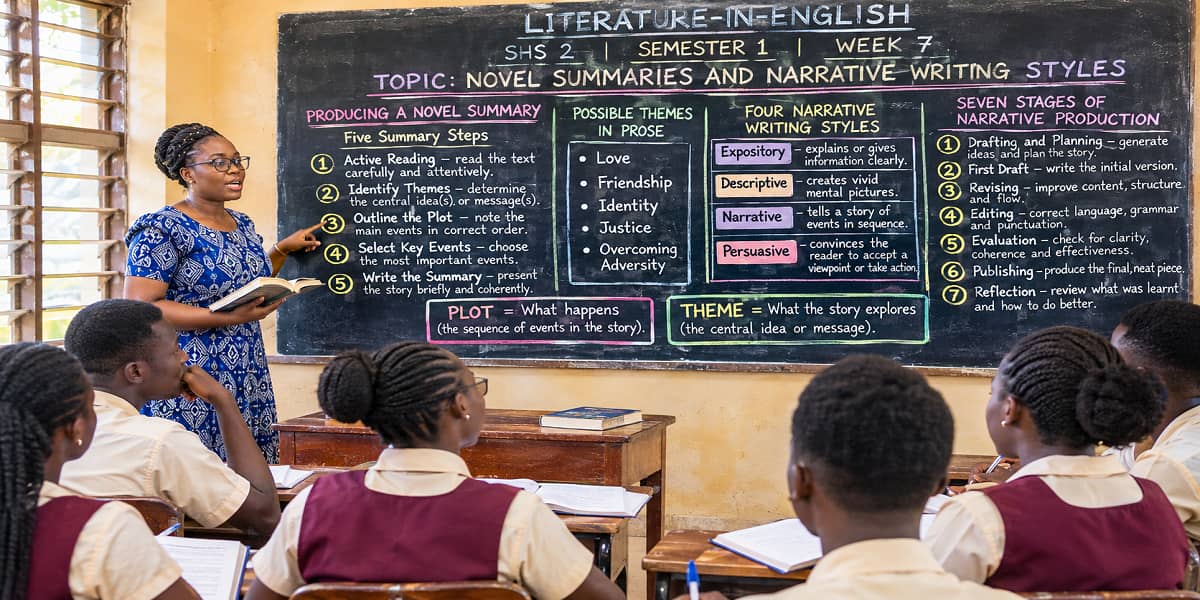
A novel summary brings together the essential elements of a story in a concise account. It identifies the main characters, their goals or conflicts, the significant events, the central themes and the resolution.
Its purpose is to preserve the essential meaning of the novel without reproducing every detail.
Consider the difference between remembering an incident and understanding its importance. An event may introduce a conflict, reveal a character’s motivation or demonstrate how a relationship changes.
Its significance lies not merely in its occurrence but in its contribution to the development of the story. Effective summarising therefore requires careful selection. The writer must distinguish what is essential from what can reasonably be excluded.
2. Themes Reveal the Ideas Behind Literary Events
A theme is a central idea or concern explored through a literary work. Themes help readers move beyond individual incidents and recognise the broader ideas that connect different parts of a novel.
Possible themes include love, friendship, identity, justice and overcoming adversity.
These ideas may emerge through relationships, character decisions, conflicts and the consequences of actions.
For example, friendship may be explored through the way characters relate to one another and respond when their relationship faces difficulties. Justice may emerge through situations involving fairness and the treatment of individuals.
A theme should not be selected merely because a particular word appears in a novel. The interpretation should be supported by the story’s actual development.
It is also possible for one novel to explore several themes. These themes may complement one another or present contrasting concerns. Recognising this relationship is important because a summary should not focus exclusively on the sequence of events while ignoring the ideas that connect them.
3. The Importance of Active Reading
A reliable summary begins before the first sentence is written. It begins with active reading.
Active reading means paying attention to how the novel develops and deliberately recording information that contributes to understanding its meaning.
Four areas deserve particular attention:
Characters
Identify the main characters, their traits, motivations and relationships. Understanding what they desire helps explain why particular events occur.
Setting
Observe the circumstances and environment in which the story takes place. The setting provides context for understanding characters and their experiences.
Key Events
Record important incidents that move the plot forward, reveal character traits or contribute to the development of themes. Consider why each event matters and how it influences subsequent developments.
Recurring Themes
Identify ideas that appear throughout the novel and consider the events that support their interpretation.
Highlighting, underlining and making notes can help organise these observations. Separate notes for characters, settings, themes and significant plot developments make it easier to prepare a coherent summary.
The central principle is to read with questions in mind:
- Why did this event happen?
- What does it reveal about the character?
- How does it influence subsequent developments?
- What idea does it help communicate?
These questions encourage deeper understanding than simply memorising incidents.
4. Selecting the Events That Deserve Attention
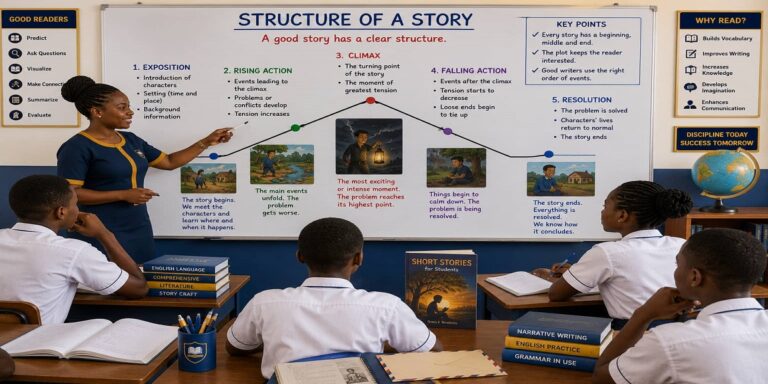
The plot is the arrangement of events that forms the story. Before writing a summary, the reader should outline the major developments in their original sequence.
This involves identifying the circumstances in which the story begins, the main characters, the central conflict, significant decisions and actions, and the events leading towards the conclusion.
Not every event deserves equal attention.
A key event is important because it advances the plot, reveals something significant about a character or develops a theme.
An incident that changes a character’s circumstances may be essential because it influences subsequent developments. By contrast, a minor incident that contributes little to the central story may be omitted.
Maintaining the original sequence is particularly important. Reorganising events carelessly can confuse readers and distort the development of the plot.
5. Turning Literary Understanding into a Good Summary
After identifying the main characters, themes and important events, the writer must organise the information into a coherent account.
A useful summary introduces the central characters and explains what drives the story. It then presents the significant conflict, describes the important decisions and actions, and concludes with the resolution.
| Summary component | Its contribution |
|---|---|
| Characters | Identifies the individuals central to the story. |
| Motivations | Explains what drives the characters. |
| Conflicts | Identifies the difficulties they encounter. |
| Key events | Shows how the plot develops. |
| Resolution | Explains how the story concludes. |
| Themes | Communicates the central ideas explored. |
A summary should not become a collection of disconnected incidents. Each sentence should contribute to understanding the novel.
Unnecessary repetition and excessive details should be avoided. The writer must also preserve the distinction between what happens in the story and what the story explores.
6. Four Writing Styles and Their Different Purposes
Literary expression depends partly on how a writer chooses to present information.
A writing style refers to the manner in which ideas, experiences, arguments and stories are communicated.
Four commonly recognised styles are expository, descriptive, narrative and persuasive writing.
Expository Writing: Explaining Clearly
Expository writing provides factual information and explains ideas, concepts or processes in a straightforward manner.
Its purpose is to communicate information clearly by answering questions such as what, why and how. The writer relies almost exclusively on facts rather than attempting to create a fictional story or influence the reader through emotional appeals.
Many forms of journalism fall within this category because they aim to expose facts and explain events.
Descriptive Writing: Making Readers Imagine
Descriptive writing focuses on vivid details that create a sensory experience. Its purpose is to paint a picture in the reader’s mind of a person, place, object or event.
Writers use carefully selected words and literary devices to make descriptions meaningful.
Simile
A comparison using words such as like or as.
Metaphor
A direct comparison in which one thing is presented as another.
Personification
Giving human qualities or actions to non-human things.
Sensory details also strengthen descriptions by appealing to sight, hearing, smell, taste and touch.
Instead of simply describing a person as beautiful, a writer might refer to thick, raven hair, melodic laughter and a distinctive manner of walking.
Such details help the reader form a clearer mental picture.
Narrative Writing: Telling a Developing Story
Narrative writing tells a story through a sequence of events. It often involves a narrator guiding readers through the plot and the interactions between characters.
A developed narrative requires attention to several connected elements:
Setting: Establishes the circumstances and environment in which the story occurs.
Character psychology: Explains the motivations, thoughts and behaviour that influence characters’ decisions.
Main conflict: Introduces the difficulty or problem that drives the events.
Resolution: Explains how the story reaches its conclusion.
Timeline: Establishes the order in which events occur.
Relationships between characters: Shows how the characters are connected and how their interactions influence the story.
Novels and short stories are examples of narrative writing. Some poems also employ narrative techniques.
Persuasive Writing: Influencing Readers
Persuasive writing aims to convince readers of a particular viewpoint or argument.
Writers may use rhetorical devices and emotional appeals to influence their audience. Examples include editorials, advertisements, marketing materials and cover letters.
The defining purpose is to encourage readers to consider or accept a particular position.
| Writing style | Central purpose | Key feature |
|---|---|---|
| Expository | Explain | Facts and information. |
| Descriptive | Create a mental picture | Imagery and sensory details. |
| Narrative | Tell a story | Characters and plot development. |
| Persuasive | Convince | Arguments and appeals. |
7. Why Writing Styles Can Work Together
Although the four styles have different purposes, they do not always appear independently within a complete literary work.
A narrative may contain descriptive passages that help readers imagine its setting. Characters may use persuasive language during disagreements. An explanatory passage may also provide information needed to understand an event.
The presence of one technique does not necessarily determine the dominant style of the entire work.
For example, a story may contain several descriptive paragraphs while remaining fundamentally narrative because its main purpose is to present a developing sequence of events.
Readers and writers should therefore consider both the language used and the overall purpose of the writing.
8. The Writing Process: From an Idea to a Finished Narrative
Producing an effective narrative requires more than having an interesting idea. The writer must organise that idea, develop the story, improve its expression and prepare it for an audience.
1. Drafting and Planning
Begin by thinking of the central idea. Decide how you want to tell the story, whether through detailed descriptions, substantial dialogue or another suitable approach.
Prepare a plan showing the main parts of the story and how they will develop.
2. Writing the First Draft
Use the plan to develop characters, events and their responses. Experiment with different ways of presenting the story. The writing may be exciting, adventurous or mysterious, depending on the intended effect.
3. Revising
Read the story again and check whether it makes sense. Improve the flow between sections, refine word choice and consider whether sentence length and imagery suit the intended style.
4. Editing
Correct spelling mistakes and problems with sentence construction. Ensure that the writing is clear and that the chosen style remains consistent.
5. Evaluation
Consider whether the story achieves its intended purpose. Ask whether it makes sense, whether it is interesting and whether the selected style is appropriate.
6. Publishing
Make the final changes and prepare the work for presentation. The completed story may be printed or shared online.
7. Reflection
Consider what was learned during the writing process. Think about how the use of different styles influenced the story and how future writing could be improved.
9. Reading and Writing as Connected Literary Skills
The ability to summarise novels and produce narratives reinforces a deeper understanding of literature.
When readers summarise novels, they practise selecting important information, interpreting themes and understanding how characters and events contribute to meaning.
When writers produce narratives, they apply their understanding of story development, character relationships, conflict and resolution.
The connection becomes particularly clear when someone examines a novel and then attempts to construct an original story.
Understanding how a writer develops a plot can help another writer organise events. Recognising descriptive language can also demonstrate how imagery and word choice create a vivid experience.
Reading different stories and identifying their writing styles therefore provides useful opportunities for improving written expression.
10. Developing Independent Literary Judgement
Literary understanding should extend beyond recalling definitions. Readers should be able to identify important events, describe themes and produce summaries that communicate the essential meaning of novels.
More advanced analysis involves integrating contrasting themes from two novels and reflecting on how thematic interpretation influences understanding.
Narrative writing also requires practical application. Writers should be able to identify different styles, rewrite a scene using a different approach and develop prompts that encourage experimentation with other writing techniques.
For example, a scene presented descriptively may be rewritten with greater emphasis on narrative development or conversational interaction. The writer must consider how the change influences the reader’s experience.
Group discussions, presentations and constructive feedback can further strengthen these abilities by allowing different interpretations and approaches to be examined.
Conclusion: Understanding Literature Through Interpretation and Expression
Producing meaningful novel summaries and creating narrative pieces using different writing styles are complementary literary skills.
Summarising requires readers to identify essential characters, events, conflicts, themes and resolutions. Narrative production requires writers to understand how ideas can be developed through planning, drafting, revision and evaluation.
Expository writing explains, descriptive writing creates vivid impressions, narrative writing tells stories and persuasive writing seeks to influence opinions.
The ability to recognise these differences improves literary interpretation and written communication.
Ultimately, strong readers do more than remember stories. They understand how the stories work, recognise the ideas they communicate and use that understanding to express their own ideas with greater purpose and clarity.
Access NaCCA-aligned Support Packs
Download your structured NaCCA-aligned Teacher Support Pack and Student Learning Pack, designed for clarity, practicality, and reliable teaching and learning.