Effective Communication, Story Summarising and Adjectives – SHS 1 English Language (Semester 1, Week 5)
Introduction: Communicating Clearly and Understanding Language
Imagine speaking with a close friend during break time and then presenting a request to your school’s headteacher. Would you use exactly the same expressions in both situations? Now consider reading a story containing several characters and events. How would you explain its main message to someone who has not read it? When describing an object or person, how do you select words that communicate the exact qualities you have in mind?
These everyday situations demonstrate why effective English Language use requires more than memorising vocabulary and grammatical rules.
Speakers need to understand their communication context, readers need to identify important information, and writers need to select words that express meaning accurately.
This week’s learning explores three interconnected areas: discourse and conversations, the parts and elements of a story, and adjectives. Each develops a practical skill that supports effective communication.
1. Discourse and Conversations: Understanding Communication
Discourse involves the use of language to communicate ideas, exchange information and participate in different speech situations. Conversation is an exchange of ideas, information or opinions between two or more people.
Successful communication requires participants to consider the situation, their audience and the purpose of the interaction.
For example, a learner speaking with a classmate may use relaxed everyday expressions. The same learner speaking with a school headteacher would normally select more formal and respectful language.
This difference introduces an important concept in communication: register.
2. Register: Selecting Language for the Situation
Register refers to the variety of language and vocabulary appropriate to a particular situation or context.
It influences the expressions, tone and level of formality used when communicating.
Three speech contexts are important:
Formal communication: This involves official or professional situations where careful and respectful language is expected. Examples include writing formal letters, preparing formal speeches and speaking with a school headteacher.
Semiformal communication: This involves situations where communication is polite and relatively structured but may retain a conversational character. The expressions depend on the relationship between the speakers and the purpose of the interaction.
Informal communication: This involves relaxed conversations among familiar people, such as friends and classmates. Everyday discussions within the school environment provide examples.
3. How Language Changes Across Speech Situations
Appropriate communication requires selecting words that reflect the circumstances of an interaction.
Asking for directions: A speaker should use clear and polite expressions when requesting information about a location.
Requesting a favour: The language should communicate the request respectfully and appropriately.
Describing a market scene: Suitable descriptive vocabulary helps explain the activities, people and surroundings being observed.
Attending a job interview: Formal expressions are important when answering questions and presenting information about oneself.
Speaking in class: Learners should communicate their questions clearly and respectfully while participating in discussions.
Speaking with school authorities: Respectful expressions help establish appropriate communication between learners and school officials.
These situations show that effective communication depends not only on what is said but also on how appropriately it is expressed.
4. Communicative Strategies for Effective Conversations
Good conversations require active participation from everyone involved.
Listening: Participants should pay attention to others before responding. This reduces misunderstanding and helps maintain meaningful discussions.
Appropriate vocabulary: Speakers should choose expressions that suit their audience and communication context.
Clear responses: Responses should address the subject being discussed and communicate the intended message.
Respect for different opinions: Participants should allow others to express their views without unnecessary arguments or interruptions.
Turn-taking: Effective conversations involve allowing each participant an opportunity to contribute.
Role-play: Acting out different speech situations helps learners practise vocabulary and communicative strategies in realistic contexts.
5. Story Structure: How Narratives Are Organised
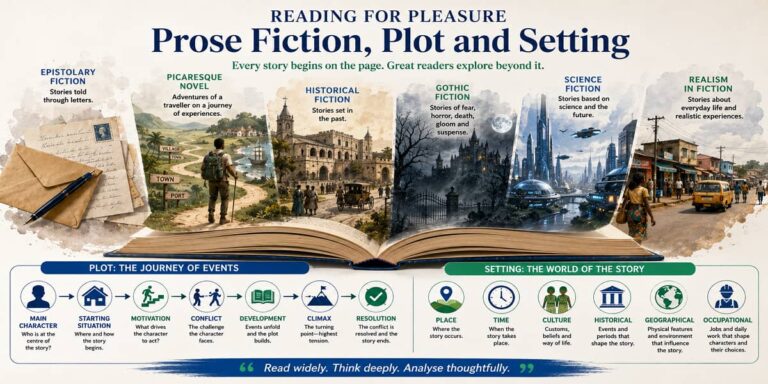
Stories communicate events involving characters within particular settings. Understanding how these events are organised makes it easier to interpret and retell a narrative.
Every story has three main parts: introduction, main body and conclusion.
Introduction: The opening section introduces the situation and provides the background information needed to understand the narrative.
Main body: The central section presents the developing events, including the problems characters encounter and their responses.
Conclusion: The final section brings the narrative to an end and presents the outcome of the events.
Recognising these three parts helps readers understand the overall organisation of a story.
6. The Five Elements of Plot
Plot refers to the events and actions that drive a story. It explains what happens, the problems characters attempt to solve and how those problems develop towards an outcome.
The plot contains five important elements.
Exposition: This introduces the background information and circumstances necessary for understanding the story.
Rising action: This presents the developing events and complications that build towards the central problem.
Climax: This is the major turning point or most intense moment in the story.
Falling action: This presents the events that follow the climax as the situation moves towards its outcome.
Resolution: This brings the main problem or conflict towards its conclusion.
Understanding the five elements helps readers follow the development of events rather than treating a story as a collection of unrelated incidents.
7. Other Important Elements of a Story
Setting: Setting refers to the physical location and point in time in which the plot takes place. It establishes where and when the events occur.
Characters: Characters are the people, animals, beings or personified objects that drive the story. A narrative may contain several characters or focus on one central character.
Conflict: Conflict is the major problem the main character attempts to overcome or resolve.
Point of view: This describes the perspective through which the story is told. It determines the narrative lens through which readers receive information.
8. Three Common Points of View
First-person point of view: The narrator tells the story from a personal perspective, commonly using I and we.
Second-person point of view: The narrator addresses the reader or another person using you. This form is relatively rare in storytelling.
Third-person point of view: The narrator tells the story using expressions such as he, she and they. The learning material identifies third-person omniscient narration as a common form.
Recognising the point of view helps readers understand the perspective from which events are presented.
9. Main Ideas and Supporting Details
When reading a paragraph or longer text, not every sentence communicates information of equal importance.
Main idea: The main idea is the central point or most important message communicated in a paragraph or text.
Supporting details: These are explanations, examples and other sentences that develop or provide evidence for the main idea.
Consider a paragraph about the importance of education. Its main idea may be that education contributes to personal development. Supporting details could explain how education develops knowledge, improves skills and prepares individuals for different responsibilities.
The supporting details make the main idea clearer and more meaningful.
10. Summarising: Communicating Essential Information
Summarising is a reading technique that involves identifying and presenting the main parts or important ideas of a text without including every detail.
It allows readers to communicate the essential information in a shorter and more focused form.
For example, after watching a short drama, a learner may explain the central problem, the important actions and the final outcome without reproducing every conversation.
Identifying the central message: Read carefully and determine what the paragraph or story is mainly communicating.
Selecting supporting information: Identify the details that explain or develop the central message.
Recognising important events: In a story, select the significant events that contribute to the development of the plot.
Presenting the summary: Organise the selected information into a clear and concise account that preserves the important meaning.
11. Retelling Stories and Developing Interpretation
Retelling involves communicating the main events of a story to someone who has not read or watched it.
A good retelling should preserve the important information while avoiding unnecessary details.
Readers can practise this skill through short stories, drama, videos and other reading materials. Group discussions also provide opportunities to compare interpretations and explain how language contributes to the meaning of a story.
Summarising and retelling therefore develop the ability to identify important information, organise ideas and communicate clearly.
12. Adjectives: Describing People, Places and Things
Adjectives are words that describe nouns. They make nouns more specific by communicating their qualities, appearance, characteristics or quantity.
Examples include enormous, doglike, silly, yellow, fun, fast, many, few and some.
Consider the sentence: “The brilliant learner answered the difficult question.”
The words brilliant and difficult describe the nouns learner and question respectively.
Without adjectives, descriptions may lack important information about the people and things being discussed.
13. Functions of Adjectives
Adjectives qualify their associated nouns and help communicate more specific information.
Describing qualities: “Maggie wore a beautiful hat to the gari-eating contest.” The adjective beautiful describes the hat.
Describing appearance: “Furry dogs may overheat in the summertime.” The adjective furry describes the dogs.
Indicating quantity: Words such as many, few and some communicate the amount or number of nouns.
Expressing degrees of qualities: “The scariest villain of all time is Kweku Ananse.” The adjective scariest expresses a high degree of the quality being described.
14. Attributive and Predicative Adjectives
Adjectives can qualify nouns in different positions within a sentence.
Attributive adjectives: These appear directly before the nouns they qualify.
Examples:
- A beautiful hat.
- Furry dogs.
- Sixteen candles.
- The scariest villain.
In each example, the adjective appears before the noun it describes.
Predicative adjectives: These qualify nouns without appearing immediately before them. They commonly function as complements through linking verbs.
Examples:
- The perfume smells good.
- Fatima is intelligent.
- Driving is faster than walking.
- Papa Minka seemed upset.
In these sentences, the adjectives describe the subjects through the sentence structure rather than appearing directly before the nouns.
15. Degrees of Adjectives
Adjectives have three degrees: absolute, comparative and superlative.
Absolute degree: Describes a quality without making a comparison.
Examples: cool, messy, rigid, awful and mischievous.
Comparative degree: Compares two or more things according to a particular quality.
Examples: cooler, messier, more rigid, more awful and more mischievous.
Superlative degree: Expresses the highest degree of a quality among the things being considered.
Examples: coolest, messiest, most rigid, most awful and most mischievous.
16. How to Form Comparative Adjectives
Comparative adjectives are commonly formed by adding -er or placing more before the adjective.
One-syllable adjectives: Generally add -er.
Examples: fast → faster; cool → cooler.
Adjectives ending in -e: Add -r.
Example: large → larger.
Some two-syllable adjectives: These may take -er. Adjectives ending in -y commonly replace y with -ier.
Example: messy → messier.
Adjectives with three or more syllables: Generally use more before the adjective.
Examples: rigid → more rigid; mischievous → more mischievous.
17. How to Form Superlative Adjectives
Superlative adjectives commonly use -est or most.
One-syllable adjectives: Generally add -est.
Example: fast → fastest.
Adjectives ending in -e: Add -st.
Example: large → largest.
Two-syllable adjectives ending in -y: Replace y with -iest.
Example: messy → messiest.
Longer adjectives: Generally use most.
Examples: rigid → most rigid; mischievous → most mischievous.
The definite article the is generally used with superlative adjectives because the expression identifies the item or items having the highest degree of a particular quality.
18. Adjectives in Different Contexts
Adjectives can be used in different sentence constructions.
Directly before nouns: “Amuzu is an amazing footballer.” The adjective amazing describes footballer.
With the verb to be: “Fatima is very intelligent.” The adjective intelligent describes Fatima.
With sensory verbs: “The food tastes awful.” The adjective awful describes the food through the sensory verb tastes.
With verbs of appearance: “Papa Minka seemed very upset.” The adjective upset describes Papa Minka through seemed.
19. Order of Adjectives
When adjectives appear together, their order should communicate the intended meaning naturally.
The learning material highlights relationships such as minor to, superior to and inferior to. It also identifies TIME, MANNER, PLACE as the general order in the rare rhetorical use of three different adjectives together.
Example: “The late-running, overheating, local train finally arrived.”
Practising adjective arrangement helps learners produce more natural and meaningful descriptions.
20. Bringing the Three Learning Areas Together
Discourse, summarising and adjectives contribute to different aspects of effective English communication.
Register helps speakers select language suitable for different situations. Summarising develops the ability to identify essential information and communicate it clearly. Adjectives improve descriptions by making nouns more specific.
Consider a learner describing a market visit. The learner must choose suitable language for the audience, identify the important events and use adjectives to describe the people, objects and activities observed.
For example, expressions such as “a crowded market”, “fresh vegetables” and “a busy trader” communicate more information than simply referring to a market, vegetables and a trader.
These skills work together to improve communication, comprehension and writing.
Conclusion: Building Effective English Language Skills
Effective English Language use requires an understanding of context, the ability to interpret information and the knowledge to select appropriate grammatical structures.
Discourse and conversations develop the ability to communicate appropriately in formal, semiformal and informal situations. Understanding the structure and elements of stories improves reading comprehension and helps learners identify main ideas and summarise important information. Adjectives develop descriptive accuracy by expressing qualities, characteristics and degrees.
Through regular reading, discussion, role-play and writing activities, learners can strengthen these skills and apply them in everyday communication.
Check Your Understanding
Can you distinguish formal, semiformal and informal speech? Can you identify the three parts of a story and explain the five elements of plot? Can you identify main ideas and supporting details? Can you distinguish attributive and predicative adjectives and form their comparative and superlative degrees?
These questions provide a useful review of the week’s learning and help identify areas requiring further practice.
Access NaCCA-aligned Support Packs
Download your structured NaCCA-aligned Teacher Support Pack and Student Learning Pack, designed for clarity, practicality, and reliable teaching and learning.