Understanding Pronouns, Short Story Writing and Literary Characters – SHS 1 English Language (Sem. 1 – Week 4)
Introduction: Language Is More Than Words
Have you ever listened to someone tell a story and struggled to understand who they were talking about? Have you read a short story that made you imagine an experience vividly? Or have you wondered why certain characters in novels and plays behave differently from others?
These experiences reveal three important dimensions of English Language: grammatical accuracy, creative writing and literary understanding.
Communication becomes clearer when we use appropriate pronouns. Writing becomes more engaging when we choose precise words. Literature becomes more meaningful when we understand the individuals represented in stories and how writers present their personalities.
These are the central concerns of this week’s SHS 1 English Language lessons: additional types of pronouns, short story writing, and character and characterisation.
1. Pronouns: Small Words with Important Functions
Pronouns help us communicate without repeatedly mentioning the same nouns. They make sentences more natural and reduce unnecessary repetition.
Consider this example: “Ama collected Ama’s books because Ama needed the books.” Repeating the same name and noun makes the sentence unnecessarily long.
A clearer expression is: “Ama collected her books because she needed them.”
The words her, she and them replace nouns or refer to previously mentioned subjects. This makes the sentence easier to read.
However, using too many pronouns without clear references can create confusion. Readers should always be able to identify the people or things represented by pronouns.
2. Interrogative Pronouns: Asking for Information
Interrogative pronouns are used to ask questions. They help speakers obtain information about people, objects, places, time and other matters.
Examples include who, what, when, whom, why, where, which and whose.
Consider these questions:
- Who is your class teacher?
- What happened during the programme?
- When will the examination begin?
- Whom did the school invite?
- Why are the learners discussing the story?
- Where is the library?
- Which book did you select?
- Whose bag is on the table?
Each word introduces a question that seeks particular information. Learning to use these pronouns correctly improves the way learners participate in conversations and construct written questions.
3. Reflexive Pronouns: Referring Back to the Subject
Reflexive pronouns refer back to the subject of a sentence. They are useful when the person or thing performing an action is also the one affected by that action.
The examples include myself, yourself, herself, himself, oneself, itself, ourselves, themselves and yourselves.
For example:
- I completed the work myself.
- She introduced herself to the visitors.
- He prepared himself for the competition.
- We organised the programme ourselves.
- The machine switches itself off.
In each sentence, the reflexive pronoun refers back to the subject. This relationship is important when constructing grammatically meaningful sentences.
4. Demonstrative Pronouns: Pointing to Specific Objects
Demonstrative pronouns are used to point to specific objects. The four examples are this, that, these and those.
They help speakers identify the particular things being discussed.
- This is my textbook.
- That belongs to the headteacher.
- These are my examination papers.
- Those are the learners who represented the school.
This and these generally refer to things considered near the speaker, while that and those generally refer to things considered farther away.
Knowing the differences between these pronouns helps learners communicate more precisely.
5. Using Pronouns Without Creating Confusion
Although pronouns reduce repetition, their references must remain clear.
Consider the sentence: “When Ama met Esi, she gave her the book.” Without further context, the reader may not know who gave the book and who received it.
A clearer version might be: “When Ama met Esi, Ama gave Esi the book.”
Repeating names is sometimes better than using ambiguous pronouns. Good writing involves selecting the expression that communicates the intended meaning most clearly.
6. The Short Story: Communicating an Experience Through Narrative
A short story is a brief narrative that is shorter than a novel and usually deals with only a few characters.
It is generally concerned with a single central idea communicated through one or a few significant episodes or scenes.
For example, a story about a learner’s first day at school may focus on the learner’s arrival, an unexpected experience and what the learner discovers. The writer concentrates on the significant events rather than describing every experience from the learner’s entire school life.
This makes the short story an effective form of creative writing because the writer must select details carefully.
7. What Makes a Good Short Story?
Several characteristics distinguish a short story from a lengthy narrative.
Brief narrative: The story communicates its central experience without unnecessary length or repetition.
Few characters: A limited number of characters allows the writer to concentrate on those directly connected to the central idea.
Single central idea: The narrative generally focuses on one major idea developed through a few significant episodes.
Economy of setting: The writer selects only the necessary setting details to establish the circumstances of the events.
Concise narrative: Descriptions and events are presented economically while retaining their meaning.
Limited plot complexity: The story generally avoids an unnecessarily complicated plot.
Character portrayal through action: Characters are revealed through their actions and dramatic encounters.
These features help writers produce focused and meaningful narratives.
8. Precise Words and Phrases: Making Writing More Powerful
Precise words and phrases are exact expressions selected to communicate ideas clearly and create vivid mental pictures without using unnecessarily many words.
Compare these expressions:
| General expression | Precise alternative |
|---|---|
| Got there | Arrived |
| Put in | Installed or deposited |
| Got to see | Realised or found out |
For example, “The visitor got there late” can become “The visitor arrived late.” The revised sentence communicates the action more directly.
Precision does not mean filling a story with complicated vocabulary. It means choosing the most appropriate expression for the intended meaning.
When learners use precise words, they improve clarity and help readers imagine the experiences being described.
9. Choosing a Short Story Topic
Writers can develop short stories from familiar experiences and meaningful events.
Some suitable topics include:
- My first day at school.
- My favourite family pastime.
- The best thing that ever happened to me.
- My favourite short story.
These topics encourage learners to draw on experiences they can understand and communicate.
Before writing, learners should identify the central idea, consider the relevant characters and setting, and select the significant events that will communicate the experience.
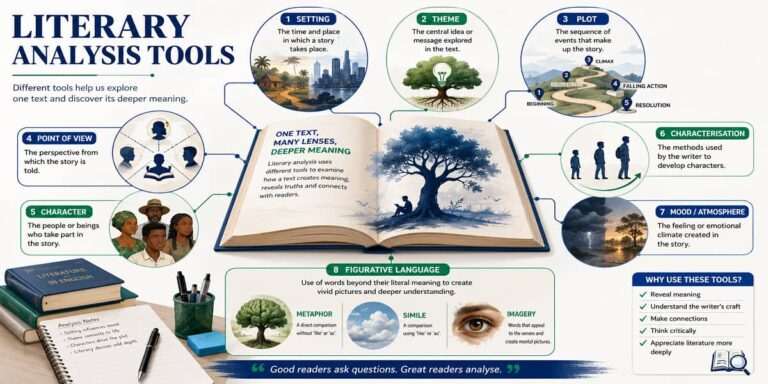
10. Understanding Character in Literature
Stories, novels, films and plays contain individuals who participate in the events being presented. These individuals are called characters.
A character is someone who appears in a book, film or other fictional work. The term also refers to the attributes or features that distinguish an individual.
Characters contribute to the development of a narrative through their actions, relationships and decisions.
Some characters occupy central positions, while others support the development of the story.
Main or central characters are closely connected to the major events of a story.
Minor or supporting characters contribute to the narrative without necessarily occupying its central position.
Fictional characters and cartoon characters are other forms identified in the learning material.
11. Characterisation: How Writers Present Personalities
Characterisation is the representation of an individual’s personality in a fictional or dramatic work.
It is important to distinguish between the character and characterisation. The character is the individual, while characterisation concerns how that individual’s personality is represented.
For example, a story may contain a learner who is hardworking, determined and respectful. These qualities help readers understand the learner’s personality as represented in the narrative.
The language used in a literary work is therefore important when analysing characters. Learners should examine the portrayal of individuals rather than simply listing their names.
12. Seven Important Character Classifications
Dynamic character: A character who changes over the course of the story, often developing to become better or wiser.
Static character: A character who does not change throughout the story. Such a character may also be described as flat or one-dimensional.
Stock character: A familiar figure who appears repeatedly in different stories. Examples include jokers, mentors and bad-tempered shopkeepers.
Round character: A character with a developed personality and a backstory revealed through emotions, language and realistic motivations.
Foil character: A character whose personality and values clash with those of the protagonist.
Antagonist: A character who opposes the protagonist. The weekly learning material also discusses the antagonist in relation to the anti-villain and opposing characteristics.
Protagonist: The main character around whom most of the action centres.
13. Literary Examples of Protagonists
Recognising protagonists in familiar literary works helps learners connect character classifications to actual reading experiences.
Examples identified in the weekly learning material include:
- Okonkwo in Chinua Achebe’s Things Fall Apart.
- Sidi in Wole Soyinka’s The Lion and the Jewel.
- Faiza in Mamle Wolo’s The Kaya Girl.
These examples demonstrate how the protagonist occupies a central position in the development of a literary work.
14. Comparing Character Types
| Character type | Identifying feature |
|---|---|
| Dynamic | Changes during the story. |
| Static | Remains unchanged. |
| Stock | A familiar, recurring figure. |
| Round | Has a developed personality and realistic motivations. |
| Foil | Contrasts with the protagonist. |
| Antagonist | Opposes the protagonist. |
| Protagonist | Central character in the story. |
These classifications should be understood according to the different features they describe. A character’s position in the story and the way that character develops are not necessarily the same classification.
15. Why These Three Areas Matter Together
Pronouns, short story writing and characterisation contribute to effective communication in different but connected ways.
Pronouns help learners construct grammatically appropriate sentences and communicate without unnecessary repetition. Precise language helps writers express experiences clearly and economically. Character analysis develops the ability to interpret personalities and understand how individuals contribute to the meaning of literary works.
For example, a learner writing a short story about a school experience can use demonstrative pronouns to identify objects, reflexive pronouns to describe actions and interrogative pronouns when presenting questions in dialogue. Precise expressions can make the narrative more vivid, while the portrayal of the people involved gives the story meaning.
Conclusion: Developing Accuracy, Creativity and Literary Understanding
English Language learning involves more than memorising grammatical definitions. It requires learners to apply language in meaningful situations.
Interrogative, reflexive and demonstrative pronouns improve the way people ask questions, refer to themselves and identify specific objects. Short story writing develops the ability to communicate experiences through concise narratives and precise expressions. Character and characterisation help readers examine the personalities and roles of individuals in fictional and dramatic works.
By practising these skills through reading, discussion, writing and literary analysis, SHS 1 learners can become more confident and effective users of English.
Check Your Understanding
Can you explain the three additional pronoun categories? Can you describe the characteristics of a short story and identify precise alternatives for vague expressions? Can you distinguish a character from characterisation and explain the seven character types?
These questions provide a useful review of the week’s learning. Regular practice will help turn the concepts into practical communication skills.
Access NaCCA-aligned Support Packs
Download your structured NaCCA-aligned Teacher Support Pack and Student Learning Pack, designed for clarity, practicality, and reliable teaching and learning.