Pronouns, Short Story Writing, Character and Characterisation
Introduction
Language becomes effective when people can express ideas clearly, describe experiences accurately and understand the personalities represented in stories. In everyday communication, we use words to ask questions, refer to ourselves, identify objects and explain what happens around us. In writing, we select precise expressions to create meaningful descriptions and develop interesting narratives. In literature, we examine the people represented in stories and discover how writers communicate their personalities.
Consider a learner describing an experience at school. The learner may ask, “Who organised the programme?”, explain, “I prepared the presentation myself”, and point out, “Those are the books we used.” The words who, myself and those perform different grammatical functions. Similarly, a writer describing an exciting experience must select precise words rather than depend on vague expressions.
This lesson explores three interconnected areas of English Language: additional types of pronouns, short story writing and characterisation. Understanding these areas improves grammatical accuracy, creative expression and literary interpretation.
PART ONE: GRAMMAR — ADDITIONAL TYPES OF PRONOUNS
1. Understanding the Purpose of Pronouns
A pronoun is a word that stands in for a noun or refers to a person, thing or other subject. Pronouns help prevent unnecessary repetition in speech and writing.
For example, instead of writing, “Ama collected Ama’s books because Ama needed the books”, we can write, “Ama collected her books because she needed them.” The pronouns her, she and them make the sentence more natural.
However, pronouns must have clear references. Excessive or confusing use can make communication difficult. Consider this sentence: “When I asked her what she’d said, she said that she’d not spoken to her.” It is difficult to determine who the people represented by her and she are. A good writer therefore uses pronouns carefully and makes their references clear.
2. Interrogative Pronouns
Interrogative pronouns are pronouns used to ask questions. They help speakers obtain information about people, things, places, time and other matters.
Examples include who, what, when, whom, why, where, which and whose.
Examples in sentences:
- Who is your English teacher?
- What did you bring to school?
- When will the programme begin?
- Whom did the principal invite?
- Why are the learners discussing the story?
- Where did you keep the textbook?
- Which of these books belongs to you?
- Whose notebook is on the desk?
Notice that each interrogative pronoun introduces a question. The answer supplies the information being requested.
3. Reflexive Pronouns
Reflexive pronouns are pronouns used to refer back to the subject in a sentence. They show that the person or thing performing an action is also the one affected by that action.
Examples include myself, yourself, herself, himself, oneself, itself, ourselves, themselves and yourselves.
Examples in sentences:
- I prepared the assignment myself.
- You should believe in yourself.
- She introduced herself to the visitors.
- He blamed himself for the mistake.
- The machine switches itself off.
- We organised the programme ourselves.
- They prepared themselves for the examination.
- You should express yourselves clearly.
Reflexive pronouns are useful when the subject and the person or thing affected by an action refer to the same entity.
4. Demonstrative Pronouns
Demonstrative pronouns are pronouns used to point to specific objects. They help speakers and writers identify the particular things being discussed.
The four demonstrative pronouns are this, that, these and those.
- This: This is my exercise book.
- That: That belongs to the headteacher.
- These: These are the books I borrowed.
- Those: Those are the learners who won the competition.
This and these generally point to things considered near the speaker, while that and those generally point to things considered farther away.
5. Comparing the Three Pronoun Types
| Pronoun type | Function | Examples |
|---|---|---|
| Interrogative | Asks questions. | Who, what, when, whom, why, where, which, whose. |
| Reflexive | Refers back to the subject. | Myself, yourself, herself, himself, itself, ourselves, themselves. |
| Demonstrative | Points to specific objects. | This, that, these, those. |
6. Using Pronouns Accurately
Pronouns improve communication when they are selected appropriately and their references are clear. A writer should avoid unnecessary repetition without making the reader uncertain about who or what is being discussed.
For example, “Kofi told Ama that she should submit her assignment” may require additional context if several female learners have been mentioned. Repeating the appropriate name can sometimes make the meaning clearer.
Good grammatical practice therefore involves both using pronouns correctly and ensuring that the reader can identify their references.
PART TWO: WRITING — THE SHORT STORY
7. Understanding a Short Story
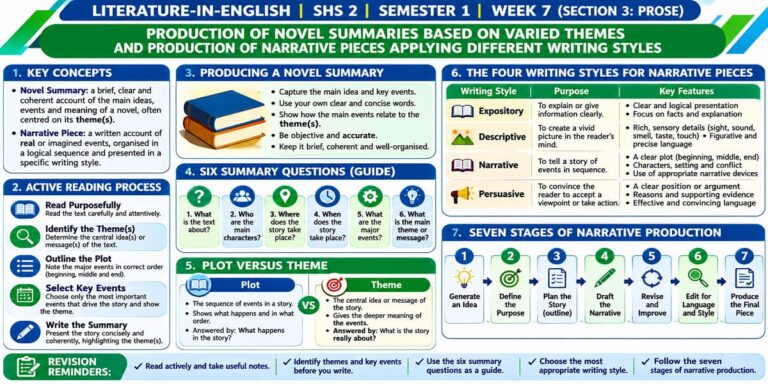
A short story is a brief narrative that is shorter than a novel and usually deals with only a few characters. It generally focuses on a single idea communicated through one or a few significant episodes or scenes.
Unlike a lengthy novel, a short story does not normally require an extensive setting or a complex plot. Its narrative is concise, and the writer selects the details necessary to communicate the central idea.
For example, a story about a learner’s first day at school may focus on the learner’s arrival, an unexpected experience and the lesson gained from that experience. The writer does not need to describe every event that occurred throughout the learner’s entire school life.
8. Characteristics of a Short Story
Brief narrative: A short story presents its events in a limited amount of writing. The writer avoids unnecessary explanations and concentrates on the central experience.
Few characters: Short stories usually involve a small number of characters. This allows the writer to concentrate on the people directly connected to the central idea.
Single central idea: A short story is generally concerned with one major idea communicated through one or a few significant episodes or scenes.
Economy of setting: The story uses a limited and carefully selected setting. Descriptions should provide the necessary background without distracting from the narrative.
Concise narrative: Events and descriptions are presented briefly and meaningfully. Unnecessary details are avoided.
Limited plot complexity: A short story generally avoids an unnecessarily complicated plot. Its events are organised to support the central idea.
Character development through action: Characters are revealed through their actions and dramatic encounters. Their behaviour helps readers understand their personalities.
9. Precise Words and Phrases
Precise words and phrases refer to the use of exact parts of speech to create vivid mental pictures without using unnecessarily many words to communicate an idea.
Precise language makes writing clearer, stronger and more interesting. It helps readers imagine experiences and understand what the writer intends to communicate.
Consider these examples:
| General expression | More precise expression | Improvement |
|---|---|---|
| Put in | Installed | Communicates a more exact action. |
| Put in the envelope | Deposited in the envelope | Identifies the action more precisely. |
| Got there | Arrived | Expresses reaching a destination concisely. |
| Got to see | Realised or found out | Communicates discovery or understanding more accurately. |
For example, compare “The visitor got there late” with “The visitor arrived late.” The second sentence uses a more precise expression and communicates the action directly.
10. Using Precise Language to Create Vivid Pictures
Writers should choose expressions that communicate exactly what happened rather than depending on vague or repetitive words.
Activity example: Compare “The boy got to see the damage” with “The boy discovered the damage.” The second expression communicates the discovery more directly.
Similarly, selecting exact verbs and descriptive phrases helps readers picture the events being narrated.
Precise language should not mean using unnecessarily complicated vocabulary. The aim is to choose words that express the intended meaning accurately and economically.
11. Planning and Writing a Short Story
Before writing, a learner should identify the experience or central idea to be communicated. The writer should then consider the relevant characters, setting and significant events.
The weekly learning activities require learners to outline the structure of a short story, draw and label a concept map of a given story, and use the structure to write their own narratives. These activities encourage learners to organise their ideas before producing a finished composition.
Possible story topics include:
- My first day at school.
- My favourite family pastime.
- The best thing that ever happened to me.
- My favourite short story.
When developing these topics, select a central experience, use only the necessary characters and details, and employ precise words and phrases to communicate the events effectively.
PART THREE: LITERATURE — CHARACTER AND CHARACTERISATION
12. Understanding Character
A character is someone who appears in a book, film or other fictional work. The term also refers to the attributes or features that make up and distinguish an individual.
Characters are important because they participate in the events of a narrative or dramatic work. Their actions, decisions and relationships contribute to the development and meaning of the story.
For example, a character may be a student, parent, teacher, community leader or another individual represented in a fictional work.
13. Understanding Characterisation
Characterisation is the representation of an individual’s personality in a fictional or dramatic work.
It concerns how the personality and distinguishing features of a character are presented to readers or audiences.
Writers use language and the portrayal of characters to help audiences understand the individuals represented in stories, novels and plays.
The distinction is important: a character is the individual in the fictional work, while characterisation is the representation of that individual’s personality.
14. Main and Minor Characters
Main, lead or central character: This is a character who occupies an important position in the story or play. Much of the action centres around this individual.
Minor or supporting character: This character supports the development of the narrative. Although not always central to the action, the character contributes to the events and meaning of the work.
15. Other Forms of Characters
Fictional characters: These are individuals represented in fictional works such as novels and plays.
Cartoon characters: These are characters represented through cartoon or animated forms.
16. Types of Characters
Dynamic character: A dynamic character changes over the course of a story. The character may develop and become better or wiser as events unfold. The source gives the villain or protagonist as possible examples.
Static character: A static character does not change over the course of a story. Such a character may also be referred to as flat or one-dimensional.
Stock character: A stock character is a familiar figure who appears repeatedly in different stories or dramatic works. Examples include jokers, mentors and bad-tempered shopkeepers.
Round character: A round character has a developed personality and a full backstory revealed through emotions, language and realistic motivations for actions.
Foil character: A foil character has a personality and values that clash with those of the protagonist. This contrast helps distinguish the protagonist’s characteristics.
Antagonist: The source describes the antagonist as an anti-villain with noble characteristics who opposes the protagonist, and also characterises the figure as mostly evil. The important distinction in the lesson is the antagonist’s opposition to the protagonist.
Protagonist: The protagonist is the main character around whom most of the action centres. The character is central to the development of the plot.
Examples provided include Okonkwo in Chinua Achebe’s Things Fall Apart, Sidi in Wole Soyinka’s The Lion and the Jewel, and Faiza in Mamle Wolo’s The Kaya Girl.
17. Comparing Character Types
| Character type | Meaning |
|---|---|
| Dynamic | Changes over the course of the story. |
| Static | Does not change throughout the story. |
| Stock | A familiar figure appearing repeatedly in stories. |
| Round | Has a developed personality, emotions and realistic motivations. |
| Foil | Contrasts with the protagonist in personality and values. |
| Antagonist | Opposes the protagonist. |
| Protagonist | The main character around whom the action centres. |
These classifications describe different aspects of characters. For example, a character’s importance in a story is not the same as whether the character changes. Readers should therefore examine the role and personality of each character carefully.
PART FOUR: PRACTICE QUESTIONS AND MODEL ANSWERS
18. Grammar — Pronouns
Question 1: What are interrogative pronouns?
Model Answer: Interrogative pronouns are pronouns used to ask questions.
Question 2: Give five examples of interrogative pronouns.
Model Answer: Who, what, whom, which and whose.
Question 3: What are reflexive pronouns?
Model Answer: Reflexive pronouns are pronouns used to refer back to the subject in a sentence.
Question 4: Give five examples of reflexive pronouns.
Model Answer: Myself, yourself, herself, himself and ourselves.
Question 5: What are demonstrative pronouns?
Model Answer: Demonstrative pronouns are pronouns used to point to specific objects.
Question 6: State the four demonstrative pronouns.
Model Answer: This, that, these and those.
Question 7: Identify the pronouns in this sentence: “I prepared the assignment myself because those were the instructions.”
Model Answer: I, myself and those.
Question 8: Complete the following sentences with appropriate pronouns.
- ______ is your English teacher?
- She completed the assignment ______.
- ______ are the books I borrowed.
Model Answers:
- Who.
- Herself.
- These.
19. Writing — The Short Story
Question 9: What is a short story?
Model Answer: A short story is a brief narrative that is shorter than a novel and usually deals with only a few characters.
Question 10: State four characteristics of a short story.
Model Answer:
- It is a brief narrative.
- It usually involves a few characters.
- It focuses on a single central idea.
- It generally avoids a complex plot.
Question 11: Explain precise words and phrases.
Model Answer: They are exact expressions used to create vivid mental pictures and communicate ideas clearly without using unnecessarily many words.
Question 12: Replace the following expressions with more precise alternatives.
- Got there.
- Put in.
- Got to see.
Model Answers:
- Arrived.
- Installed or deposited, depending on the context.
- Realised or found out, depending on the context.
Question 13: State four possible topics for short story writing.
Model Answer: My first day at school; My favourite family pastime; The best thing that ever happened to me; My favourite short story.
20. Literature — Character and Characterisation
Question 14: What is a character?
Model Answer: A character is someone who appears in a book, film or other fictional work.
Question 15: What is characterisation?
Model Answer: Characterisation is the representation of an individual’s personality in a fictional or dramatic work.
Question 16: Differentiate between a character and characterisation.
Model Answer: A character is the individual represented in a fictional work, while characterisation is the representation of that individual’s personality.
Question 17: Explain the difference between dynamic and static characters.
Model Answer: A dynamic character changes over the course of a story, while a static character does not change.
Question 18: What is a foil character?
Model Answer: A foil character is one whose personality and values clash with those of the protagonist.
Question 19: Who is a protagonist?
Model Answer: A protagonist is the main character around whom most of the action in a story centres.
Question 20: Who is an antagonist?
Model Answer: An antagonist is a character who opposes the protagonist.
Question 21: Identify three examples of protagonists mentioned in the lesson.
Model Answer: Okonkwo in Things Fall Apart, Sidi in The Lion and the Jewel, and Faiza in The Kaya Girl.
PART FIVE: EXTENDED LEARNING ACTIVITIES
21. Grammar Activities
Activity 1: Pronoun Identification
Write five sentences containing interrogative pronouns. Underline the pronouns and explain the questions they introduce.
Activity 2: Reflexive Pronoun Practice
Write five sentences using reflexive pronouns. Ensure that each pronoun refers back to the subject of its sentence.
Activity 3: Demonstrative Pronoun Practice
Use this, that, these and those in separate sentences to point to specific objects.
Activity 4: Pronoun Exploration
Work in mixed-ability groups to identify different pronoun types in newspaper articles, short stories and other reading materials. Discuss your findings while respecting different opinions.
22. Writing Activities
Activity 5: Short Story Concept Map
Select a short story and draw a concept map showing its central idea, characters, setting and significant events. Label the different parts clearly.
Activity 6: Precise Language Exercise
Rewrite five sentences by replacing vague expressions with more precise words and phrases. Explain how the revised expressions improve meaning.
Activity 7: Short Story Composition
Write a short story on the topic “The Best Thing That Ever Happened to Me”. Concentrate on a single central idea, use a few relevant characters and select precise expressions to communicate the experience vividly.
23. Literature Activities
Activity 8: Character Identification
Watch a suitable film or read a literary text. Identify the main and supporting characters and describe their roles in the work.
Activity 9: Character and Characterisation
Choose a character from a play or story. Explain the difference between the individual and the way the writer represents that individual’s personality.
Activity 10: Character Classification
Identify dynamic, static, stock, round, foil, protagonist and antagonist characters from a suitable story or film. Explain the reasons for your classifications.
Activity 11: Character Analysis
Discuss how the language used by a writer helps readers understand the personality and role of a character.
Conclusion
This lesson has explored three important areas of English Language. Interrogative, reflexive and demonstrative pronouns help learners ask questions, refer back to subjects and point to specific objects. Using them accurately improves communication and reduces unnecessary repetition.
Short story writing develops the ability to communicate experiences through concise narratives. Selecting a central idea, using a limited number of characters and choosing precise words and phrases help create meaningful and vivid stories.
Character and characterisation are equally important in literature. Understanding the different types of characters helps readers examine their roles, personalities and contributions to the meaning of fictional and dramatic works.
Final Self-Check
Before completing this lesson, confirm that you can:
- Explain why pronouns are used.
- Identify interrogative pronouns.
- Identify reflexive pronouns.
- Identify demonstrative pronouns.
- Use the three pronoun types in appropriate sentences.
- Define a short story and describe its characteristics.
- Explain the importance of precise words and phrases.
- Write a short story around a central idea.
- Differentiate between character and characterisation.
- Identify and explain the different types of characters.
Final Application: Write a short story about an important experience. Use interrogative, reflexive and demonstrative pronouns appropriately where they fit the narrative. Include a few clearly developed characters, use precise language and identify the protagonist and antagonist where applicable.
Access NaCCA-aligned Support Packs
Download your structured NaCCA-aligned Teacher Support Pack and Student Learning Pack, designed for clarity, practicality, and reliable teaching and learning.