Adverbial Clauses, Narrative Writing and Poetry Themes Explained for SHS 2 English Language (Sem. 1 – Week 8)
How English Helps Us Explain, Remember and Interpret Experience
Language is more than a collection of grammatical rules. We use it to explain why something happened, recount an experience that shaped us, and interpret what a writer may be saying about human behaviour. A well-formed sentence makes relationships between ideas clear. A carefully organised story gives an experience direction and significance. A thoughtful reading of a poem can reveal meanings that are not immediately obvious from its words alone.
These three activities connect grammar, writing and literature. Adverbial clauses help us communicate relationships such as time, reason and contrast. Narrative writing turns events into an intelligible sequence and uses detail to bring an experience to life. Poetry invites readers to examine images, contrasts and patterns to discover themes. Each skill asks us to move beyond individual words and consider how meaning is built.
Grammar: The Small Clause That Changes the Meaning
Consider the sentence, She decided to stay home. It communicates a decision, but it does not explain why she made it. Now consider, Because she was feeling unwell, she decided to stay home. The added clause gives a reason and makes the relationship between the circumstances and the decision explicit.
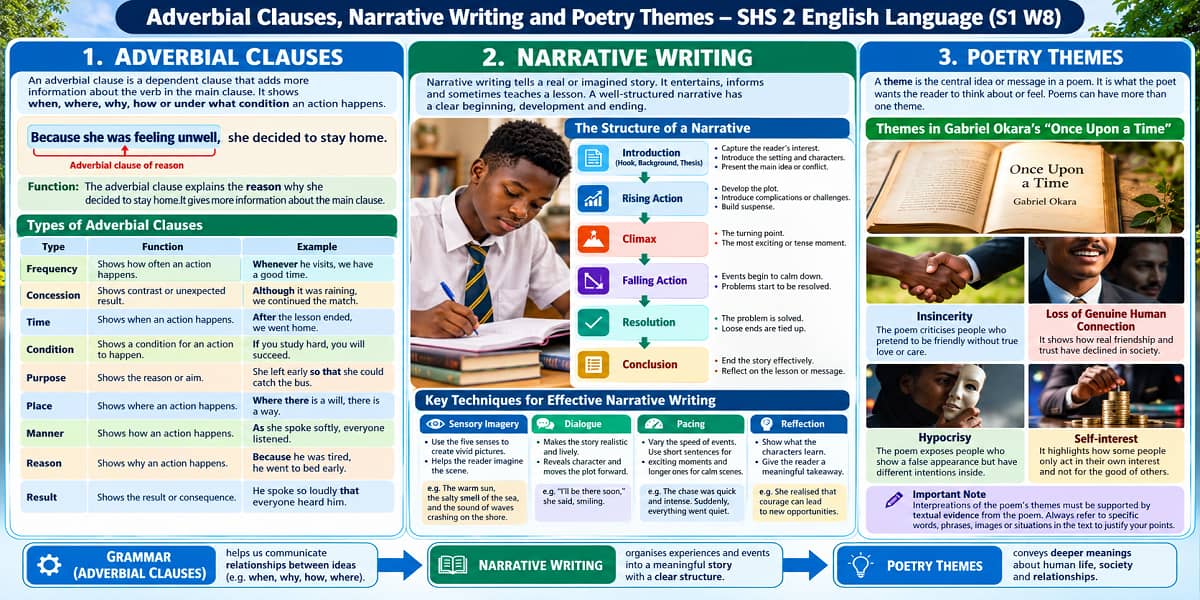
An adverbial clause is a dependent clause that functions like an adverb. It adds information about the action or situation in the main clause. The clause is dependent because it does not serve as a complete independent sentence in the way it is used here. It is valuable because it tells the reader how to understand the main action: when it happened, where it happened, how often it happened, how it happened, why it happened, what condition applied, what purpose was intended, what contrast existed or what result followed.
Nine relationships to recognise
| Relationship | Example | What the clause adds |
|---|---|---|
| Frequency | Whenever she visits her grandparents, she brings them fresh flowers. | The action happens each time she visits. |
| Concession | Although the experiment was difficult, the students completed it successfully. | Success contrasts with the difficulty. |
| Time | When the bell rings, the students rush to their next class. | The timing of the action. |
| Condition | If it rains tomorrow, we shall cancel the picnic. | The circumstance on which the decision depends. |
| Purpose | She saved money so that she could buy a new laptop. | The intended aim of saving. |
| Place | You can sit wherever you find a free seat. | The location related to the action. |
| Manner | Adoma solved the problem as if she were a professional mathematician. | How the problem was solved. |
| Reason | Because she was feeling unwell, she decided to stay home. | The explanation for the decision. |
| Result | Aziz studied so hard that he aced all his exams. | The outcome of studying hard. |
These categories matter because similar-looking sentences can communicate different relationships. Purpose concerns an intention; result concerns an outcome. A condition states what must or may happen for another action to follow, while concession introduces a contrast between an obstacle and an outcome. To identify the clause accurately, ask what relationship the whole sentence expresses rather than relying only on a single word.
From grammatical label to interpretation
When asked for a grammatical name and function, give two parts to your answer. First, name the clause. Second, explain its role in the sentence. In “Because she was feeling unwell, she decided to stay home,” the expression beginning with because is an adverbial clause of reason. Its function is to explain why she stayed home. In “The presentation was so captivating that the audience was left in awe,” the clause beginning with that expresses result: it describes the audience’s response to the captivating presentation.
This distinction is useful beyond grammar exercises. When explaining an event, a writer who clearly distinguishes reason, condition and result makes the account easier to follow. The reader can understand what prompted an action, what it depended on and what followed from it.
Narrative Writing: Turning Events into a Meaningful Story
People remember experiences as more than bare lists of actions. A story may contain anticipation, uncertainty, a turning point and a new understanding. Narrative writing uses this movement to engage readers and communicate the significance of an experience.
A narrative essay may recount a personal experience, often using the first person. It commonly includes characters, a setting, descriptive language, dialogue, sensory details, an engaging opening, connected paragraphs and a conclusion. Reflection is important because it allows the writer to explain what the experience meant or how it changed the narrator’s understanding.
The story’s architecture
The introduction can be planned using HBT: Hook, Background and Thesis. The hook draws the reader in; the background establishes the circumstances; and the thesis previews the story and why it matters. Rising action develops the events and builds tension. The climax is the critical turning point. Falling action presents the consequences, and the resolution addresses the central conflict. The conclusion summarises the experience and offers final thoughts or reflection.
This structure is a guide, not a demand that every story follow exactly the same order. A non-linear narrative may present events out of sequence, but transitions must orient the reader and make the relationships between events understandable. Without such guidance, a reader may struggle to distinguish a memory, an earlier event and what is happening in the present.
Why sensory details matter
Imagery helps readers form a mental picture of an experience. Sensory language draws on sight, sound, smell, taste and touch. Compare a general statement such as The room was unpleasant with a more specific description: I stepped into the dim room, where the smell of damp wood lingered and a loose window rattled in the wind. The second sentence gives the reader details that can be imagined rather than simply telling the reader what to think.
Strong description is purposeful, not excessive. A writer should select sensory details that establish the setting, reveal a character’s feelings or sharpen an important moment. Too many unrelated details can slow the story and distract from its central event. Figurative language can deepen the effect: a simile makes a comparison using like or as; a metaphor describes one thing in terms of another; personification gives human qualities to something non-human; hyperbole exaggerates for emphasis; and alliteration repeats initial consonant sounds.
Style, pacing and dialogue
Style is the writer’s distinctive way of expressing ideas. It includes tone, vocabulary, sentence arrangement, pacing, dialogue, imagery and figurative language. Tone shapes the reader’s impression of the narrator: a reflective tone may emphasise learning, while a humorous tone may present an event differently. Pacing controls how quickly events unfold. A short sentence can intensify a moment, while a longer sentence may allow room for reflection. Dialogue can reveal character and relationships, but should have a purpose within the story.
Transitions such as after that, meanwhile, before long and eventually can help connect events. Coherence depends on more than transitions alone: the events must relate to the main experience, the paragraphs must develop the story, and the ending must make sense in light of what came before.
Planning a story with a clear message
Take the saying “No pain, no gain.” A narrative might follow a learner who enters a competition without preparing adequately. During practice, the learner struggles and makes a serious mistake. This becomes a turning point: the learner begins practising regularly and seeks feedback. Improvement follows, and the narrator reflects on the relationship between sustained effort and progress. The message grows out of the sequence rather than being added as an unrelated statement.
Another narrative could end with “It was a blessing in disguise.” The narrator misses a trip because of an unexpected problem and initially feels disappointed. Later, the narrator learns that the absence kept them away from a difficulty affecting the group. The conclusion reflects on why the event appeared negative at first but later seemed beneficial. Such a plan gives the writer a clear route from the opening problem to a meaningful ending.
Poetry: Reading Beyond the Surface
Poetry often compresses meaning into a small number of words. Images, contrasts, tone and repeated ideas can make a poem suggest more than it states directly. Readers therefore need to connect specific details to a larger interpretation. A theme is the central idea or insight a poem explores; it is not simply the name of its subject.
In Gabriel Okara’s poem “Once Upon a Time,” the speaker addresses his son and remembers how people behaved in the past. The speaker recalls that they used to laugh “with their hearts” and “with their eyes,” but says that now they “only laugh with their teeth.” The contrast encourages readers to question whether a visible smile always signals genuine happiness or goodwill.
Images of warmth, coldness and self-interest
The phrase “ice-block-cold eyes” strengthens the impression that the people described have become emotionally distant or insincere. The speaker says that these eyes search “behind my shadow,” suggesting suspicion. The remembered handshake was made “with their hearts”; now people shake hands “without hearts,” while their left hands search the speaker’s empty pockets. The handshake, normally associated with greeting or connection, becomes an image of a gesture that may conceal an interest in personal gain.
The poem also describes something that once seemed “a giant as tall as / Rice stacks” shrinking “to less than a peanut,” while something mighty now lies in a whisper. The images of shrinking and quietness suggest a loss of former size, power or significance. Their full meaning emerges when readers consider the larger contrast between the past and present described by the speaker.
Possible themes and textual evidence
One possible theme is insincerity: the difference between laughter with the heart and laughter with the teeth suggests a gap between outward expression and inner feeling. Another is the loss of genuine human connection, because the speaker contrasts warm, heartfelt interactions with colder present behaviour. The poem can also be read in terms of hypocrisy, where a friendly outward appearance conceals a different intention, and self-interest, suggested by the image of hands searching the speaker’s empty pockets.
These interpretations overlap but are not identical. Insincerity describes a lack of genuine feeling; hypocrisy concerns a misleading presentation; self-interest highlights the pursuit of personal gain. A convincing interpretation explains how the image or contrast supports the proposed theme. Simply naming a theme is less persuasive than showing the textual evidence and explaining the connection.
Finding common themes across poems
When comparing poems, begin by identifying what each poem explores. Then look for an idea shared by the texts, such as love, hard work, commitment, nature, hatred or insincerity, only where the poems support that connection. Examine how each poet develops the idea through imagery, tone, the speaker’s perspective and contrasts. Two poems may address the same subject but reach different conclusions about it. For instance, one poem about friendship might celebrate trust, while another explores betrayal. The subject overlaps, but the theme and the way it is developed may differ.
This approach also encourages careful discussion. Readers may offer different interpretations, but interpretations should be grounded in the language and images of the poem. Evidence allows a reader to explain not only what they think the poem means, but why that reading is reasonable.
Bringing the Three Skills Together
Grammar, narrative and poetry support different stages of understanding. Adverbial clauses make the relationships between events and ideas explicit. Narrative structure helps a writer organise events so that readers can follow the development and understand the outcome. Poetry asks readers to interpret the relationships between images and ideas, often by examining contrasts between what appears on the surface and what may lie beneath it.
These skills can be practised through a simple sequence. First, explain an event using clauses that show reason, time, condition or result. Next, organise an experience into an introduction, rising action, climax, falling action, resolution and conclusion. Then read a poem closely, identify an important contrast and support a possible theme with textual evidence. In each case, ask what each part contributes to the overall meaning.
Questions for Reflection
- What is the difference between purpose and result in an adverbial clause?
Purpose expresses an intended aim, as in saving money so that a laptop can be bought. Result expresses an outcome, as in studying so hard that one aces the exams. - Why is sensory detail useful in a narrative?
It helps the reader imagine the setting or experience and can reveal atmosphere, character or the significance of a moment. - What is the role of the climax?
It is the most intense or critical moment and acts as a turning point in the story. - Give one possible theme in “Once Upon a Time” and explain the evidence.
Insincerity is a possible theme. The contrast between laughing with hearts in the past and laughing with teeth in the present suggests that outward friendliness may hide a lack of genuine feeling. - How can two poems share a subject but explore different themes?
They may discuss the same subject while presenting different attitudes or insights. Poems about friendship, for example, might explore trust in one case and betrayal in another.
Conclusion: Meaning Depends on Relationships
Clear communication depends on understanding how ideas relate. Adverbial clauses show relationships such as time, reason, condition, contrast and result. Narrative writing arranges events into a meaningful experience through structure, imagery, style and reflection. Poetry uses carefully selected words and images to invite interpretation, with themes best supported by textual evidence. Reading and writing become more effective when we ask not only what a sentence, story or poem contains, but how its parts work together to create meaning.
Access NaCCA-aligned Support Packs
Download your structured NaCCA-aligned Teacher Support Pack and Student Learning Pack, designed for clarity, practicality, and reliable teaching and learning.