Consonant Clusters, Fluent Reading and Subject–Verb Agreement
Introduction: Three Skills That Work Together
Imagine reading a passage aloud to your classmates. You need to pronounce the words clearly, read smoothly enough for listeners to follow the message, and understand how the words fit together in sentences. These are connected skills. Pronunciation helps listeners recognise words; fluent reading helps readers concentrate on meaning; and subject–verb agreement helps sentences communicate ideas accurately.
This lesson develops three areas of English Language: consonant clusters, the importance of reading fluently, and concord or subject–verb agreement. You will practise difficult word patterns, explore the features and benefits of fluent reading, and apply agreement rules in sentences and paragraphs.
1. Oral Language: Consonant Clusters
What is a consonant cluster?
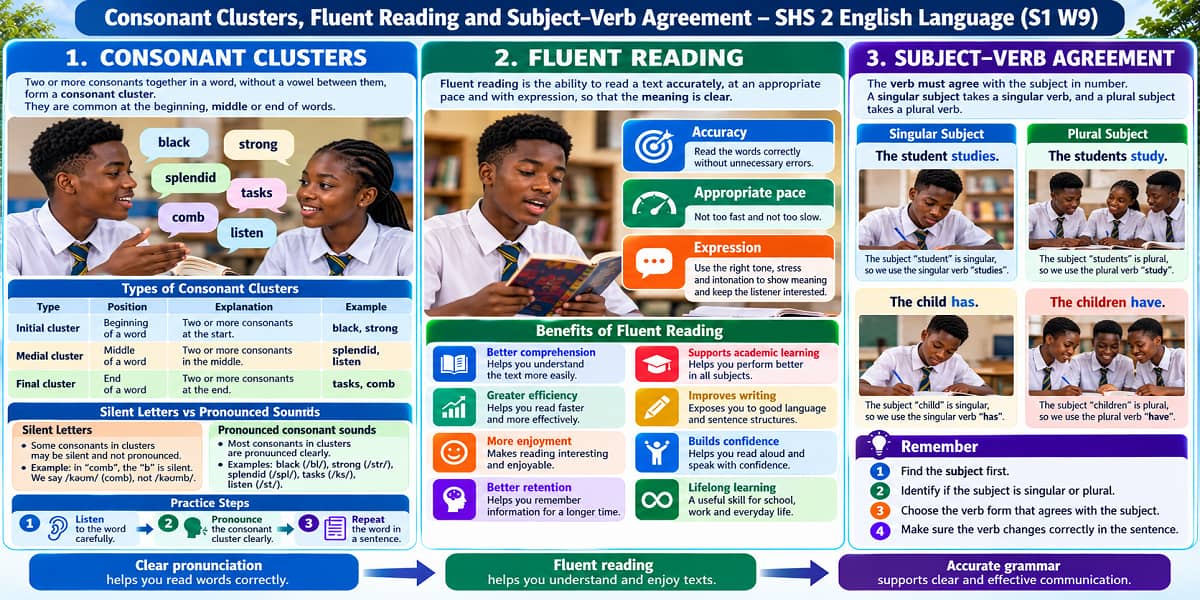
A consonant cluster is a sequence of consonant sounds occurring together in a word without a vowel sound separating the consonants in that sequence. Clusters may occur at the beginning, middle or end of words. For accurate pronunciation, listen carefully to the sounds and pronounce the required consonants without adding, omitting or exchanging sounds.
English words contain patterns that may be unfamiliar to speakers whose first languages use different consonant combinations. This can affect how some English words are pronounced. The aim of practice is not to ridicule an accent or a learner’s background. It is to help every learner communicate clearly and confidently, with patient repetition and constructive feedback.
Practising clusters in connected speech
Pronouncing a word correctly on its own is useful, but communication often requires us to say it as part of a sentence. Practise the following sentences slowly first. Then repeat them at a comfortable speaking pace while keeping the consonant sounds clear.
- The black cat slid across the ice.
- The class played flag football on the muddy ground.
- The brown cow cried out for her friend.
- Emily was happy with the results of the trial.
- The strong wind blew the leaves off the trees.
- The bright stars twinkled in the night sky.
- The strict teacher assigned challenging homework.
- The splendid fireworks lit up the dark sky.
- The scruffy dog chased its tail enthusiastically.
As you practise, avoid rushing through the sentence. Begin with the difficult word, say it clearly, then place it back into the sentence. Gradually increase the pace without losing accuracy. A partner can listen and point out a word that needs another attempt, using respectful feedback rather than laughter or imitation.
Common pronunciation difficulties
Some learners may omit, exchange or alter sounds in English consonant clusters. Differences between English and a learner’s first language can contribute to these difficulties. The goal is to notice the specific sound pattern and practise it carefully.
The /s/ and /k/ sequence: In words such as ask, task, mask, desk, tasks, talks and desks, the sequence of sounds may be difficult to articulate. Some speakers interchange sounds or omit part of the sequence. Practise slowly and check that the intended sounds remain in the word.
The /r/ and /l/ distinction: Some learners substitute one sound for the other. Practise words such as prep, pregnant, primary, from and fries. Say each word clearly, listen to a model when available, and repeat it in a short phrase.
The “th” sound: In words such as this, the, though, through, theme, theatre, tenth, fifth and twentieth, the “th” spelling represents a sound that may be replaced by another sound during pronunciation. Pay special attention to whether it occurs at the beginning or end of the word. Listen and practise rather than assuming that spelling alone tells you how to produce the sound.
Silent consonant sounds and silent letters
Some words contain letters that are not pronounced in the usual way. These must be learned through careful listening and practice. Examples with a silent b include comb, numb, bomb, breadcrumb, succumb, tomb, climb, thumb, plumb, limb, womb, lamb, crumb and subtle.
Other examples with silent letters include listen, whistle, thistle, castle, apostle, Christmas, answer, autumn, know, aisle, isle, exhaust, debt, mnemonic, pseudo, solemn, pneumonia, knead and wring. Do not assume that every written consonant must be spoken. Learn the pronunciation of the whole word and notice which sounds are heard and which letters remain silent.
Guided pronunciation practice
Activity A: Read the following words aloud: continue, filter, cornhusks, thrift, vulcaniser, facemasks, shrink, language, fringe, multitasks, sprinkle, problem, tenth, spleen and jingles.
Suggested method: Read each word slowly, identify the consonant sequence that feels difficult, repeat the word, and then use it in a short sentence. Compare your pronunciation with a reliable spoken model if one is available. Different words may require different practice; do not treat every difficulty as the same sound problem.
Activity B: Put five words in each category: initial cluster, medial cluster and final cluster.
| Initial cluster | Medial cluster | Final cluster |
|---|---|---|
| black | splendid | tasks |
| brown | problem | desks |
| strong | whistle | talks |
| bright | Christmas | masks |
| strict | answer | fringe |
These are practice examples. When classifying a word, focus on the position of the cluster you are studying and the sounds actually pronounced. A word may contain more than one consonant sequence.
2. Reading: The Importance of Reading Fluently
What is fluent reading?
Reading fluently means reading with appropriate accuracy, pace and expression so that the reader can follow the text and communicate its meaning. Fluency is not simply reading as fast as possible. If a reader rushes and loses words, ignores punctuation or cannot explain what was read, speed alone has not produced effective reading.
Fluent reading allows more attention to be given to the message instead of struggling with every individual word. It also supports oral communication because listeners can follow a reader whose words and phrasing are clear. Pronunciation practice and reading fluency therefore reinforce each other.
Benefits of fluent reading
- Comprehension: Readers can focus more on understanding the text rather than decoding each word separately.
- Efficiency: Fluent reading can save time and mental effort, allowing information to be processed more smoothly.
- Enjoyment: A text that is easier to follow can become more engaging and encourage further reading.
- Retention: When attention is available for meaning, readers may remember more of what they have read.
- Academic success: Reading fluently helps learners access and understand texts across different subjects.
- Writing development: Reading exposes learners to vocabulary, sentence patterns and ways of organising ideas that can support their writing.
- Confidence: Regular practice can help readers approach challenging texts with greater assurance.
- Lifelong learning: Reading fluently supports continued learning and the exploration of new ideas.
Practise reading with purpose
Read a passage aloud more than once. On the first reading, concentrate on recognising the words accurately. On the next reading, notice punctuation and group words into meaningful phrases. On a further reading, work on a comfortable pace and suitable expression. After reading, explain the main events or ideas to check whether the meaning was understood.
One useful activity is model reading. A learner or facilitator reads a passage fluently while others listen for clarity, phrasing and expression. The class can then discuss what made the reading easier to follow. If comparing more fluent and less fluent reading, explain the purpose of the activity beforehand. Never turn it into a reason to ridicule a classmate. Every learner needs a respectful opportunity to practise and improve.
Paired reading can also help. One learner reads while a partner listens, then they exchange roles. Partners can point to a missed word, model a pronunciation or suggest a pause at punctuation. Chunking—reading groups of words as meaningful units—can make sentences easier to process. Games that briefly cover a word or group of words after it has been read can also be used to practise attention and reading flow.
Reading passage: “The Forgotten Lighthouse”
Read this passage aloud, concentrating first on accurate words and then on phrasing and meaning.
In a secluded coastal village, where the crashing waves whispered secrets to the wind, stood an old lighthouse. Its white paint had faded, and its lantern had long ceased to guide ships safely home. The villagers rarely visited it, believing it held no purpose anymore.
But one stormy night, as lightning forked across the sky, a young girl named Esther stumbled upon the lighthouse. She pushed open the creaky door, revealing a dusty interior. The air smelled of salt and memories. Esther’s curiosity led her up the spiralling staircase, each step echoing with the ghosts of keepers past.
At the top, she found a rusted lever. With a determined breath, she pulled it. To her surprise, the lantern flickered to life, casting its warm glow across the turbulent sea. Esther watched as ships altered their course, avoiding treacherous rocks. The lighthouse had regained its purpose.
As dawn broke, Esther sat by the window, mesmerised by the rhythmic sweep of light. She wondered about the keepers who had tended to this beacon, their stories etched into the walls. Perhaps they, too, had felt forgotten, like the lighthouse itself.
From that day on, Esther became the new keeper. She polished the glass, patched the roof, and listened to the waves. She understood that sometimes, even forgotten things could find their way back to purpose—a guiding light in the darkness.
Check your understanding: Who discovers the lighthouse? What does Esther find at the top? What changes after she pulls the lever? The answers are Esther; a rusted lever; and the lantern lights up, helping ships alter course and avoid dangerous rocks. These questions help connect fluent reading with comprehension.
3. Grammar: Concord (Subject–Verb Agreement)
What is subject–verb agreement?
Concord or subject–verb agreement means that the subject and verb agree in number and person. In the examples studied here, a singular subject generally takes a singular verb, while a plural subject takes a plural verb. Choosing the correct form makes a sentence clearer and more accurate.
Rule 1: Singular subjects
A singular subject generally takes a singular verb. For example: Kwame goes to school. Efua loves rice. The intensity of global warming has compelled a lot of people to purchase and use air conditioners. Selasi has the same birthday as Elikem. In each sentence, the subject determines the verb form. Do not choose a verb merely because a nearby noun is plural; identify the subject first.
Rule 2: Plural subjects
A plural subject generally takes a plural verb. For example: The children have a programme after church service. The trees have been shedding more leaves lately. Jack and Jill go up the hill daily. Their parents have been summoned to the school. When two subjects are joined by and, they commonly form a plural subject, as in Jack and Jill go.
Rule 3: Compound subjects and context
Compound subjects require attention to how the subjects are joined and to the meaning of the sentence. The examples include Perfect and Davis run a successful company together and Neither the dog nor the cat likes the horn of the car. In the first sentence, two people are joined by and, so the plural verb run is used. In the second, the verb form given is likes. Read the complete subject and sentence rather than selecting a verb without considering the structure.
Rule 4: Numbers and amounts
Pay attention to the noun or amount being described. Examples include Twenty students are attending the workshop, One book is missing from the shelf, Two hundred and five girls have reported to school, and One Cedi is all I have left. The grammatical subject and the way the amount is expressed determine the verb form in each example.
Rule 5: The pronoun “I”
The pronoun I takes forms such as have and make in the examples studied here, even though these forms may look like plural forms when compared with has and makes. For example: I have a pen. I make breakfast every morning. I intend doing it immediately. I eat my lunch at the opened canteen. Learn the verb form that agrees with the subject rather than applying a rule mechanically to every pronoun.
Apply concord
Activity A: Choose the correct verb.
- The student (studies / study) for the examination.
- The team (practises / practise) every day.
- The cat (sleeps / sleep) on the bed.
- The students (attends / attend) the party.
- The teacher, along with the students, (prepares / prepare) for the play.
- The new employee (learns / learn) the company policies.
Answers: 1. studies. 2. practises. 3. sleeps. 4. attend. 5. prepares. 6. learns. In sentence 5, the main subject is teacher; the phrase along with the students adds information but does not replace that subject.
Activity B: Correct the agreement errors.
- The team are going to the game.
- The student have finished their homework.
- The learner have been given a lot of exercise to do.
Suggested corrections: 1. The team is going to the game. 2. The student has finished their homework. 3. The learner has been given a lot of exercise to do.
Editing a paragraph
Read the paragraph and correct the verb and noun forms that do not agree in the intended sentences.
The team of scientist, led by Dr. Smith, performs experiment on a daily basis. The data they collects is then analysed by the research assistant. The conclusion they draws is that the hypothesis is correct. The team are excited to presents their findings at the conference. The principal investigator, Dr. Johnson, is pleased with the progress they has made. The research team are confident that their study will has a significant impact on the field.
One corrected version:
The team of scientists, led by Dr. Smith, performs experiments on a daily basis. The data they collect is then analysed by the research assistant. The conclusion they draw is that the hypothesis is correct. The team is excited to present its findings at the conference. The principal investigator, Dr. Johnson, is pleased with the progress they have made. The research team is confident that their study will have a significant impact on the field.
The corrections include plural nouns such as scientists and experiments, plural-subject verb forms such as collect and draw, and the forms present and will have. The main subject team is treated as singular in this corrected version, so it takes is. Check each sentence by locating its subject and identifying the verb form it requires.
4. Final Review
- What is a consonant cluster?
A sequence of consonant sounds occurring together without a vowel sound separating the consonants in that sequence. - Give two examples of words containing a silent letter.
Examples include comb, thumb, listen, castle, know and debt. - Why is fluent reading more than speed?
Because effective fluency combines accuracy, appropriate pace and expression to support understanding. - Give two benefits of fluent reading.
It can support comprehension and retention. Other benefits include efficiency, enjoyment, academic success, confidence, writing development and lifelong learning. - Correct the sentence: “The children has a programme.”
The children have a programme. - Why should a reader practise in a supportive environment?
Respectful practice builds confidence and gives learners the opportunity to improve without fear of ridicule.
Conclusion
Clear oral communication begins with careful pronunciation. Fluent reading combines accuracy, pace and expression so that meaning remains central. Concord helps speakers and writers select verb forms that agree with their subjects. Practise each skill regularly, listen attentively, check your understanding, and offer classmates feedback that is helpful and respectful. Progress comes from purposeful practice, not from embarrassment or rushing.
Access NaCCA-aligned Support Packs
Download your structured NaCCA-aligned Teacher Support Pack and Student Learning Pack, designed for clarity, practicality, and reliable teaching and learning.