Subtractive Processes In 3-D Art Forms
Introduction
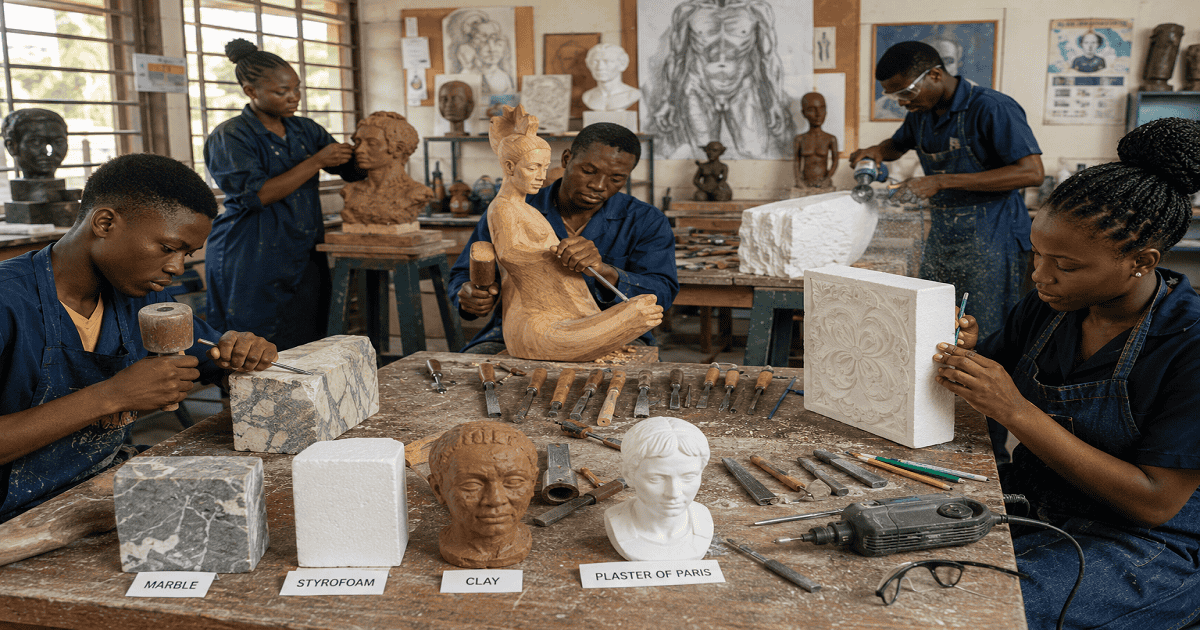
Subtractive processes in 3-D art forms involve removing material from a solid mass to create a desired shape or design. Carving is the most common subtractive process and is widely used with materials such as wood, stone, clay, plaster of Paris, and Styrofoam. Artists use specialised tools to cut, chip, scrape, or engrave surfaces in order to form artistic works.
Key Concepts
- Subtractive Process: A sculptural method where material is removed from a solid mass to create an artwork.
- Carving: The process of cutting or chipping away material from stone, wood, or other hard materials.
- Modelling: A sculptural technique involving shaping soft materials.
- Casting: A process of creating forms by pouring material into moulds.
- Assembling: Joining separate materials together to create a sculpture.
- Leatherhard Clay: Clay that is slightly dried and suitable for trimming, scoring, and carving.
Explanation
Subtractive sculpting involves systematically eliminating material from the outside inward until the desired form is achieved. This process is commonly used in carving wood, stone, wax, and clay.
There are four main sculptural techniques:
- Carving
- Modelling
- Assembling or constructing
- Casting
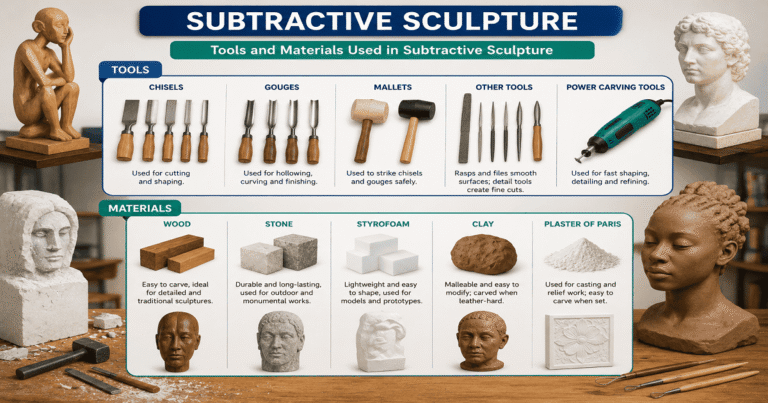
Carving is the major subtractive method. It requires tools that can cut, chip, scrape, or engrave surfaces. Artists use tools such as gouges, chisels, wooden mallets, engraving tools, electric pens, hand adzes, etching tools, and power carving tools.
Stone carving involves gradually removing pieces of stone using chisels, hammers, rasps, and carving equipment. Different stones have different hardness levels and carving properties.
Wood carving is another important subtractive process. Artists remove sections from logs or blocks of wood to reveal the intended form. In Ghana, common woods used for carving include Sese and Tweneboa. Tweneboa is soft, easy to carve, and often used in making drums.
Metals such as bronze can also be used in subtractive sculpture through etching, grinding, polishing, and refining processes.
Styrofoam is an inexpensive material that allows learners to explore texture, positive space, and negative space through carving activities.
Plaster of Paris is suitable for creating small blocks that can easily be carved into artistic forms. Leatherhard clay can be trimmed, smoothed, scored, burnished, painted, and joined during subtractive processes.
Soap can also be used for carving decorative designs because it is soft and easy to shape.
Safety is important in subtractive sculpture. Some stones may contain silica or asbestos, making respirators necessary during carving activities.
Tools And Materials For Subtractive Processes
| Tool/Material | Use | Characteristics |
|---|---|---|
| Gouges and Chisels | Cutting and shaping materials | Used for wood and stone carving |
| Wooden Mallet | Striking carving tools | Controls carving force |
| Engraving Tools | Creating detailed designs | Suitable for fine decorative work |
| Power Carving Tool | Fast material removal | Efficient for hard materials |
| Electric Pen | Surface engraving | Used for detail work |
| Hand Adze | Wood shaping | Traditional wood carving tool |
Properties Of Carvable Stones
| Stone | Colour | Hardness |
|---|---|---|
| Granite | Grey, black, browns, reds, greens | Very hard |
| Limestone | Grey and buff | Soft |
| Sandstone | Buff, reddish brown, grey | Medium to hard |
| Marble | White, greys, greens, reds, black | Medium to hard |
| Soapstone | Greys, greens, black | Very soft |
| Alabaster | White, beige, orange, yellow, red | Very soft |
Examples
Example 1
Problem: Identify suitable tools for carving wood.
- Consider tools used for cutting and shaping wood.
- Select tools suitable for subtractive carving.
- Identify tools that help create detailed designs.
Final Answer: Gouges, chisels, wooden mallets, hand adzes, and engraving tools are suitable for carving wood.
Example 2
Problem: Explain why Styrofoam is suitable for subtractive sculpture.
- Examine the texture and softness of Styrofoam.
- Consider ease of carving.
- Determine its suitability for classroom activities.
Final Answer: Styrofoam is suitable because it is inexpensive, easy to carve, and helps learners explore texture and space in sculpture.
Application and Activities
- Identify materials suitable for subtractive processes.
- Discuss the properties of carving tools and materials.
- Observe subtractive carving techniques through videos or studio visits.
- Analyse the importance of subtractive processes in art and design works.
Practice Questions
- List four materials suitable for subtractive sculpture.
- Explain three characteristics of carvable wood.
- Differentiate between subtractive processes in wood and stone carving.
Summary
Subtractive processes in 3-D art involve removing material from solid forms to create sculptures and designs. Carving is the most common subtractive technique and uses tools such as gouges, chisels, mallets, and engraving tools. Materials suitable for subtractive sculpture include stone, wood, metals, Styrofoam, plaster of Paris, leatherhard clay, and soap. Understanding the properties of these materials and tools helps artists create effective and safe sculptural works.
Access NaCCA-aligned Support Packs
Download your structured NaCCA-aligned Teacher Support Pack and Student Learning Pack, designed for clarity, practicality, and reliable teaching and learning.