Economics Starts from the Home and the Economist Explained for SHS 1 Economics (Sem. 1 – Week 1)
What does Economics have to do with everyday life?
More than you might think.
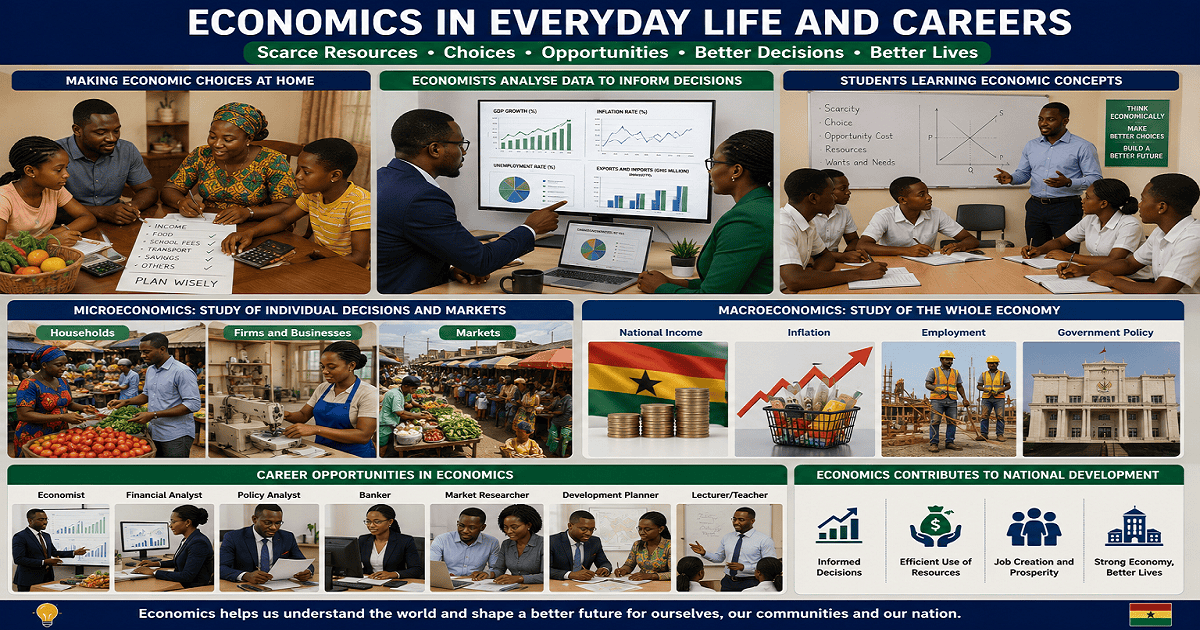
Every time people face limited resources and competing wants or needs, an economic decision becomes necessary. A household deciding how to use its available resources, a firm deciding how to allocate inputs, and a government deciding how to use public resources all face the problem of choice.
Scarcity Is Where Economics Begins
Human wants and needs can continue to grow, but the resources available to satisfy them are limited.
This is the fundamental problem that gives Economics its importance. Because resources are scarce, people cannot satisfy every want at the same time. They must choose.
In simple terms:
Limited Resources → Competing Wants and Needs → Choice → Allocation
This principle can be seen at home, in school, in businesses and throughout society.
Why the Home Is a Good Starting Point
A household offers a familiar example of scarcity.
Suppose the available resources in a home cannot satisfy every want and need. Someone has to decide how those resources will be used. Some wants may receive attention while others may not.
That decision-making process is economic.
Understanding this everyday experience makes it easier to understand why Economics studies the choices made by individuals, businesses and governments.
Goods and Services Are Everywhere
Economic activity involves both goods and services.
Goods are tangible items such as cars, houses, food and clothing. Services are intangible, including cleaning, teaching, health care and transport services.
| Goods | Services |
|---|---|
| Tangible items | Intangible items or activities |
| Cars, houses, food and clothing | Cleaning, teaching, health care and transport |
The distinction is useful because it helps us recognise the different forms through which economic wants and needs can be satisfied.
Where Do Products and Services Come From?
Production requires resources.
In Economics, resources are the factors or inputs used to produce goods and services. They are also known as factors of production.
The four resources identified are land, labour, capital and entrepreneurial ability.
The central issue remains scarcity: resources available for production are limited and therefore have to be allocated.
Who Makes the Choices?
Economic choices are made by economic agents.
These include households, firms, governments and other organisations involved in economic activities.
An economic agent makes decisions about the allocation of scarce resources in order to achieve particular objectives.
From the Household to the Economy
Once we understand economic choices at household level, we can widen the lens.
At one level, Economics examines individual households, firms and industries. At another, it examines the economy as a whole.
Two Ways of Looking at Economic Activity
| Microeconomics | Macroeconomics |
|---|---|
| Individual households, firms and industries | The economy as a whole |
| Resource allocation, market interactions and individual decision-making | GDP, inflation, unemployment, fiscal and monetary policies |
Microeconomics looks closely at individual economic units.
Macroeconomics takes the wider view and considers aggregate economic activity.
Not All Economic Statements Are Judgements
Economics also distinguishes between statements that describe economic reality and statements that express opinions about what should happen.
This distinction gives us positive and normative Economics.
Positive Economics: Describing What Is
Positive Economics deals with objective statements based on facts and data analysis. It describes and explains economic phenomena as they are without expressing opinions or value judgements.
For example:
“Ghana’s government introduced a program to provide free primary education, leading to increased enrollment and access to education.”
The statement presents an economic situation and its reported effect.
Normative Economics: Considering What Ought to Be
Normative Economics involves subjective value judgements.
For example:
“The government should provide subsidies for small farmers to promote agricultural productivity and food security.”
The statement is normative because it recommends what the government should do.
A Useful Question for Economic Reading
Whenever you encounter an economic statement, ask:
Is this describing what is, or arguing for what ought to be?
That question can help you distinguish positive from normative Economics.
The Economist: Turning Economic Knowledge into Analysis
An economist is a professional who studies and analyses the production, distribution and consumption of goods and services within an economy.
Economists use theories, models and empirical research to understand how economies function, identify trends and predict future developments.
This makes Economics a field that combines conceptual understanding with analysis and research.
Where Economists Work
Economists can work in both the private sector and the public sector.
The private sector consists of the part of the economy owned, controlled and operated by private individuals or entities. The public sector consists of the part owned, controlled and operated by government or its agencies.
Research and Data
One career direction is data analysis and research.
Economists can work as data analysts and research associates. Their work can involve analysing large datasets, conducting empirical studies and producing economic forecasts.
These skills can be relevant in academia, think tanks and research organisations.
Entrepreneurship and Innovation
Economic knowledge can also support entrepreneurship and innovation.
Understanding markets and consumer behaviour can help with identifying opportunities and making informed business decisions.
Policy and Social Impact
Economics also connects with policy and social issues.
Career possibilities include economic development specialist, environmental economist and social policy analyst.
These areas apply economic thinking to development, environmental and social policy questions.
Business and Finance
Economic analysis is also valuable in business and finance.
Career areas include:
- investment banking;
- financial analysis;
- market research; and
- consulting.
In these areas, economic analysis can contribute to decision-making.
Public-Sector Opportunities
Economists can also work in government agencies, central banks and international organisations.
Their work can contribute to policy-making and economic development.
A Career Field for Everyone
Economics careers are not limited by gender. Women as well as men can become economists and work across private and public sectors.
This broad range of opportunities means that learners can explore Economics according to their interests and strengths.
Economics as a Way of Thinking
Economics is not simply about memorising definitions.
It encourages learners to recognise scarcity, identify competing wants and needs, examine choices and understand how resources are allocated.
It also develops the ability to distinguish objective economic descriptions from subjective value judgements.
A Practical Economics Question
Suppose your school has limited resources and several important needs.
An economist would be interested in questions such as:
- What resources are available?
- What needs are competing for those resources?
- What choices have to be made?
- How should the resources be allocated?
These are economic questions because they involve scarcity and choice.
From Everyday Experience to Economic Analysis
The journey into Economics can therefore begin with something as simple as observing decisions at home.
From there, the same thinking can be applied to firms, governments and the economy as a whole.
The scale changes, but the central concern remains the allocation of limited resources among competing wants and needs.
A Compact Concept Map
Unlimited Wants and Needs
↓
Limited Resources
↓
Choice
↓
Allocation of Resources
↓
Economic Decisions by Households, Firms and Governments
Why This Foundation Matters
These concepts provide a foundation for understanding more advanced economic ideas.
If you understand why scarcity creates choice, you can better understand why economic agents have to make decisions. If you can distinguish microeconomics from macroeconomics, you can recognise whether an economic issue concerns individual units or the economy as a whole. If you can distinguish positive from normative statements, you can separate economic description from economic judgement.
Thinking About Your Future
Economics can also help learners begin exploring possible careers.
| Interest | Possible Economics Direction |
|---|---|
| Data and investigation | Data analysis and research |
| Business ideas | Entrepreneurship and innovation |
| Social and development issues | Economic development, environmental economics and social policy analysis |
| Finance | Investment banking and financial analysis |
| Markets and business decisions | Market research and consulting |
Three Ideas to Master
First: scarcity makes choice necessary.
Second: microeconomics studies individual economic units, while macroeconomics studies the economy as a whole.
Third: positive Economics concerns what is, while normative Economics concerns what ought to be.
These three ideas provide a powerful foundation for beginning the study of Economics.
Final Takeaway
Economics starts with a problem that can be observed almost anywhere: people have many wants and needs, but the resources available to satisfy them are limited.
That scarcity forces choices. Households, firms, governments and other economic agents must decide how available resources should be allocated.
From this foundation come the major ideas introduced in Week 1: goods, services, resources, economic agents, microeconomics, macroeconomics, positive Economics, normative Economics and the economist as a professional.
The subject also opens doors to careers in research, data analysis, entrepreneurship, policy, economic development, social impact, government, business and finance.
Once you learn to recognise scarcity and choice in everyday life, you have already begun to think like an economist.
Access NaCCA-aligned Support Packs
Download your structured NaCCA-aligned Teacher Support Pack and Student Learning Pack, designed for clarity, practicality, and reliable teaching and learning.