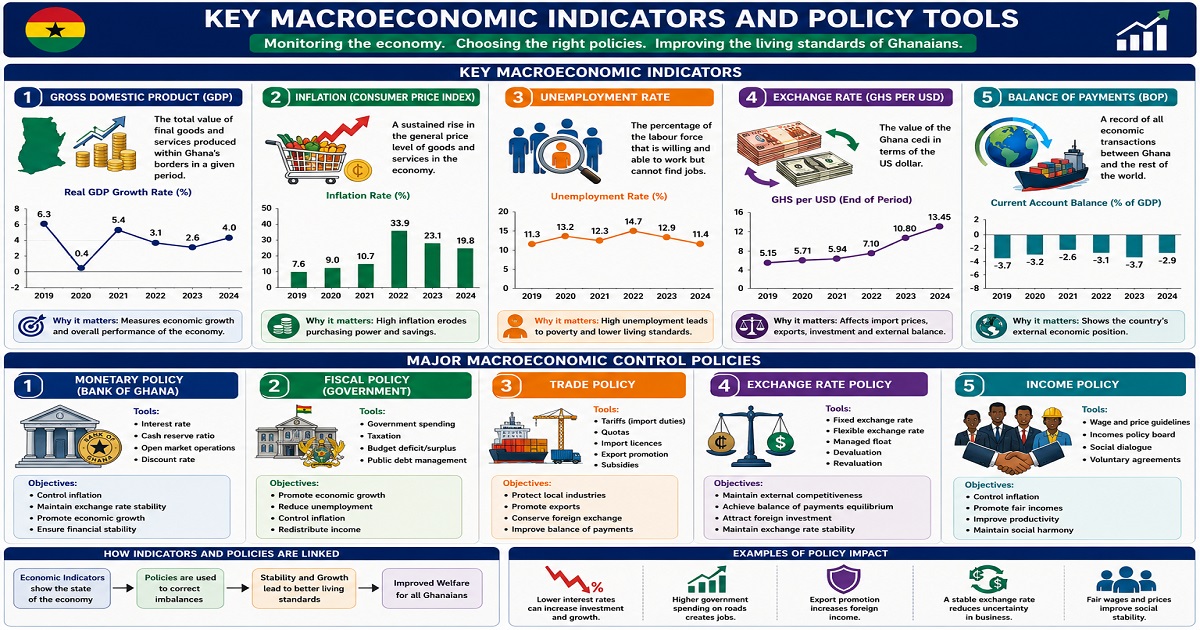
Macroeconomic Variables And Control Policies
Introduction
Macroeconomics studies the overall behaviour and performance of a country’s economy. It focuses on major economic variables such as Gross Domestic Product (GDP), inflation, unemployment, and exchange rates. Changes in these variables can significantly affect economic growth, living standards, investment, employment, and national development. Governments and central banks use control policies to manage these changes and promote economic stability.
Key Concepts
- Macroeconomics: The branch of economics that studies the overall performance of an economy.
- Gross Domestic Product (GDP): The total value of goods and services produced within a country’s borders.
- Inflation: The rate at which the general price level of goods and services rises.
- Deflation: A general decline in prices across an economy.
- Unemployment: A situation where people willing and able to work cannot find jobs.
- Exchange Rate: The value of one country’s currency in relation to another currency.
- Monetary Policy: Measures used by the central bank to influence money supply and interest rates.
- Fiscal Policy: Government spending and taxation policies used to influence economic activity.
- Trade Policy: Government measures regulating international trade.
- Income Policy: Government measures used to control wages and prices.
Explanation
GDP measures the total value of goods and services produced within a country. It is an important indicator of economic performance, growth, living standards, investment, and employment. Changes in inflation, unemployment, and exchange rates directly affect GDP.
Inflation refers to a rise in the general price level of goods and services. Moderate and stable inflation can stimulate spending and investment because consumers and businesses prefer to spend or invest money before prices rise further. Inflation may also reduce the real value of debt and support wage adjustments.
However, high and unpredictable inflation can create uncertainty, reduce purchasing power, increase production costs, discourage investment, and slow economic growth. Deflation can also be harmful because it may reduce spending and investment.
Unemployment occurs when individuals capable of working are unable to find employment. High unemployment generally reduces GDP because unemployed individuals have lower incomes and spend less. It may also reduce business investment, productivity, and government tax revenue while increasing government expenditure on welfare programs.
In some cases, unemployment may put downward pressure on wages and encourage the movement of resources into more productive sectors. Nevertheless, persistent unemployment often harms long-term economic growth.
Exchange rates represent the value of one currency relative to another. A weak currency can boost exports, encourage domestic production, attract tourism, and stimulate foreign investment. However, it may also increase inflation, reduce purchasing power, increase debt burdens, and create business uncertainty.
A strong currency can reduce inflation, increase purchasing power, lower debt burdens, attract investment, and reduce production costs. On the other hand, it may reduce export competitiveness, discourage tourism, increase imports, and contribute to trade deficits.
Governments and central banks use control policies to reduce the negative effects of changes in macroeconomic variables and maintain economic stability.
Effects Of Inflation On GDP
| Effect Type | Impact | Outcome For GDP |
|---|---|---|
| Positive | Stimulates spending and investment | Can increase GDP growth |
| Positive | Reduces real value of debt | Encourages economic activity |
| Negative | Creates uncertainty | Reduces investment |
| Negative | Reduces purchasing power | Lowers consumption |
| Negative | Raises production costs | Reduces profitability and output |
Effects Of Unemployment On GDP
| Effect | Description | Economic Impact |
|---|---|---|
| Reduced Consumption | Lower household spending | Reduces GDP |
| Lower Investment | Reduced business confidence | Slows growth |
| Lost Productivity | Idle labour resources | Reduces output |
| Lower Tax Revenue | Fewer employed taxpayers | Constrains public spending |
| Increased Welfare Spending | More government support programs | Strains public finances |
Exchange Rate Effects
| Exchange Rate Condition | Positive Effects | Negative Effects |
|---|---|---|
| Weak Currency | Boosts exports, tourism, domestic production, and investment | Higher inflation, lower purchasing power, debt burden |
| Strong Currency | Lower inflation, increased purchasing power, attracts investment | Reduced exports, lower tourism, possible trade deficits |
Control Policies
Monetary Policy is implemented by the central bank. Expansionary monetary policy lowers interest rates and increases money supply to combat unemployment, while contractionary monetary policy raises interest rates and reduces money supply to control inflation.
Fiscal Policy involves government spending and taxation. Expansionary fiscal policy increases spending or reduces taxes to stimulate economic activity, while contractionary fiscal policy reduces spending or increases taxes to control inflation.
Exchange Rate Policy manages the value of a country’s currency through fixed, floating, or managed float systems.
Trade Policy includes tariffs, quotas, and trade agreements designed to regulate international trade.
Income Policy involves wage and price controls and indexation policies to help manage inflation.
Examples
Example 1
Problem: Explain how moderate inflation can support GDP growth.
- Identify the effect of moderate inflation on spending.
- Determine its impact on investment.
- Relate the outcome to GDP.
Final Answer: Moderate inflation encourages consumption and investment, which can increase economic activity and support GDP growth.
Example 2
Problem: Explain one negative effect of a strong currency exchange rate.
- Identify how a strong currency affects export prices.
- Determine its effect on foreign demand.
- Relate the outcome to GDP.
Final Answer: A strong currency makes exports more expensive abroad, which may reduce export demand and slow economic growth.
Application and Activities
- Discuss how inflation affects households and businesses.
- Compare the effects of unemployment on GDP.
- Examine examples of currency appreciation and depreciation.
- Identify control policies used in Ghana to manage economic challenges.
Practice Questions
- Define inflation and unemployment.
- Explain two effects of exchange rate changes on GDP.
- Discuss how monetary and fiscal policies help stabilise the economy.
Summary
Macroeconomic variables such as inflation, unemployment, and exchange rates have significant effects on GDP and overall economic performance. Moderate inflation can stimulate growth, while excessive inflation and unemployment can reduce economic activity. Exchange rate movements affect exports, imports, investment, and purchasing power. Governments and central banks use monetary, fiscal, exchange rate, trade, and income policies to manage these challenges and promote economic stability and sustainable growth.
Access NaCCA-aligned Support Packs
Download your structured NaCCA-aligned Teacher Support Pack and Student Learning Pack, designed for clarity, practicality, and reliable teaching and learning.