Market And Its Types
Introduction
A market is an important institution in every economy because it brings buyers and sellers together to exchange goods, services, and resources. Markets facilitate trade, help determine prices, allocate resources efficiently, and contribute to economic growth. Markets may exist as physical locations or online platforms and can operate locally, nationally, or internationally.
Key Concepts
- Market: A system, environment, or arrangement where buyers and sellers interact to exchange goods, services, or resources.
- Demand: The willingness and ability of consumers to purchase goods and services at a given price.
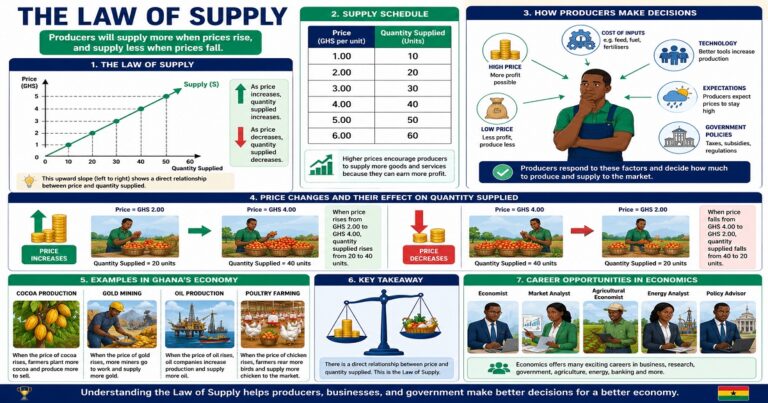
- Supply: The willingness and ability of producers to offer goods and services for sale.
- Equilibrium Price: The price at which quantity demanded equals quantity supplied.
- Physical Market: A market where buyers and sellers meet face-to-face to conduct transactions.
- Online Market: A market that operates through internet platforms and facilitates virtual transactions.
- Product Market: A market for the exchange of tangible goods.
- Service Market: A market for the exchange of intangible services.
- Labour Market: A market where labour services are exchanged between employers and job seekers.
- Black Market: An illegal or unauthorized market that operates outside government regulations.
Explanation
A market is a system or environment where buyers and sellers interact to exchange goods, services, or resources. It facilitates voluntary exchange based on mutual agreement and pricing. Buyers express their demand by being willing to pay a certain price, while sellers provide supply by offering goods and services at specific prices. The interaction between demand and supply determines the equilibrium price and quantity in the market.
Markets play a significant role in resource allocation, price discovery, competition, and economic growth. They are influenced by factors such as consumer preferences, production capabilities, technological advancements, government policies, and global economic conditions. Markets may exist as physical locations such as shopping malls and traditional markets or as online platforms such as e-commerce websites.
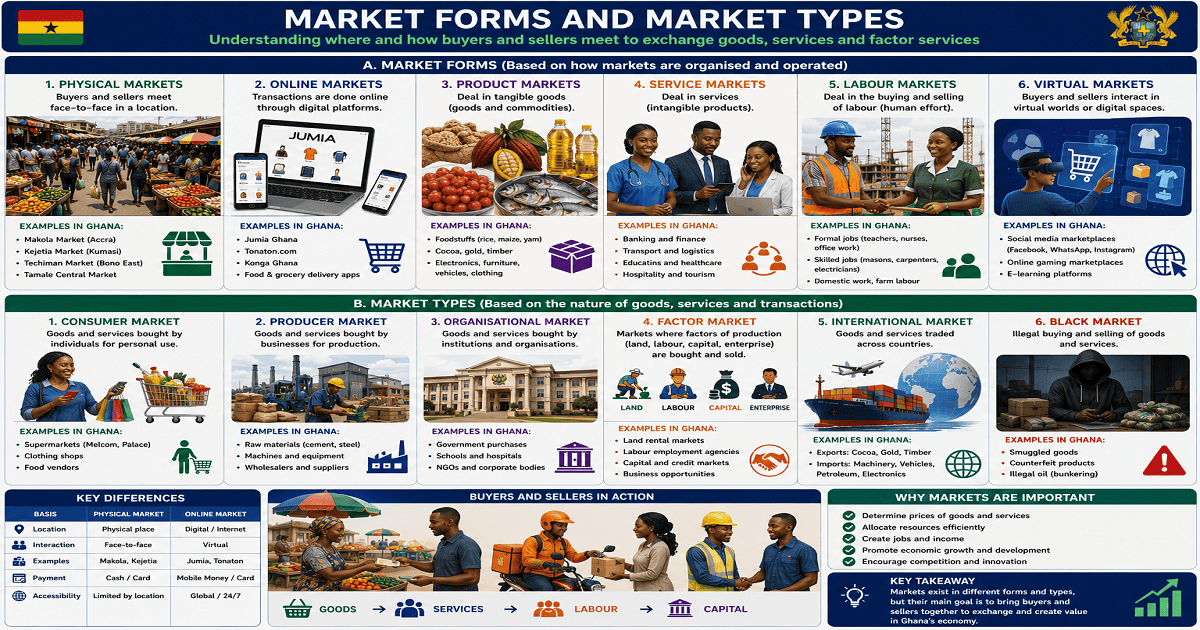
There are two main forms of markets:
Physical Markets involve direct face-to-face transactions between buyers and sellers in a physical location. Examples include traditional markets, farmers’ markets, retail stores, shopping malls, and Melcom outlets.
Online Markets operate through internet platforms and enable virtual transactions. Examples include Jumia Ghana, Zoobashop, and Melcom Online. These platforms allow buyers and sellers to interact without being physically present in the same location.
Markets can also be classified into different types based on what is exchanged.
Product Markets deal with tangible goods such as food, electronics, clothing, machinery, and raw materials.
Service Markets involve the exchange of intangible services such as healthcare, financial services, education, housing, and professional services.
Labour Markets facilitate the exchange of labour services between employers and job seekers through recruitment agencies, job fairs, and online job portals.
Virtual Markets are online communities where virtual goods and digital products are bought and sold, such as gaming economies and digital marketplaces.
Black Markets involve illegal trading activities that operate outside official regulations and government controls.
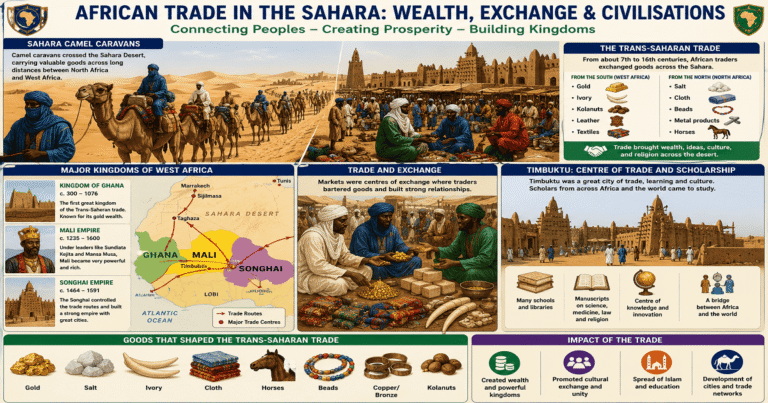
Examples of major markets in Ghana include Makola Market in Accra, Kejetia Market in Kumasi, Techiman Market, Tamale Central Market, Takoradi Market Circle, and Jumia Market. These markets support commerce, employment, and economic development.
Forms Of Markets
| Form Of Market | Description | Examples |
|---|---|---|
| Physical Market | Face-to-face transactions in a physical location | Makola Market, Kejetia Market, Melcom |
| Online Market | Transactions conducted through internet platforms | Jumia Ghana, Zoobashop, Melcom Online |
Types Of Markets
| Type Of Market | Goods Or Services Exchanged | Examples |
|---|---|---|
| Product Market | Tangible goods | Food, clothing, electronics |
| Service Market | Intangible services | Healthcare, education, banking |
| Labour Market | Labour services | Job fairs, recruitment agencies |
| Virtual Market | Digital and virtual products | Gaming economies |
| Black Market | Illegal goods and services | Unauthorized trade activities |
Examples Of Markets In Ghana
| Market | Location | Main Activities |
|---|---|---|
| Makola Market | Accra | Trading in textiles, food, electronics, and household items |
| Kejetia Market | Kumasi | Trading in food, clothing, handicrafts, and electronics |
| Techiman Market | Techiman | Agricultural products and tubers |
| Tamale Central Market | Tamale | Foodstuffs, livestock, handicrafts, and clothing |
| Takoradi Market Circle | Takoradi | General trading activities |
| Jumia Market | Online Platform | E-commerce and online transactions |
Examples
Example 1
Problem: Differentiate between a physical market and an online market.
- Identify how transactions occur in a physical market.
- Identify how transactions occur in an online market.
- Compare the two forms of markets.
Final Answer: Physical markets involve face-to-face transactions in a physical location, while online markets operate through internet platforms and facilitate virtual transactions.
Example 2
Problem: Classify a recruitment agency as a type of market.
- Identify the service being exchanged.
- Determine the participants involved.
- Classify the market type.
Final Answer: A recruitment agency operates within the labour market because it facilitates the exchange of labour services between employers and job seekers.
Application and Activities
- Identify markets within your community and classify them according to their forms and types.
- Discuss experiences from visits to physical and online markets.
- Compare the advantages of online and physical markets.
- Research major markets in Ghana and their economic importance.
Practice Questions
- Define a market.
- Differentiate between physical markets and online markets.
- Explain three types of markets and provide examples of each.
Summary
A market is a system where buyers and sellers interact to exchange goods, services, and resources. Markets facilitate trade, determine prices, and support economic growth. The two main forms of markets are physical markets and online markets. Major market types include product markets, service markets, labour markets, virtual markets, and black markets. Ghana has several important markets such as Makola Market, Kejetia Market, Techiman Market, Tamale Central Market, Takoradi Market Circle, and Jumia Market.
Access NaCCA-aligned Support Packs
Download your structured NaCCA-aligned Teacher Support Pack and Student Learning Pack, designed for clarity, practicality, and reliable teaching and learning.