
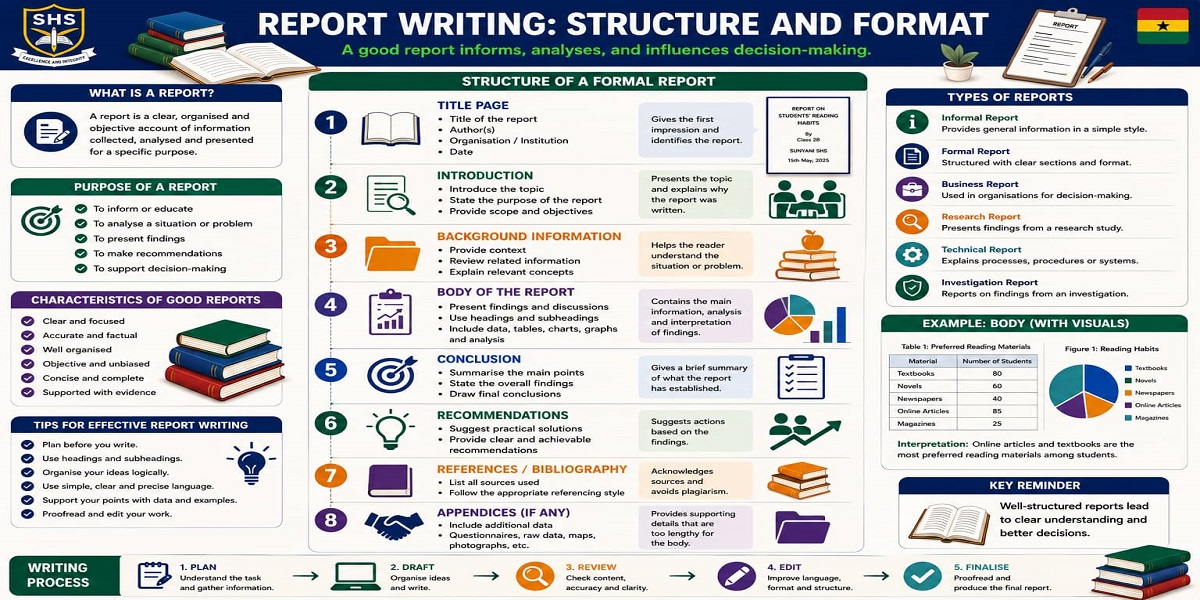
Report Writing Structure And Format
Introduction
Report writing is an important communication skill that enables individuals to present information, findings, analyses, and recommendations in a clear and organised manner. Learners study the meaning, types, structure, significance, and key features of report writing to improve their ability to communicate complex information professionally and effectively.
Key Concepts
- Report Writing: The process of compiling and organising information, data, and research into a structured document that presents findings, analyses, and recommendations.
- Formal Report: An official document with a formal tone and structure.
- Technical Report: A detailed document presenting research or technical information.
- Business Report: A report used for analysing market trends, finances, and planning.
- Research Report: A systematic presentation of research findings and methodology.
- Progress Report: A report providing updates on project status and challenges.
- References: Sources cited in a report to acknowledge information and avoid plagiarism.
Explanation
Report writing is the process of compiling and organising information, data, and research into a concise and structured document. Reports communicate findings, analyses, and recommendations to support decision-making or document events.
There are different types of reports used for various purposes. These include formal reports, informal reports, technical reports, business reports, research reports, investigative reports, progress reports, feasibility reports, compliance reports, and incident reports. Each type is designed to meet the needs of a specific audience or purpose.
Types Of Report Writing
| Type | Description | Purpose |
|---|---|---|
| Formal Report | Official and structured document | Business and academic use |
| Technical Report | Presents technical information | Scientific and engineering fields |
| Business Report | Analyses trends and performance | Corporate decision-making |
| Research Report | Presents research findings | Academic studies |
| Progress Report | Provides project updates | Project management |
| Incident Report | Records events or accidents | Legal and investigative purposes |
A report follows a logical structure. It begins with an introduction containing an overview, purpose, and scope. This is followed by background information, the body containing evidence and analysis, the conclusion, recommendations where necessary, and references. References are mandatory because they help avoid accusations of plagiarism.
Structure Of Report Writing
| Section | Content | Purpose |
|---|---|---|
| Introduction | Overview, purpose, and scope | Introduces the report |
| Background Information | Context and definitions | Provides supporting information |
| Body | Evidence, analysis, and interpretation | Presents findings |
| Conclusion | Summary and recommendations | Brings the report to a close |
| Recommendations | Suggested actions | Improves decision-making |
| References | Sources consulted | Avoids plagiarism |
Reports are important because they facilitate communication, provide documentation, present analysis and insight, support decision-making, and promote learning and development.
Significance Of Report Writing
| Importance | Description |
|---|---|
| Communication | Conveys information and ideas |
| Documentation | Provides records of activities and events |
| Analysis And Insight | Presents interpretation of information |
| Decision-Making | Supports problem-solving |
| Learning And Development | Promotes knowledge acquisition |
Effective reports possess qualities such as a clear purpose, organised structure, objective language, concise writing, accurate content, proper formatting, references, relevance, timeliness, and the use of visual aids where appropriate.
Examples
Example 1
Problem: State two sections of a report.
- Identify the major sections.
- Select any two sections.
Final Answer: The introduction and conclusion are two major sections of a report.
Example 2
Problem: Explain one importance of report writing.
- Identify the significance.
- Explain its function.
Final Answer: Report writing supports decision-making by presenting information and recommendations clearly.
Application and Activities
- Examine different sample reports and identify their sections.
- Write reports on assigned scenarios.
- Conduct peer reviews of reports prepared by classmates.
- Compare reports from different sources and discuss their similarities.
Practice Questions
- Define report writing.
- State four types of reports.
- Explain three features of effective report writing.
Summary
Report writing is the organised presentation of information, findings, and recommendations. Reports can be formal, technical, business, research, or progress reports, among others. Effective reports follow a clear structure and possess qualities such as accuracy, objectivity, relevance, and proper referencing. Report writing enhances communication, documentation, and decision-making.
Access NaCCA-aligned Support Packs
Download your structured NaCCA-aligned Teacher Support Pack and Student Learning Pack, designed for clarity, practicality, and reliable teaching and learning.