Challenges And Solutions To The Agricultural Sector In Ghana Explained for SHS 2 Economics (Semester 2, Week 10)
Agriculture remains one of the most important sectors of Ghana’s economy because it provides food, employment, and raw materials for industries. However, several factors limit its growth and productivity.
What You Will Learn
- The importance of agriculture in Ghana
- The major challenges facing the agricultural sector
- Measures used to overcome these challenges
- The importance of mechanisation and extension services
- How improved agricultural practices can increase productivity
Main Explanation
Agriculture is part of the primary industry and contributes significantly to Ghana’s GDP and employment. The sector includes crop production, livestock, fisheries, and forestry. Major crops grown in Ghana include cocoa, maize, cassava, rice, yams, and oil palm. Most agricultural activities are undertaken by smallholder farmers.
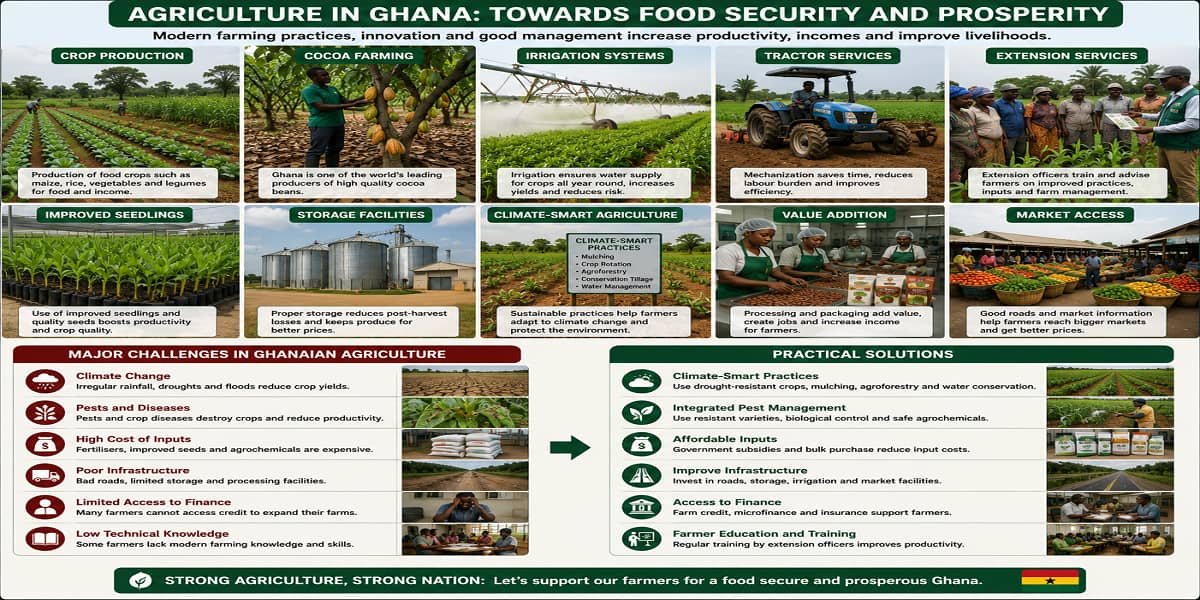
Despite its importance, the sector faces numerous challenges. Climate change and irregular weather conditions reduce crop yields and threaten food security. Traditional farming practices and inadequate access to modern technologies contribute to low productivity. Poor infrastructure, financial difficulties, land tenure problems, pests and diseases, low mechanisation, and weak extension services further affect agricultural performance. :contentReference
Several solutions have been proposed to address these problems. Climate-smart farming practices improve resilience to changing weather conditions. Access to modern farming technologies increases efficiency, while infrastructure development improves transportation and storage. Financial support enables farmers to invest in inputs and equipment. Land reforms, pest control measures, mechanisation support, and stronger extension services also contribute to sustainable agricultural development.
Challenges And Their Solutions
| Challenge | Solution |
|---|---|
| Climate Change | Climate-smart agriculture |
| Traditional Farming Methods | Modern technologies |
| Poor Infrastructure | Infrastructure development |
| Financial Constraints | Access to credit and insurance |
| Pests And Diseases | Integrated pest management |
| Low Mechanisation | Support for farm machinery |
| Poor Extension Services | Farmer training programmes |
Worked Examples
Example 1
Scenario: A farmer experiences low yields because of prolonged drought and irregular rainfall.
Explanation: Climate change and weather variability reduce crop yields and affect food production. Climate-resilient farming practices can help address this problem.
Example 2
Scenario: Farmers in a community receive training on improved farming practices and pest control.
Explanation: Strong extension services improve knowledge and encourage the adoption of innovations that increase productivity.
Why This Topic Matters
Understanding the challenges facing agriculture and the measures needed to solve them helps learners appreciate the importance of food security, rural development, and sustainable economic growth.
Quick Practice
- State two challenges facing agriculture in Ghana.
- Explain one solution to poor agricultural productivity.
- Describe the importance of extension services.
Summary
Agriculture plays a vital role in Ghana’s economy but faces challenges including climate change, inadequate infrastructure, financial constraints, pests and diseases, and low mechanisation. Appropriate solutions such as climate-smart agriculture, improved technologies, financial support, and extension services can enhance productivity and promote sustainable development.
Access NaCCA-aligned Support Packs
Download your structured NaCCA-aligned Teacher Support Pack and Student Learning Pack, designed for clarity, practicality, and reliable teaching and learning.