The Fundamental Macroeconomic Variables
Introduction
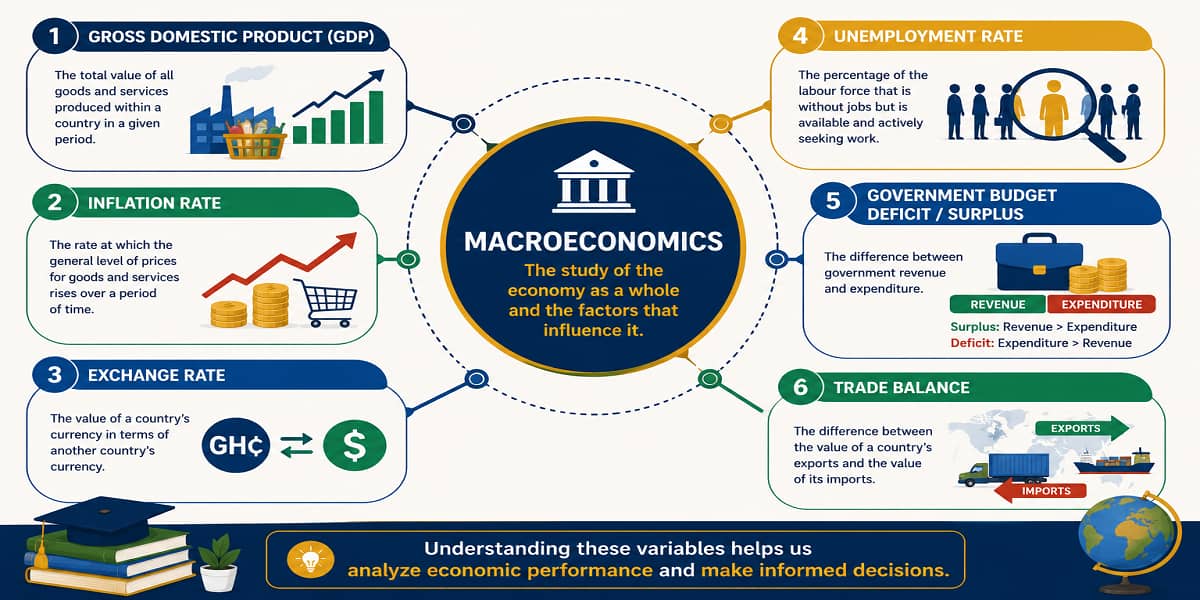
Macroeconomics is the branch of economics that studies the overall economy and its large-scale performance. It focuses on the behaviour and interactions of major economic aggregates. To understand how well an economy is performing, economists and policymakers rely on a number of key indicators known as the fundamental macroeconomic variables. These variables help measure economic performance, analyse trends and support policy decisions.
Key Concepts
- Macroeconomics: The study of the overall economy and its large-scale performance.
- Gross Domestic Product (GDP): The total value of all goods and services produced within a country’s borders during a specified period, usually a quarter or a year.
- Unemployment Rate: The percentage of the labour force that is unemployed and actively seeking employment.
- Inflation Rate: The percentage increase in the general price level of goods and services over time.
- Exchange Rate: The value of one country’s currency relative to another country’s currency.
- Government Budget Deficit: Occurs when government expenditure exceeds government revenue.
- Government Budget Surplus: Occurs when government revenue exceeds government expenditure.
- Trade Balance: The difference between a country’s exports and imports of goods and services.
Explanation
Macroeconomic variables are the major indicators used to determine the health and overall performance of an economy. Governments, economists and policymakers use these indicators to monitor economic conditions, formulate policies and make informed decisions.
Gross Domestic Product (GDP) measures the total value of all goods and services produced within a country’s borders during a given period. GDP is one of the most important measures of economic activity because it reflects the size and performance of an economy.
The unemployment rate measures the proportion of the labour force that is unemployed but actively looking for work. It provides information about employment opportunities and the health of the labour market.
The inflation rate measures the rate at which the general prices of goods and services increase over time. A moderate and stable inflation rate is generally regarded as healthy for the economy, whereas high or unpredictable inflation can negatively affect economic activities.
Exchange rates show the value of one country’s currency compared with another. Exchange rates influence international trade, capital flows and a country’s competitiveness in the global market.
The government budget deficit or surplus reflects the relationship between government expenditure and government revenue. When expenditure exceeds revenue, a budget deficit occurs. When revenue exceeds expenditure, a budget surplus occurs.
The trade balance, also known as part of the balance of payments, measures the difference between exports and imports of goods and services. When exports exceed imports, there is a trade surplus. When imports exceed exports, there is a trade deficit.
| Macroeconomic Variable | Meaning | Importance |
|---|---|---|
| Gross Domestic Product (GDP) | Total value of goods and services produced within a country | Measures overall economic output |
| Unemployment Rate | Percentage of unemployed people actively seeking work | Measures labour market performance |
| Inflation Rate | Percentage increase in the general price level | Measures price stability |
| Exchange Rate | Value of one currency relative to another | Affects international trade and competitiveness |
| Government Budget Deficit/Surplus | Difference between government revenue and expenditure | Shows government’s fiscal position |
| Trade Balance | Difference between exports and imports | Measures international trade performance |
Examples
Example 1
Problem: Ghana’s unemployment rate in 2023 was 14.7%.
- Identify the macroeconomic variable.
- Interpret what the percentage represents.
Final Answer: The unemployment rate indicates that 14.7% of Ghana’s labour force was unemployed and actively seeking employment during that period.
Example 2
Problem: Ghana experienced an inflation rate of 41.2% in April 2023.
- Identify the macroeconomic variable.
- Explain what the figure represents.
Final Answer: The inflation rate indicates that, on average, the general price level of goods and services increased by 41.2% compared with the previous year.
Example 3
Problem: Ghana’s GDP in 2022 was approximately 72.84 billion US dollars.
- Identify the macroeconomic variable.
- Explain what GDP measures.
Final Answer: GDP measures the total value of all goods and services produced within Ghana’s borders during the year.
Application and Activities
- Discuss the inflation and unemployment situation in the country.
- Research Ghana’s current budget and identify the inflation rate, unemployment rate and GDP.
- Use the national budget to explain national income.
- List the major trading currencies used in Ghana.
- Demonstrate changes in the prices of commodities to explain inflation.
- Use examples of unemployment within the community to explain the unemployment rate.
- Observe major foreign currencies used by Ghanaian traders to explain exchange rates.
Practice
- List the fundamental macroeconomic variables.
- Explain the difference between a government budget deficit and a government budget surplus.
- Use changes in the prices of everyday goods such as milk, sugar, gari or soap to explain inflation.
Summary
Macroeconomics studies the overall performance of an economy through important indicators known as the fundamental macroeconomic variables. These include Gross Domestic Product (GDP), unemployment rate, inflation rate, exchange rates, government budget deficit or surplus, and trade balance. Together, these variables provide valuable information about economic growth, employment, price stability, government finances and international trade, enabling governments and policymakers to make informed economic decisions.
Access NaCCA-aligned Support Packs
Download your structured NaCCA-aligned Teacher Support Pack and Student Learning Pack, designed for clarity, practicality, and reliable teaching and learning.