The Importance of Industry to the Ghanaian Economy Explained for SHS 1 Economics (Semester 2, Week 11)
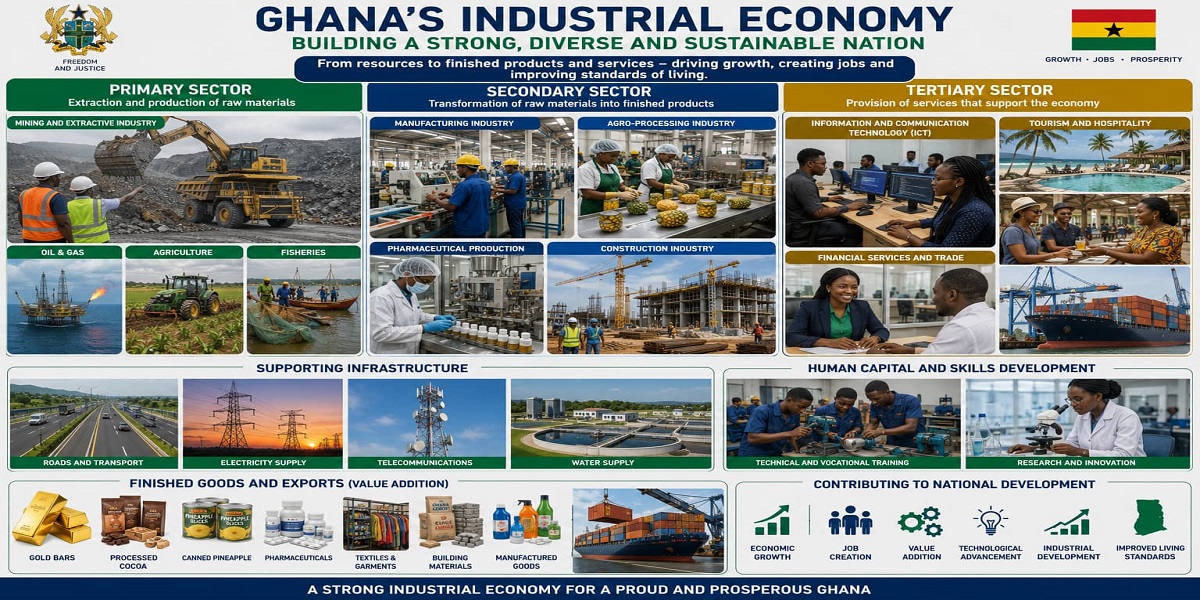
Industry transforms resources and raw materials into useful products while creating jobs, supporting exports and strengthening Ghana’s economic development.
What You Will Learn
- The meaning of industry and economic growth.
- The importance of industry to the Ghanaian economy.
- How industry supports value addition, employment and technological advancement.
- The primary, secondary and tertiary industry sectors.
- Examples and activities of different industries.
Main Explanation
Industry refers to the sector of the economy involved in producing goods through manufacturing, processing and various forms of production in factories. Industrial activities transform raw materials, components and resources into finished products for use or consumption by individuals and businesses. Machinery, technology and human labour are used to produce goods on a large scale.
Industry is an important source of economic growth. Manufacturing, construction, mining and energy production contribute to Ghana’s Gross Domestic Product and stimulate economic development. As industries expand, production and productivity increase and the economy becomes more competitive. The source indicates that manufacturing contributes around 20% of GDP, while the oil and gas industry is estimated to contribute around 5% of GDP.
Industry also promotes job creation. Industrial enterprises employ skilled and unskilled workers across different sectors. Growth in manufacturing can absorb surplus labour from agriculture and create opportunities for workers to move into higher-productivity and higher-paying jobs.
Value addition and export diversification are also important benefits of industry. When raw materials and agricultural products are processed into finished goods, Ghana can capture a larger share of the value in the production chain. Products such as textiles, garments, processed foods, chemicals and machinery can be exported to international markets, generating foreign exchange and reducing dependence on primary commodities.
The industrial sector promotes technological advancement through research and development, technology transfer and investment in machinery and equipment. Improved technology can increase production efficiency, enhance product quality and strengthen the ability of Ghanaian industries to compete globally.
Industrialisation contributes to infrastructure development. Industries require reliable transportation networks, power supply, telecommunications systems, water and sanitation facilities. The establishment of factories, warehouses and industrial parks therefore encourages the development of supporting infrastructure.
Industry supports income generation and poverty reduction by creating higher-paying employment and income-generating opportunities. Improved wages and incomes can raise living standards and increase access to education, health care and other essential services.
A diverse industrial sector improves economic resilience and the trade balance. Producing manufactured goods domestically reduces import dependence and promotes self-sufficiency. A strong industrial base also helps Ghana withstand changes in global commodity prices and international trade conditions.
Industrialisation further promotes skills development and human capital formation. Industries need skilled workers, technicians, engineers and professionals. This creates opportunities for training, technical education and capacity building, developing workers who can support both industry and other sectors of the economy.
| Industry Sector | Examples | Activities |
|---|---|---|
| Primary Sector | Mining and Extractive Industries | Extraction and processing of minerals, oil, gas and coal |
| Secondary Sector | Manufacturing Industry | Production of physical goods from raw materials or components |
| Secondary Sector | Construction Industry | Construction of residential, commercial and public structures and infrastructure |
| Secondary Sector | Pharmaceutical Industry | Research, development and production of drugs and medications |
| Secondary Sector | Agro-processing Industry | Processing agricultural products through milling, canning and packaging |
| Tertiary Sector | Information Technology Industry | Development, production and maintenance of software, hardware and related services |
| Tertiary Sector | Tourism Industry | Services provided by hotels, restaurants, tour operators and transportation providers |
Worked Examples
Example 1
Scenario: An agro-processing enterprise receives agricultural products and processes them through milling, canning and packaging.
Explanation: The enterprise belongs to the secondary sector because it transforms agricultural products into finished goods. The processing activity adds value to the original products and can support export diversification and foreign exchange earnings.
Example 2
Scenario: A mining enterprise extracts natural resources, while a tourism business provides hotel and transportation services to visitors.
Explanation: Mining belongs to the primary sector because it involves the extraction and processing of natural resources. Tourism belongs to the tertiary sector because it provides services through hotels, restaurants, tour operators and transportation providers.
Example 3
Scenario: A growing industrial area requires better roads, reliable electricity, telecommunications, water and sanitation facilities.
Explanation: This situation demonstrates how industrialisation promotes infrastructure development. Industrial activities require supporting facilities, and their establishment contributes to the wider development of the country’s infrastructure.
Why This Topic Matters
Understanding industry helps learners appreciate how production, processing and services contribute to Ghana’s growth and development. Industry creates employment, adds value to raw materials, promotes exports, advances technology, develops infrastructure and builds human capital. Knowledge of the primary, secondary and tertiary sectors also helps learners identify the activities of different industries in Ghana and explain their contribution to the economy.
Quick Practice
- Define industry and economic growth.
- Explain two ways industry contributes to job creation and income generation.
- Choose an industry from the primary, secondary or tertiary sector and explain its activities and importance to the Ghanaian economy.
Summary
Industry is the sector that transforms raw materials, components and resources into finished products through manufacturing, processing and other production activities. It contributes to economic growth, employment, value addition, export diversification, technological advancement, infrastructure development, poverty reduction, economic resilience and skills development. Primary, secondary and tertiary industries perform different activities, but each contributes to Ghana’s economic growth and development.
Access NaCCA-aligned Support Packs
Download your structured NaCCA-aligned Teacher Support Pack and Student Learning Pack, designed for clarity, practicality, and reliable teaching and learning.