The Features of Domestic Trade
Introduction
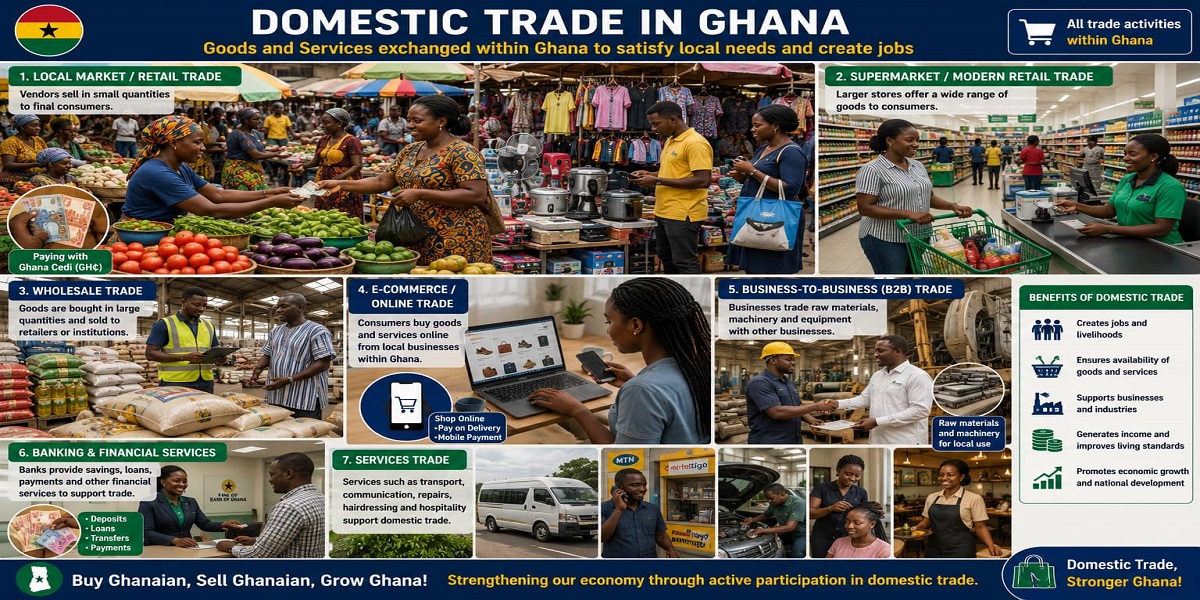
Trade is the exchange of goods and services between individuals, businesses, countries or regions. Domestic trade refers to the exchange of goods and services within the boundaries of a country between individuals, businesses and government entities. It is an essential part of economic activity within a nation and includes activities ranging from retail sales and wholesale distribution to industrial supply chains. The source illustrates domestic trade with Kaneshie Market in Accra.
Key Concepts
- Trade: The exchange of goods and services between individuals, businesses, countries or regions.
- Domestic Trade: The exchange of goods and services within the boundaries of a country between individuals, businesses and government entities.
- Wholesale Trade: The sale of goods in large quantities from manufacturers or distributors to retailers or other businesses.
- Retail Trade: The sale of goods directly to consumers.
- E-commerce: The buying and selling of goods and services through online platforms and marketplaces within the domestic market.
- Business-to-Business Trade: Trade between businesses within the same country involving raw materials, components, machinery and other goods required for production or further resale.
Explanation
Domestic trade has several features that distinguish it as trade conducted within a country’s national boundaries.
Geographical Scope: Domestic trade is confined to a country’s geographical boundaries. Transactions take place within the borders of the nation and do not involve cross-border trade.
Currency: Domestic trade normally uses the national currency of the country. In Ghana, domestic trade transactions are denominated in Ghanaian Cedis.
Regulatory Environment: Domestic trade is governed by the laws and regulations of the country in which it takes place. Governments may introduce policies and trade regulations to facilitate or regulate domestic trade activities.
Market Structure: Domestic trade includes both wholesale and retail markets. Wholesale trade involves the sale of goods in large quantities from manufacturers or distributors to retailers or other businesses. Retail markets consist of businesses that sell goods directly to consumers.
Variety of Goods and Services: Domestic trade covers a wide range of goods and services. These include consumer goods such as clothing and electronics, industrial products and professional services.
Contribution to Gross Domestic Product: The value of domestic trade is an important component of a country’s Gross Domestic Product (GDP), which measures the overall economic output produced within the nation’s borders.
| Feature of Domestic Trade | Description | Domestic Context |
|---|---|---|
| Geographical Scope | Trade occurs within a country’s geographical boundaries | Transactions remain within national borders |
| Currency | Transactions use the country’s national currency | Ghanaian Cedis are used in Ghana |
| Regulatory Environment | Trade is subject to national laws and regulations | Government policies regulate trade activities |
| Market Structure | Includes wholesale and retail markets | Goods move from manufacturers or distributors to businesses and consumers |
| Variety of Goods and Services | Covers consumer goods, industrial products and professional services | Different goods and services are exchanged within the country |
| Contribution to GDP | Forms part of the country’s total economic output | Domestic trade contributes to national economic activity |
Domestic trade is essential because it facilitates the efficient allocation of resources within a country and enables goods and services to reach consumers and businesses efficiently. It supports economic growth by creating demand for goods and services, which can increase production and employment opportunities. Domestic trade also contributes to government revenue through taxation on trade transactions. In addition, consumers gain access to goods and services from different regions of the country, encouraging competition and consumer choice.
Examples of domestic trade include retail trade, wholesale trade, e-commerce, local markets, business-to-business trade, services trade, government procurement, direct sales, franchise trade and financial services.
| Example of Domestic Trade | Description | Goods or Services Involved |
|---|---|---|
| Retail Trade | Sale of goods directly to individual consumers | Goods sold through stores, supermarkets, department stores, convenience stores and online platforms |
| Wholesale Trade | Purchase of goods in bulk and resale to retailers, businesses or institutional customers | Bulk goods from producers or manufacturers |
| E-commerce | Buying and selling through online platforms and marketplaces | Goods and services sold through online retailers, classified websites and auction platforms |
| Local Markets | Vendors sell goods to local consumers in traditional markets, farmers’ markets and bazaars | Fresh produce, handicrafts, clothing, electronics and household items |
| Business-to-Business Trade | Trade between businesses within the same country | Raw materials, components, machinery and goods for production or resale |
| Services Trade | Exchange of services within the domestic market | Legal, accounting, consulting, healthcare, hospitality, transportation and telecommunications services |
| Government Procurement | Government entities purchase from domestic suppliers and contractors | Infrastructure, public service and defence-related requirements |
| Direct Sales | Products are marketed and sold directly to consumers through representatives or consultants | Cosmetics, wellness, home care and personal care products |
| Franchise Trade | Businesses use a recognised brand and business model to sell to local consumers | Products and services offered through franchised businesses |
| Financial Services | Financial services are provided within the domestic market | Banking, insurance, investment and financial advisory services |
Examples
Example 1
Problem: A supermarket sells household items directly to individual consumers within Ghana. Identify the type of domestic trade.
- Identify who receives the goods.
- Determine whether the goods are sold directly to consumers.
- Match the transaction with the appropriate example of domestic trade.
Final Answer: The transaction is retail trade because the supermarket sells goods directly to individual consumers.
Example 2
Problem: A business purchases goods in bulk from a manufacturer and resells them to retailers within the country. Identify the type of domestic trade.
- Identify the quantity in which the goods are purchased.
- Identify the buyers who receive the goods for resale.
- Classify the transaction according to the examples of domestic trade.
Final Answer: The transaction is wholesale trade because goods are purchased in bulk and resold to retailers or other businesses within the country.
Application and Activities
- Visit a nearby market and collect data on market women who sell in markets in different towns.
- Present the findings and discuss domestic trade based on the report generated.
- Observe the school environment and identify examples of domestic trade around the school.
- Discuss how the identified examples of domestic trade differ from one another.
- In small groups, discuss examples of domestic trade in Ghana.
Practice
- Outline at least two features of domestic trade.
- Explain at least two features of domestic trade and state why domestic trade is important.
- Evaluate examples of domestic trade in Ghana and explain how they support economic activity and consumer choice.
Summary
Domestic trade is the exchange of goods and services within the boundaries of a country among individuals, businesses and government entities. Its main features include a national geographical scope, the use of national currency, regulation by domestic laws, wholesale and retail market structures, a wide variety of goods and services and contribution to GDP. Domestic trade supports resource allocation, economic growth, employment, government revenue, competition and consumer choice. Its examples include retail trade, wholesale trade, e-commerce, local markets, business-to-business trade, services trade, government procurement, direct sales, franchise trade and financial services.
Access NaCCA-aligned Support Packs
Download your structured NaCCA-aligned Teacher Support Pack and Student Learning Pack, designed for clarity, practicality, and reliable teaching and learning.