Text Types and Purposes Explained for SHS 1 English Language (Semester 2, Week 8)
Different writing situations require different text types. Knowing the purpose and format of each text type helps learners communicate effectively in school, the workplace and everyday life.
What You Will Learn
- The meaning and purpose of emails, memoranda (memos), agendas and formal letters.
- The correct format for each text type.
- The steps involved in writing a memo.
- The features of a formal letter.
- How to use appropriate language and organisation when writing.
Main Explanation
Writing is an important communication skill that enables people to share information for different purposes. Depending on the situation, different text types are used to communicate effectively. Learners should be able to compose emails, memoranda, programme agendas and formal letters using the correct format and appropriate language. The use of ICT tools also makes writing activities more practical and relevant to real-life situations.
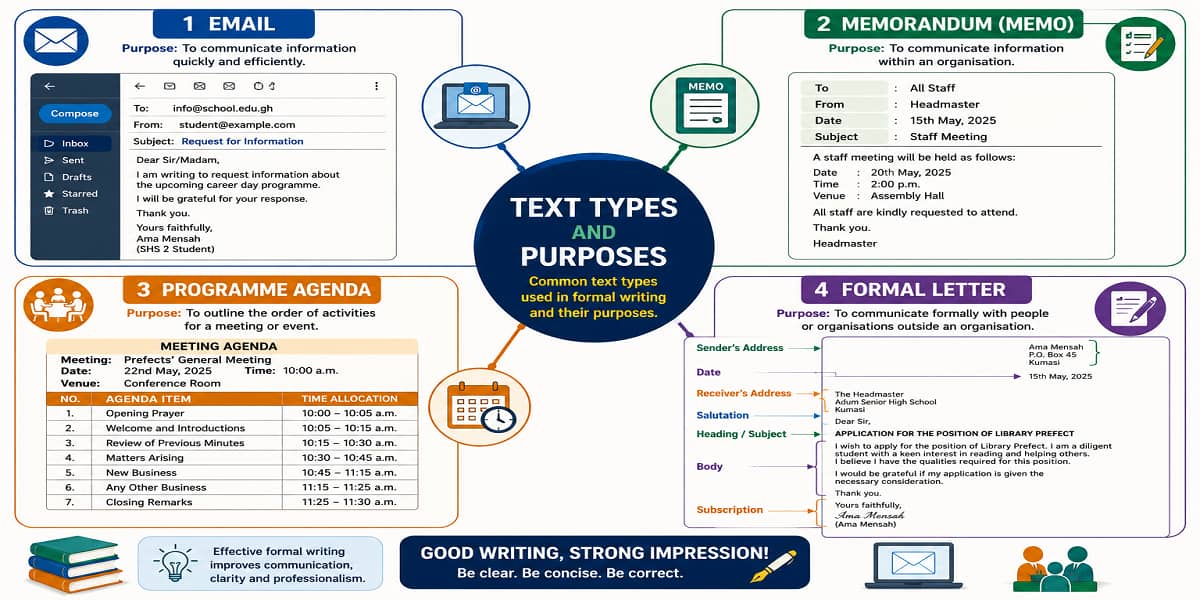
An email is a means or system for transmitting messages electronically. It is commonly used for personal, academic and professional communication. A well-written email presents its message clearly and appropriately for the intended audience and purpose.
A memorandum (memo) is a formal communication or notification used mainly within an organisation for day-to-day communication. Unlike formal letters, memos are intended for internal circulation and follow a distinctive format. The steps involved in writing a memo include writing a heading, providing a brief introduction, giving background information on the issue, outlining action items and timelines, including a closing statement, and reviewing the document before sending.
A standard memo normally contains the headings To, From, Date and Subject, followed by the body of the message. The sample memo provided in the source demonstrates this block style format for organisational communication.
An agenda is a list or outline of items to be considered during a meeting. It serves as the programme of activities for a meeting and helps participants prepare while ensuring discussions are organised and orderly. The sample meeting agenda shown in the source illustrates how meeting information, agenda items, presenters and action items are arranged.
A formal letter is written for official or professional purposes. It may be used to express concerns in a professional setting, provide official information, order goods, apply for employment or write to an editor. Formal letters include business letters, letters of application and letters to editors.
A formal letter follows a recognised structure. Its main features include the sender’s address, date, recipient’s address, salutation, heading or title, the body consisting of an introduction, main body and conclusion, and the subscription, which includes the closing, signature and full name of the writer. Writers should avoid contracted forms, use formal Standard English, write precise sentences, remain polite and conclude appropriately.
| Text Type | Purpose | Main Features |
|---|---|---|
| Transmit messages electronically | Electronic message with an appropriate subject and content | |
| Memo | Internal organisational communication | To, From, Date, Subject and message body |
| Agenda | Guide meeting discussions | List of meeting items and programme of activities |
| Formal Letter | Official or professional communication | Addresses, salutation, heading, body and subscription |
| Feature of a Formal Letter | Function |
|---|---|
| Sender’s Address | Identifies the writer |
| Date | Shows when the letter was written |
| Recipient’s Address | Identifies the receiver |
| Salutation | Provides the formal greeting |
| Heading/Title | States the purpose of the letter |
| Body | Presents the message clearly and logically |
| Subscription | Provides the closing, signature and writer’s name |
Worked Examples
Example 1
Scenario: A school administrator wants to communicate an important announcement to staff members within the school.
Explanation: A memorandum is the most appropriate text type because it is designed for internal communication within an organisation and follows the standard memo format using headings such as To, From, Date and Subject.
Example 2
Scenario: A learner wishes to apply for employment after seeing a job advertisement.
Explanation: The learner should write a formal application letter using the correct structure, including the sender’s address, date, recipient’s address, salutation, heading, body and subscription, while using formal Standard English and avoiding contracted forms.
Why This Topic Matters
Understanding different text types prepares learners to communicate effectively in academic, professional and everyday situations. The ability to compose emails, memoranda, agendas and formal letters using appropriate formats supports digital literacy, communication, collaboration, critical thinking and problem-solving skills needed in real-life contexts and the world of work.
Quick Practice
- Outline the features of an email, memo, agenda and formal letter.
- Create any two of the following: a memo, an email, a programme agenda or a formal letter.
- Prepare an agenda for a class meeting with your form master or form mistress.
- Write an application letter to seek a job.
Summary
Emails, memoranda, agendas and formal letters are important text types used for different communication purposes. Each follows a specific format that helps the writer organise ideas clearly and communicate effectively. Mastering these formats enables learners to write confidently for school, professional environments and everyday life.
Access NaCCA-aligned Support Packs
Download your structured NaCCA-aligned Teacher Support Pack and Student Learning Pack, designed for clarity, practicality, and reliable teaching and learning.