Relationship Between Context and Setting and Plot Devices Explained for SHS 1 Literature-in-English (Sem. 1 – Week 7)
A story does not happen in an empty space. Every fictional event is presented somewhere, at some point, within circumstances that help the reader understand what is happening. At the same time, the writer must decide how those events will unfold for the reader.
Two ideas therefore become especially useful in prose appreciation: context and setting, and plot and plot devices.
Context Gives a Story Its Surrounding Information
In simple terms, context can be understood as the setting of an event. More broadly, it is the information we need to truly understand something.
Consider the experience of watching a film from its opening moments. The viewer gradually learns who the characters are, where the story is set and what the plot line is. These details accumulate to create an understanding of the fictional world.
Setting is therefore part of context. The weekly material puts the relationship very simply: setting is a subset of context.
Three Ways of Thinking About Context
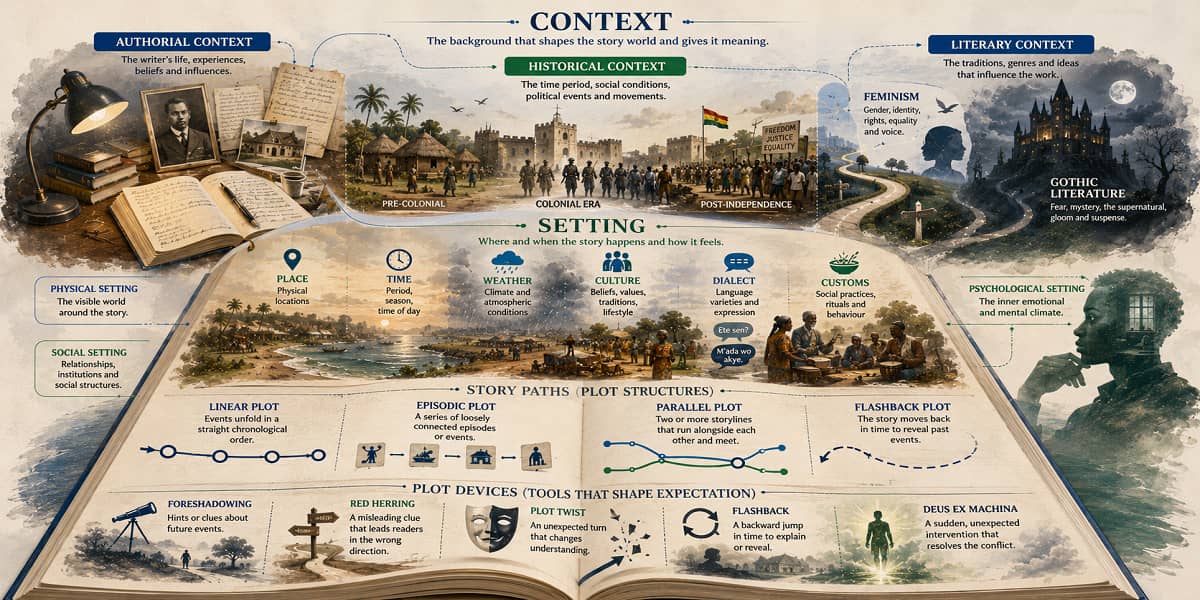
Context is not limited to physical location. The material identifies three forms that can help readers approach a literary work from different directions.
| Context | The Question It Raises |
|---|---|
| Authorial | What aspects of the writer’s life history, experiences and circumstances influenced the writing? |
| Historical | What historical or social circumstances are reflected or addressed? |
| Literary | What broad literary category or tradition does the text fit into? |
Authorial context directs attention towards the writer’s experiences. Historical context considers history and society. Literary context considers the broader literary category, with the material giving Feminism and Gothic as examples.
Setting Is More Than a Place
Readers sometimes think of setting simply as the location of a story. The material presents a wider view by identifying physical, social and psychological settings.
The physical-setting illustration on page 38 shows how many clues can contribute to the environment of a story: place, time of day, year, weather, historical era, country, season, culture, dialect and customs. :contentReference[oaicite:1]{index=1}
These details remind us that the question “Where does the story happen?” may be only the beginning. We can also ask when it happens, what cultural conditions surround it and what other circumstances shape the environment.
Reading the Clues
Suppose a prose passage contains several descriptive details about a particular place, season, dialect and custom. Those details are not simply scenery. They provide evidence about the world in which the characters and events exist.
A useful reading habit is:
Notice the clue → Identify the setting/context → Explain its contribution to meaning.
This approach turns description into evidence for interpretation.
Context Can Change the Way We Read a Story
The same event can be understood differently when the surrounding information changes. Historical circumstances can influence what a text addresses. Authorial experiences can form part of the circumstances surrounding its creation. Literary context can position a work within a wider category.
Context does not replace the text. Instead, it gives readers additional information through which the text can be understood.
From the World of the Story to the Movement of the Story
Once the reader has considered the environment, another question emerges: How does the story move?
This is where plot becomes important.
Plot is a literary device used by writers to arrange what happens in a story. It presents events and actions and includes a turning point that creates conflict which eventually needs to be resolved.
Plot is therefore about organisation. The writer is not merely presenting events; the events are arranged in a particular way.
Plot Types Give Stories Different Shapes
The weekly material identifies four plot types:
Linear Plot
A linear plot, also called dramatic or progressive plot, presents actions or occurrences chronologically.
The structure moves through:
Exposition → Setting → Characters → Conflict → Rising Action → Climax → Falling Action → Resolution
The reader is taken progressively through the development of the story.
Episodic Plot
An episodic plot consists of a series of chapters or stories linked by the same character, place or theme. Each part retains its own plot, purpose and subtext.
Parallel Plot
A parallel plot contains two or more separate narratives linked by a common character, event or theme.
The separate strands can be followed individually while the connection between them helps create the larger story.
Flashback
A flashback recounts events that happened before the story’s primary sequence of events. It can supply crucial backstory and reveal information that the reader did not previously have.
| If You Notice… | Consider… |
|---|---|
| Chronological events | Linear plot |
| Linked but individually distinct episodes | Episodic plot |
| Two or more connected narrative strands | Parallel plot |
| Earlier events inserted into the main sequence | Flashback |
Plot Devices: The Writer’s Storytelling Tools
Plot types describe broad ways of arranging a story, but writers also use specific techniques to move the plot forward.
These are plot devices.
A plot device can be something material, such as a character, or something immaterial, such as a situation or change in events.
Foreshadowing Creates a Trail
Foreshadow is a plot device that hints at something that will happen later. The significance of the hint may not be recognised until the end of the story.
This means that a later event can make an earlier detail suddenly appear more significant.
Red Herrings Deliberately Mislead
A red herring is false information used by a writer to mislead the reader about what is really happening in the plot.
Its function is therefore connected to uncertainty. The reader may form one interpretation, only to discover that the information was misleading.
Flashbacks Reveal What Came Before
Flashback can recount events that happened before the current happenings of the story. It can gradually reveal information and keep readers or audiences guessing.
This makes earlier events relevant to understanding the present sequence of the narrative.
Plot Twists Break Expectations
A plot twist is a deviation from an expected ending or direction of a plot.
The reader forms an expectation, but the story moves in a different direction. The resulting surprise can make the narrative entertaining and memorable.
Deus Ex Machina: The Sudden Solution
Deus ex machina describes a situation in which an insoluble conflict or point of tension is suddenly resolved by the appearance of a new character, force or event.
The phrase means “God out of an engine.” The material explains the idea through the image of a powerful or wise person suddenly appearing on stage to solve problems and provide the necessary healing.
The device can also remind an audience that a stage performance is not real life but a constructed drama.
One Important Distinction
It is easy to confuse a plot type with a plot device. The difference can be understood through scale.
Plot type = the larger structure of the story.
Plot device = a technique used to move or shape that structure.
For example, a story may have a linear plot while using foreshadowing and a plot twist. A story may also use flashback as part of its organisation and as a device for revealing earlier events.
How to Read Plot More Actively
Instead of asking only “What happened?”, ask how the writer arranged what happened.
Consider these questions:
- What happens first?
- What creates or develops the conflict?
- Where does the story reach a turning point?
- How are the events resolved?
- Are events presented chronologically?
- Are there separate episodes?
- Are there parallel narrative strands?
- Does the story move back to earlier events?
- Does an earlier clue point towards something later?
- Does false information mislead the reader?
- Does an unexpected twist change the direction of the story?
- Does a new character, force or event suddenly resolve an apparently insoluble conflict?
Plot and Context Belong to the Same Reading Experience
Context and plot should not be treated as completely isolated topics.
The context helps readers understand the world surrounding the events. Setting provides part of that context. Plot then organises the events that occur within that world.
In simplified form:
Context establishes understanding → Setting establishes environment → Plot organises events → Plot devices shape movement and expectation.
This sequence gives readers a practical framework for prose appreciation.
Using Textual Evidence
Literary interpretation becomes stronger when it is grounded in evidence.
If you identify a setting, quote or point to the descriptive words and phrases that reveal it. If you identify a plot type, show how the events are arranged. If you identify a plot device, explain the particular event, clue or change that demonstrates it.
The weekly material encourages learners to identify and discuss evidence in selected chapters that reveals the context and setting created by the author and to cite evidence from prose texts when highlighting different plot devices.
A Story Can Be Mapped Visually
Concept mapping is particularly useful for context and setting. A reader can place Context at the centre and connect it to setting and the different types of context.
A similar visual approach can be used for plot. Story events can be placed on cards and rearranged to reveal the structure of a linear, episodic or parallel plot.
This is more than a classroom exercise. It makes the organisation of a story visible.
The Story Sequence Game
One practical way to understand plot is to take a story whose events have been mixed up and attempt to restore their order.
For a chronological narrative, the cards should move from beginning to later events. For an episodic structure, identify the episodes and their connecting element. For parallel narratives, separate the strands and then identify the connection. For flashback, identify the event that belongs to an earlier period.
The exercise encourages readers to think about structure, not just content.
From Reader to Storyteller
Understanding plot devices can also improve creative writing.
Once you recognise how writers organise stories, you can experiment with those techniques yourself. You might construct a story with a linear structure, create parallel narratives, insert a flashback or introduce a plot twist.
You can also design a setting that communicates place, time, weather, culture, customs and other contextual details.
Designing a Story for the Screen
Imagine that a prose work is being adapted into a film. The setting would have to become visible to the audience.
A movie-set design could communicate:
- place;
- year;
- time of day;
- weather;
- historical era;
- country;
- season;
- culture;
- dialect; and
- customs.
The more clearly the visual environment communicates the relevant evidence from the text, the more effectively the setting is represented.
Prose Texts as Testing Grounds
The weekly material suggests examining plot devices in short stories, short videos and prose texts. Among the works named for exploration are Things Fall Apart by Chinua Achebe, Grief Child by Lawrence Darmani and The Thing Around Your Neck by Chimamanda Ngozi Adichie.
The purpose is not simply to label each work. The reader should identify evidence and explain how the structure or device contributes to the story.
Three Questions for Better Prose Appreciation
When approaching a new fictional text, begin with three questions:
1. What surrounds the story?
Look for context and setting.
2. How does the story unfold?
Examine plot structure.
3. What techniques shape our expectations?
Look for plot devices.
These questions create a practical bridge between simply reading a story and appreciating how it has been constructed.
Final Takeaway
Context helps readers understand a literary work. Setting is a subset of context and includes physical, social and psychological dimensions. Authorial, historical and literary contexts provide wider ways of understanding a text.
Plot then gives the story movement. A writer may use a linear, episodic, parallel or flashback structure and may employ devices such as foreshadowing, red herrings, flashbacks, plot twists and deus ex machina.
The most useful habit is to connect labels to evidence. Do not simply say that a text has a particular setting or plot device. Show what in the text supports the observation and explain what the choice contributes to the reading experience.
That is where prose appreciation becomes more than identifying features: it becomes an exploration of how writers construct worlds, arrange events and guide readers through stories.
Access NaCCA-aligned Support Packs
Download your structured NaCCA-aligned Teacher Support Pack and Student Learning Pack, designed for clarity, practicality, and reliable teaching and learning.