Fundamental Concepts of Economics II Explained for SHS 1 Economics (Sem. 1 – Week 3)
Every society faces a basic question: how should limited resources be used when there are many competing wants and needs?
The answer involves economic choices. But it also involves the way a society organises its economy. This brings us to economic systems.
From Personal Choice to Social Choice
Consider a person with several wants but limited resources. The person cannot satisfy everything at once. Priorities have to be established.
The same problem becomes much larger at community and national level. A society may have many needs but limited resources to address them.
The basic chain is:
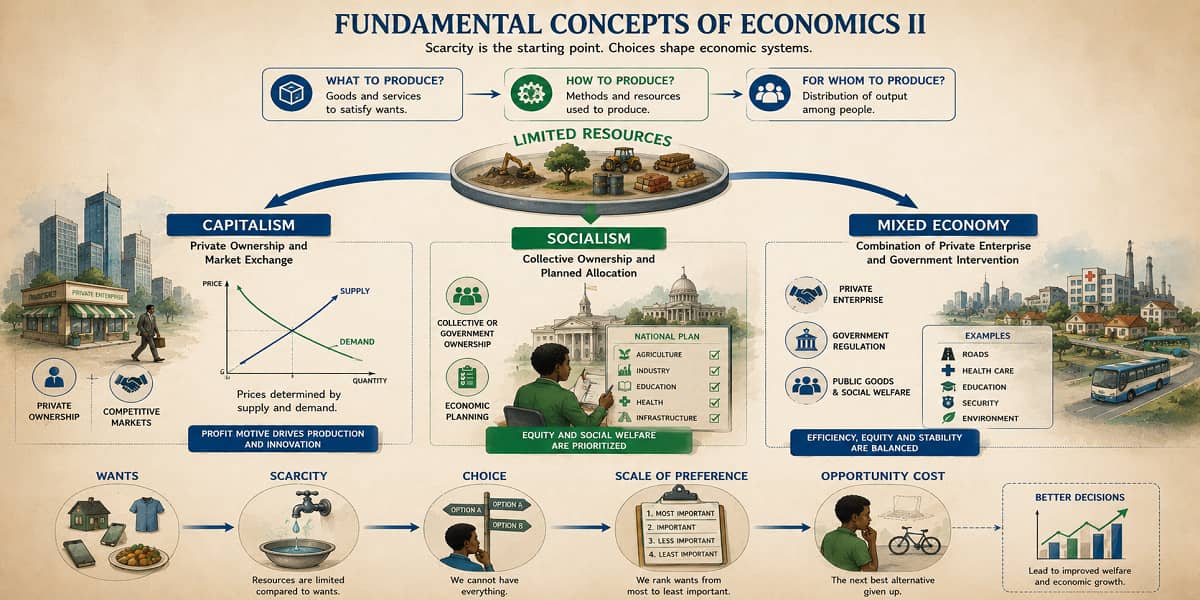
Wants → Scarcity → Choice → Priorities → Opportunity Cost
These concepts help explain why economic decisions are unavoidable.
Scarcity Is Not Simply Shortage
Scarcity refers to the limited availability of resources relative to demand for them.
Its economic importance comes from the relationship between limited resources and competing wants.
When resources are insufficient to satisfy every competing want or need, choices must be made about their use.
Choice Requires Priorities
Choice is the process of deciding how scarce resources should be allocated among competing wants and needs.
One way of organising those competing wants is through a scale of preference.
A scale of preference ranks wants according to importance or priority. It helps decision-makers determine which wants should receive attention first.
Every Choice Has a Cost
Suppose available resources can be used for only one of two competing purposes.
Choosing the first purpose means that the second is not selected with those same resources.
This is where opportunity cost becomes important. It is the cost of choosing one thing over another.
Opportunity cost makes us look beyond the option selected and consider what the choice requires us to give up.
Why Societies Need Economic Systems
Economic choices are not made only by individuals. They also occur across entire societies.
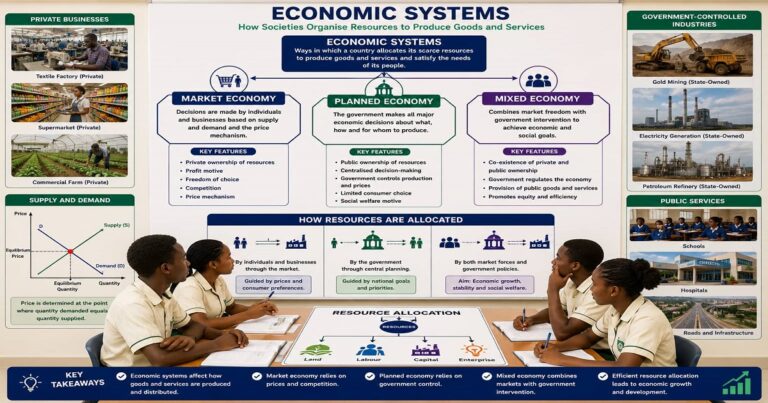
An economic system is the structure and organisation through which production, distribution and consumption of goods and services take place within a society or country.
It provides a framework for allocating resources and making decisions about three fundamental questions:
- What should be produced?
- How should it be produced?
- For whom should it be produced?
Capitalism: The Market-Oriented Approach
In capitalism, the means of production are privately owned.
Economic decisions are largely influenced by the pursuit of profit, while market forces such as supply and demand influence prices and resource allocation.
Competition is an important feature. Individuals have freedom to own property and engage in voluntary exchange.
Capitalism therefore places considerable emphasis on private ownership and market forces.
Socialism: Collective Organisation
Socialism emphasises collective or government ownership of the means of production.
Economic planning and centralised decision-making play a significant role. The aim is to achieve a more equitable distribution of wealth and resources and to meet the needs of society rather than focusing primarily on individual profit.
Mixed Economy: Combining Approaches
A mixed economy combines elements of capitalism and socialism.
Private ownership exists alongside government intervention. Governments may regulate certain industries, provide public goods and services and implement social welfare programmes, while market forces operate in other areas.
Three Systems, Three Organisational Patterns
| System | Ownership | Role in Allocation |
|---|---|---|
| Capitalism | Private | Market forces and competition |
| Socialism | Collective or government | Planning and centralised decision-making |
| Mixed economy | Private + government involvement | Market forces + government intervention |
What Remains the Same?
The three systems differ in how economic decisions are organised, but they all operate within the reality of limited resources.
That means the fundamental economic problem remains important.
Whether decisions are influenced primarily by markets, planning or a combination of both, society still has to determine how scarce resources will be used.
The Three Economic Questions
Every economic system must deal with questions about production and distribution.
What to produce? Resources cannot be used to produce everything, so priorities are necessary.
How to produce? The available resources have to be organised for production.
For whom to produce? Decisions have to be made about who receives the goods and services produced.
These questions connect economic systems directly to scarcity and choice.
A Community Example
Imagine a community with limited resources and several important problems.
The community first identifies its wants and needs. It then examines its available means and recognises the scarcity involved.
Next, it ranks the problems according to importance. This creates a scale of preference.
Resources are then directed towards selected priorities. The needs that are not addressed with those resources represent the sacrifice involved in the decision—the opportunity cost.
Why the Economic System Matters
The economic system influences how these choices are organised.
Under capitalism, market forces and private ownership play major roles. Under socialism, collective or government ownership, planning and centralised decision-making play major roles. In a mixed economy, market activity operates alongside government intervention.
The system therefore provides a framework for dealing with scarcity and organising economic decisions.
Learning Through Role-Play
Economic concepts can become easier to understand when they are acted out.
A role-play can place learners in a situation involving competing wants, limited resources and difficult choices. Participants can then identify the scarcity, establish priorities and explain the opportunity cost of their decisions.
The activity becomes even more meaningful when the decisions are connected to real situations in the community or wider society.
From Drama to Real Economic Questions
After exploring an economic situation, ask:
- What were the competing wants?
- Which resources were limited?
- What choices were available?
- How were priorities established?
- What was given up?
- Which economic system could organise the decisions, and how?
These questions turn an everyday situation into an economic analysis.
Thinking Critically About Economic Systems
Understanding an economic system involves more than memorising its name.
You should be able to explain how ownership, decision-making and resource allocation are organised within each system.
You should also be able to connect these arrangements to the fundamental economic problem of scarcity.
A Useful Comparison
Think of the three systems as different ways of organising economic decisions:
Capitalism: private ownership + market forces + competition.
Socialism: collective or government ownership + planning + centralised decision-making.
Mixed economy: private ownership + government intervention + market activity.
Why These Ideas Matter to Everyday Life
Economic systems may sound like large national concepts, but their decisions ultimately affect the production, distribution and consumption of goods and services.
They therefore connect back to everyday economic life.
The same basic question remains: how should limited resources be organised to meet competing needs?
Key Ideas to Remember
- Scarcity arises because resources are limited relative to competing wants.
- Choice is necessary because resources cannot satisfy every want at once.
- A scale of preference ranks wants according to priority.
- Opportunity cost is the cost of choosing one thing over another.
- An economic system organises production, distribution and consumption.
- Capitalism emphasises private ownership and market forces.
- Socialism emphasises collective or government ownership and economic planning.
- A mixed economy combines private ownership with government intervention.
- Economic systems provide different ways of organising decisions about what, how and for whom to produce.
Final Takeaway
Economic systems are different ways of organising society’s response to scarcity.
The fundamental economic concepts—wants, scarcity, choice, scale of preference and opportunity cost—help us understand why decisions must be made. Economic systems help us understand how those decisions are organised.
Capitalism gives a major role to private ownership and market forces. Socialism gives a major role to collective or government ownership and economic planning. A mixed economy combines private economic activity with government intervention.
Once these connections become clear, Economics becomes more than a collection of definitions. It becomes a way of understanding how people and societies make choices when resources are limited.
Access NaCCA-aligned Support Packs
Download your structured NaCCA-aligned Teacher Support Pack and Student Learning Pack, designed for clarity, practicality, and reliable teaching and learning.