
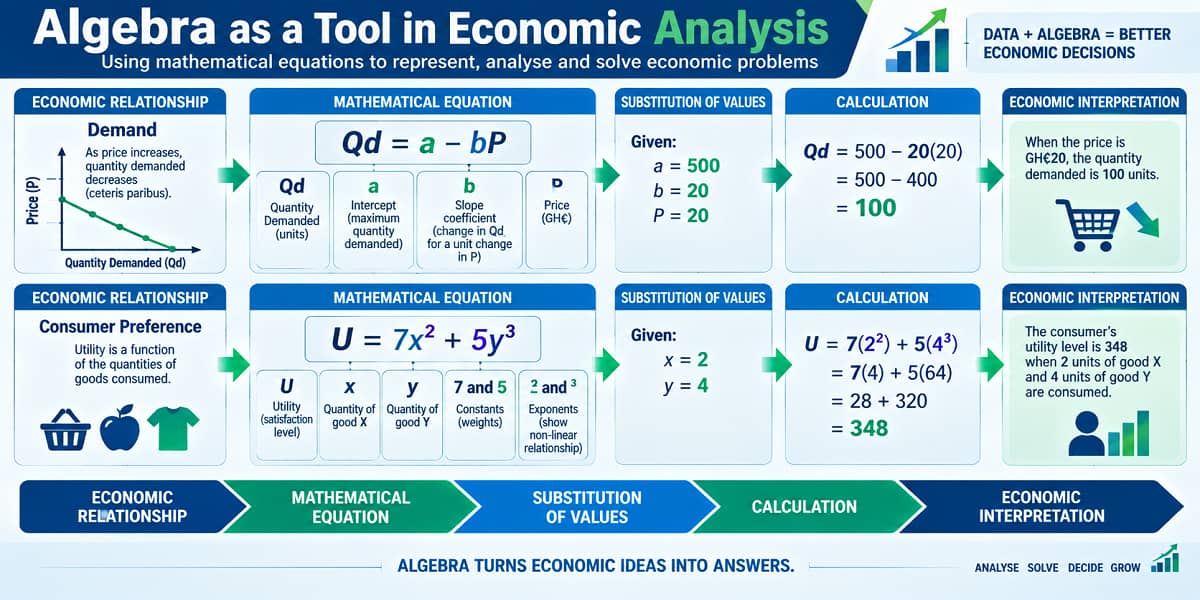
Algebra as a Tool in Economic Analysis
Economics often deals with relationships between variables. Algebra helps us express those relationships mathematically, calculate unknown values and interpret economic behaviour.
1. Algebra in Economics
Algebra is a fundamental tool used to model and solve economic issues. It allows an economic relationship to be written as an equation that can be calculated and interpreted.
For example, a demand relationship can be written as:
Qd = f(P)
where:
- Qd = quantity demanded;
- P = price; and
- f(P) shows that quantity demanded depends on price.
2. The Demand Function
A common algebraic form of the demand function is:
Qd = a − bP
| Symbol | Meaning |
|---|---|
| Qd | Quantity demanded. |
| P | Price of the product. |
| a | Intercept; the base level of demand when price is zero or other specified factors are neutralised. |
| b | Slope coefficient showing how quantity demanded responds to price. |
In Qd = a − bP, a positive value of b produces the familiar negative relationship between price and quantity demanded because bP is subtracted from a.
3. Worked Demand Example
Suppose the demand equation for local rice is:
Qd = 500 − 20P
Here, a = 500. The coefficient of price is −20, meaning that for every GH₵1 increase in price, quantity demanded decreases by 20 units.
When P = GH₵20
Substitute P = 20 into the equation:
Qd = 500 − 20(20)
Qd = 500 − 400
Qd = 100
Therefore, at a price of GH₵20, the quantity demanded is 100 units.
4. Reading the Equation Economically
The equation tells us more than the answer to one calculation.
Because the price coefficient is negative, an increase in price reduces quantity demanded, while a decrease in price increases quantity demanded, other things remaining equal.
The algebra therefore provides a compact way of expressing an economic relationship.
5. Other Economic Functions
Algebra can also represent other economic concepts, including:
- Supply function — relates quantity supplied to relevant economic variables.
- Production function — relates total output to inputs such as labour and capital.
- Utility function — expresses the utility obtained from combinations of commodities.
In a production function, for example:
Q represents total output, L represents labour and K represents capital.
6. Utility Functions
A utility function expresses the level of utility associated with a combination of commodities.
Suppose Kwame consumes two commodities, x and y.
Consider the following functions and values.
a. First Utility Function
U = 2x + 3y, where x = 5 and y = 7.
Substitute the values:
U = 2(5) + 3(7)
U = 10 + 21
U = 31
Utility = 31.
b. Second Utility Function
U = x2 + 5y, where x = 4 and y = 2.
U = 42 + 5(2)
U = 16 + 10
U = 26
Utility = 26.
c. Third Utility Function
U = 7x2 + 5y3, where x = 2 and y = 2.
U = 7(22) + 5(23)
U = 7(4) + 5(8)
U = 28 + 40
U = 68
Utility = 68.
| Case | Utility |
|---|---|
| U = 2x + 3y | 31 |
| U = x2 + 5y | 26 |
| U = 7x2 + 5y3 | 68 |
Under the stated calculations, the third case produces the highest numerical utility, 68.
7. A Second Utility Comparison
Consider two consumers with the following utility functions:
Nana Yaw: U(M, B) = M2 + B
Habiba: U(M, B) = 2M + B2
Let M = 1 and B = 1.
Nana Yaw
U = 12 + 1
U = 1 + 1 = 2
Habiba
U = 2(1) + 12
U = 2 + 1 = 3
Thus, the calculated utilities are 2 for Nana Yaw and 3 for Habiba.
The difference arises from the different mathematical forms of their utility functions, which represent different preferences for the two goods.
8. A Simple Problem-Solving Method
When solving an economic function:
- Write the function.
- Identify the given values.
- Substitute the values carefully.
- Apply powers before addition or subtraction.
- Calculate each term.
- Interpret the result economically.
9. Practice
Question 1: Calculate Afi’s utility when x = 2, y = 3, and U = x + 2y.
Solution:
U = 2 + 2(3)
U = 2 + 6 = 8
Answer: U = 8.
Question 2: Calculate Kojo’s utility when x = 3, y = 3, and U = 2x2 + 3y.
Solution:
U = 2(32) + 3(3)
U = 2(9) + 9
U = 18 + 9 = 27
Answer: U = 27.
10. Think Like an Economist
Algebra becomes especially useful when an economic statement needs to be turned into a measurable relationship.
For example:
Economic idea: quantity demanded changes when price changes.
Algebraic expression: Qd = a − bP.
Calculation: substitute a particular price to determine quantity demanded.
Interpretation: explain what the calculated quantity means economically.
The important skill is therefore not merely obtaining a numerical answer. It is connecting the calculation to the economic relationship it represents.
11. Final Synthesis
Algebra gives Economics a precise way to express relationships and calculate outcomes.
The demand function Qd = a − bP expresses the relationship between price and quantity demanded. Utility functions allow the level of utility associated with particular combinations of goods to be calculated.
Remember the sequence: function → substitute → calculate → interpret.
Access NaCCA-aligned Support Packs
Download your structured NaCCA-aligned Teacher Support Pack and Student Learning Pack, designed for clarity, practicality, and reliable teaching and learning.