
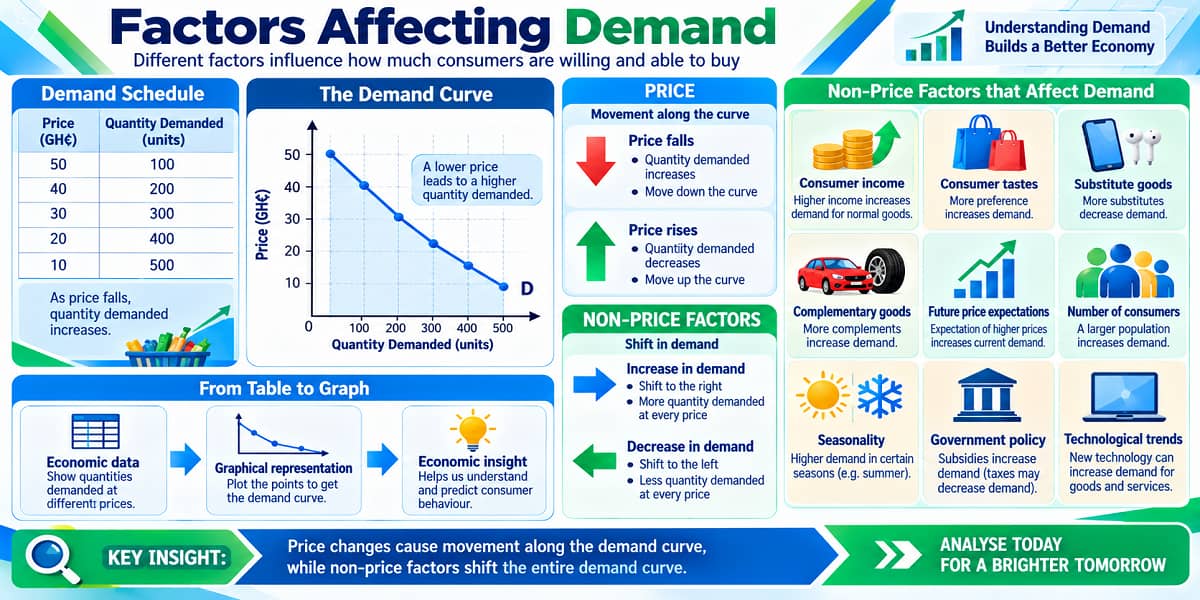
Factors Affecting Demand for a Commodity
Demand does not depend on price alone. A change in the price of a commodity affects the quantity demanded, while changes in other demand factors can cause a change in demand.
1. Price and Quantity Demanded
The law of demand states that, all things being equal, as the price of a commodity decreases, quantity demanded increases; as price increases, quantity demanded decreases.
This is an inverse relationship between price and quantity demanded.
| Price | Quantity Demanded |
|---|---|
| GH₵10 | 12 |
| GH₵20 | 8 |
| GH₵30 | 5 |
| GH₵40 | 2 |
Notice what happens: as price rises from GH₵10 to GH₵40, quantity demanded falls from 12 to 2.
2. Why Does Price Affect Quantity Demanded?
Two important reasons are highlighted by the relationship:
- Substitution: when the price of a commodity rises, consumers may switch to a cheaper alternative.
- Purchasing power: a higher price reduces consumers’ real purchasing power, while a lower price increases their purchasing power.
3. Movement Along the Demand Curve
When the price of the commodity itself changes, the quantity demanded changes. The result is a movement along the same demand curve.
Key distinction: a price change causes a change in quantity demanded, not a shift of the entire demand curve.
4. Other Factors Affecting Demand
Demand can also be affected by:
- income of consumers;
- consumer preferences and tastes;
- prices of related goods;
- expectations of future prices;
- number of consumers;
- seasonality;
- government policies; and
- market dynamics such as trends, fads and technological advancement.
5. Income of Consumers
Normal goods are goods for which demand increases as consumer income increases.
Inferior goods are goods for which demand decreases as consumer income increases and increases when income falls.
| Type of good | Change in income | Effect on demand |
|---|---|---|
| Normal good | Income increases | Demand increases |
| Inferior good | Income increases | Demand decreases |
6. Consumer Preferences and Tastes
Changes in tastes and preferences can change demand. Trends, advertising and fashion can influence what consumers want to buy.
For example, if a new health study indicates that a particular food is beneficial, demand for that food may increase.
7. Prices of Related Goods
Related goods can be substitutes or complements.
Substitutes can replace each other because they satisfy similar needs. If the price of one substitute rises, consumers may switch to the other, increasing its demand.
Complements are goods normally consumed together. If the price of one complement rises, demand for the other usually decreases.
| Related goods | Effect |
|---|---|
| Substitutes | Price of one rises → demand for the other typically increases. |
| Complements | Price of one rises → demand for the other usually decreases. |
8. Expectations of Future Prices
What consumers expect to happen in the future can influence what they buy today.
If consumers expect prices to rise, they may purchase more now, increasing current demand.
If they expect prices to fall, they may delay purchases, reducing current demand.
9. Number of Consumers
An increase in the number of consumers in a market can increase demand. A decrease in the number of consumers has the opposite effect.
10. Seasonality
Some commodities experience seasonal changes in demand. For example, demand for warm clothing increases in winter.
11. Government Policies
Government taxes, subsidies and regulations can influence demand.
A subsidy is financial assistance provided by government to individuals, businesses or other organisations to support or promote economic activities considered beneficial to the public.
For example, a subsidy on electric cars can increase their demand.
12. Market Dynamics
Trends and fads can temporarily increase demand for particular commodities.
Technological advancement can also make certain products more desirable and increase their demand.
13. Change in Demand
A change in demand occurs when the entire demand curve shifts because of a factor other than the commodity’s own price.
There are two directions:
- Increase in demand: the demand curve shifts to the right. Consumers demand more at every price level.
- Decrease in demand: the demand curve shifts to the left. Consumers demand less at every price level.
14. Price Change or Demand Change?
| What changes? | Result | Graphical effect |
|---|---|---|
| Price of the commodity | Change in quantity demanded | Movement along the same demand curve |
| Income, tastes, related goods, expectations, etc. | Change in demand | Shift of the entire demand curve |
15. Apply What You Know
Question 1: What happens to quantity demanded when the price of a commodity falls?
Answer: Quantity demanded increases, all things being equal.
Question 2: A commodity’s price changes from GH₵2 to GH₵8. Using the schedule below, describe the change in quantity demanded.
| Price (GH₵) | Quantity Demanded |
|---|---|
| 2 | 5 |
| 4 | 4 |
| 6 | 3 |
| 8 | 2 |
| 10 | 1 |
Answer: When price rises from GH₵2 to GH₵8, quantity demanded falls from 5 to 2. This is a change in quantity demanded and would be shown as a movement along the same demand curve.
Question 3: Identify three factors other than price that affect demand.
Answer: Income, consumer preferences and tastes, and prices of related goods.
Question 4: If consumers expect the price of a commodity to rise in the future, what may happen to current demand?
Answer: Consumers may buy more now, increasing current demand.
16. Everyday Economic Thinking
When analysing a change in demand, ask one question first:
Did the price of the commodity itself change, or did something else change?
If the commodity’s own price changed, think movement along the curve.
If another factor changed, think shift of the entire curve.
17. Final Synthesis
Price affects quantity demanded. A rise in price generally reduces quantity demanded, while a fall in price generally increases it.
Income, tastes and preferences, prices of related goods, expectations, number of consumers, seasonality, government policies and market dynamics can cause a change in demand.
Price change → movement along the curve.
Non-price factor → shift of the demand curve.
Access NaCCA-aligned Support Packs
Download your structured NaCCA-aligned Teacher Support Pack and Student Learning Pack, designed for clarity, practicality, and reliable teaching and learning.