Consonant Sounds: Affricates and Approximants; Grammatical Structures; Subordinate Clauses: Relative/Adjective Clauses
1. Begin with What You Already Know
Think about how you speak with friends, read a passage aloud, or answer a comprehension question. Clear communication depends on more than knowing the meanings of words. You also need to pronounce sounds clearly, recognise how words are arranged into meaningful structures, and understand how clauses provide information in sentences.
Read these sentences aloud:
- The judge chose a chair.
- The Ghanaian footballers are skilful.
- The student who answered the question received praise.
Notice three different features. The first sentence contains consonant sounds that need careful articulation. In the second, the word Ghanaian describes the noun footballers. In the third, the words who answered the question identify which student is meant. These examples introduce the three areas of study in this lesson.
2. Consonant Sounds: Affricates and Approximants
2.1 Affricates
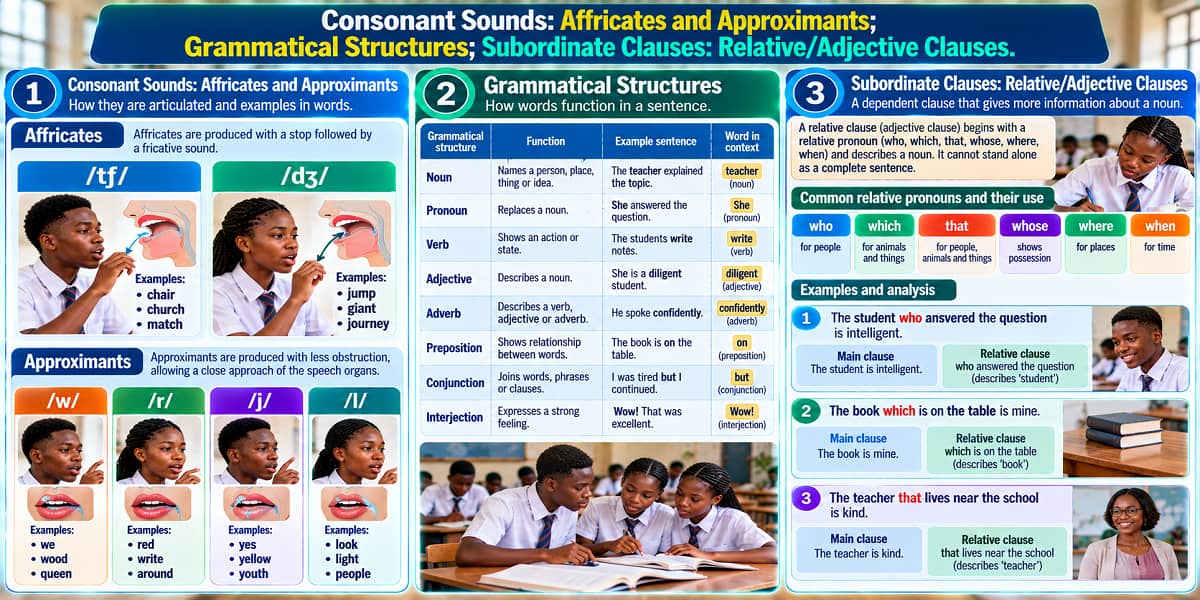
An affricate is a consonant sound produced by beginning with a complete blockage of the airflow, like a plosive, and immediately releasing it through a narrower passage, producing friction like a fricative. English has two affricate phonemes discussed here: /tʃ/ and /dʒ/.
The sound /tʃ/ is heard in church, chin, chick, check, chew, cheap, catch, lunch and feature. It can occur at the beginning, middle or end of a word.
The sound /dʒ/ is heard in judge, jury, age, jeep, edge and large. It can be represented by different spellings. Examples include dg in edge and judge, dj in adjacent, gg in suggest, and di in soldier.
Remember that a spelling does not always tell you the sound by itself. Listen to the word and identify the sound being pronounced.
| Sound | Examples | Practice sentence |
|---|---|---|
| /tʃ/ | chin, rich, catch, church, lunch | The child chose a chocolate chip cookie. |
| /dʒ/ | judge, age, jeep, edge, large | The judge sent Jim to jail. |
2.2 Approximants
Approximants are produced when two speech articulators come close together without touching. Air passes through without the strong friction associated with fricatives. The result is a smooth, vowel-like consonant sound. The four approximants covered here are /w/, /r/, /j/ and /l/.
| Sound | Examples |
|---|---|
| /w/ | west, woman, water, wink, own, brow |
| /r/ | rest, red, era, crown |
| /j/ | yes, you, young, few, mayor |
| /l/ | love, allow, total, allow, track |
In the phonetic symbols used here, /j/ represents the initial sound in yes and young, not the sound usually represented by the letter j in judge. The latter begins with /dʒ/. This distinction is important when you classify words by sound.
2.3 Practise the sounds in connected speech
Pronouncing a sound in isolation is useful, but ordinary communication requires you to produce it clearly within words and sentences. First say the target word slowly. Next, repeat it at a natural pace inside a sentence. Finally, read the complete sentence aloud without separating every word unnaturally.
- The chef cooked a delicious meal.
- The chicken crossed the road.
- The church choir sang a beautiful hymn.
- The judge made a careful decision.
- The cheerleader read the well-written letter yesterday.
- The judge sent Jim to jail for stealing gin and jam.
When practising with a partner, listen attentively before offering feedback. Identify the target sound, say the word clearly, and then use it in a new sentence. You can also create a short rhyme, dialogue, tongue twister or story that includes several of the sounds.
2.4 Worked practice: classifying sounds
Consider chair, cheer, jar and joy. The first two begin with /tʃ/, while the last two begin with /dʒ/. The words differ in spelling, but classification depends on their spoken initial consonants.
Try classifying these words: chest, rich, agenda, large, perch, edge, Japan, lunch.
Suggested answer: /tʃ/: chest, rich, perch, lunch. /dʒ/: agenda, large, edge, Japan. Listen carefully to the pronunciation of each word and check the initial, medial or final position where relevant.
3. Grammatical Structures and Reading Comprehension
3.1 What are grammatical structures?
Grammatical structures are the ways words are organised into phrases, clauses and sentences to communicate meaning. They include phrase structures, clause structures, sentence structures, modifiers and verb structures. Recognising these structures helps you understand how parts of a sentence relate to one another.
For example, in The Ghanaian footballers are skilful, the word Ghanaian qualifies the noun footballers. It functions as an adjective in this sentence. The relationship between the two words helps the reader understand which footballers are being described.
3.2 How structure helps you understand a passage
When you read a comprehension passage, do not treat each word as an isolated item. Examine how the words work together.
- Relationships: Grammar shows how people, objects, actions and ideas are connected.
- Meaning: The arrangement of words helps reveal what a sentence says.
- Organisation: Sentence and clause patterns help you follow the development of ideas.
- Emphasis: A structure can place attention on a particular person, action or result.
- Inference: Grammatical clues can help you work out information that is implied rather than directly stated.
- Coherence: Connected grammatical structures make a passage easier to follow.
- Genre and purpose: Patterns of language can help you recognise whether a passage is narrating, describing or arguing.
Context is equally important. A word may perform different functions in different sentences, so examine how it is used rather than deciding from the word alone.
3.3 A method for answering grammar questions
- Read the whole sentence. Establish what the sentence is communicating.
- Identify the target word or expression. Notice the words immediately before and after it.
- Ask what work it does. Does it name, describe, express an action, modify another word or show a relationship?
- State the grammatical name. Name the part of speech or structure accurately.
- State its function in context. Explain what it contributes to that particular sentence.
For instance, in The Ghanaian footballers are skilful, the grammatical name of Ghanaian is an adjective, and its function is to qualify the noun footballers. A good answer gives both the name and the function when both are requested.
3.4 Try these examples
Use the method above to consider the following sentences:
- She quickly finished her work. The word quickly is an adverb; it modifies the verb phrase by indicating how she finished the work.
- She is a happy person. The word happy is an adjective; it qualifies the noun person.
- I live in the city. The expression in the city is a prepositional phrase indicating where the speaker lives.
- I love to laugh. The expression to laugh is an infinitive phrase functioning as the object or complement of love in this sentence.
- The book is under the table. The expression under the table is a prepositional phrase indicating location.
These examples demonstrate why context matters. The same grammatical category can perform different functions in different sentence patterns.
4. Subordinate Clauses: Relative or Adjective Clauses
4.1 Understanding the clause
A subordinate clause depends on another clause for its place in a larger sentence. A relative clause, also called an adjective clause, gives information about a noun or identifies the person or thing being discussed. It answers a question such as Which one?
Relative clauses commonly begin with the relative pronouns who, whom, whose, which or that.
- The book which is on the table is mine.
- The person who is smiling is my friend.
- The dog that continues barking is my neighbour’s.
- The woman whose name I know is waiting outside.
In each example, the highlighted clause provides information about a noun: book, person, dog or woman. It does not function as an independent sentence in the example; it forms part of a larger sentence.
4.2 Restrictive and non-restrictive clauses
A relative clause may be essential to identifying the noun, or it may add information about a noun already identified. Compare the following sentences.
| Type | Example | How it works |
|---|---|---|
| Restrictive relative clause | The book that is on the table is mine. | The clause identifies which book is meant. |
| Non-restrictive relative clause | The book, which is on the table, is mine. | The clause adds information about a book already identified; commas set it apart. |
| Defining relative clause | The woman who is smiling is my sister. | The clause identifies the particular woman. |
| Non-defining relative clause | My sister, who is smiling, is a doctor. | The clause adds information about the already identified sister. |
In this lesson, restrictive and defining describe the essential identifying role of a clause. Non-restrictive and non-defining describe additional information. Commas are an important clue for a non-restrictive or non-defining clause in these examples.
4.3 Find the noun being described
To identify a relative clause, use three steps:
- Find the relative pronoun, such as who, whom, whose, which or that.
- Read the words that follow it and identify the clause that provides the information.
- Ask which noun the clause describes or identifies.
Example: The student who answered the question received praise. The relative pronoun is who. The relative clause is who answered the question. It describes student and identifies which student received praise.
Another example is My sister, who is smiling, is a doctor. The clause who is smiling adds information about my sister. The commas show that the information is additional rather than necessary to identify which sister is meant in this sentence.
5. Guided Practice with Answers
Activity A: Consonant sounds
Classify each word according to its initial affricate where applicable: chair, jar, chest, joy, judge, cheer.
Answer: /tʃ/: chair, chest, cheer. /dʒ/: jar, joy, judge.
Give two words for each approximant /w/, /r/, /j/ and /l/.
Sample answer: /w/: water, west; /r/: rest, red; /j/: yes, young; /l/: love, total.
Activity B: Grammatical structures
In The Ghanaian footballers are skilful, state the grammatical name and function of Ghanaian.
Answer: It is an adjective; it qualifies the noun footballers.
In She quickly finished her work, identify quickly.
Answer: It is an adverb; it modifies the verb phrase by showing how the work was finished.
Activity C: Relative clauses
Identify the relative clause and its function in each sentence.
- The person who is smiling is my friend.
- My sister, who is smiling, is a doctor.
- The dog that continues barking is my neighbour’s.
Answers:
- who is smiling describes and identifies person; it is defining or restrictive in this sentence.
- who is smiling adds information about my sister; it is non-defining or non-restrictive and is enclosed by commas.
- that continues barking identifies which dog is meant; it is defining or restrictive.
6. Independent Application
Complete the following tasks in your notebook. Give clear examples rather than listing terms without explanation.
- Write four words containing /tʃ/ and four containing /dʒ/. Indicate whether each target sound occurs at the beginning, middle or end of the word.
- Write two words for each of the approximants /w/, /r/, /j/ and /l/, then use at least four of the words in complete sentences.
- Read a short comprehension passage and identify a word or expression whose grammatical function depends on its context. State its grammatical name and function.
- Write four sentences containing relative clauses. Include at least one defining clause and one non-defining clause, using commas where needed.
- Create a short story or dialogue containing several affricate and approximant sounds. Read it aloud clearly to a partner.
Self-check: Can a reader identify your examples easily? Are your sentences complete? Have you identified the noun described by each relative clause? Have you distinguished /tʃ/ from /dʒ/ by sound rather than spelling alone?
7. Bring the Three Areas Together
Clear English depends on sound, structure and meaning working together. Affricates and approximants help you articulate words in connected speech. Grammatical structures help you recognise how words and expressions contribute to meaning in a sentence or passage. Relative clauses add information about nouns or identify precisely which person or thing is meant.
When reading, listen to the words in your mind, examine how the sentence is built, and ask how each clause contributes to the message. When speaking or writing, select structures that express your meaning clearly, and use relative clauses when additional description or identification is needed.
Final reflection: Explain in your own words the difference between /tʃ/ and /dʒ/, describe one way grammatical structure helps comprehension, and write a sentence containing a relative clause. If you can do all three accurately, you have connected the main ideas of this lesson.
Access NaCCA-aligned Support Packs
Download your structured NaCCA-aligned Teacher Support Pack and Student Learning Pack, designed for clarity, practicality, and reliable teaching and learning.