Consonant Sounds: Affricates and Approximants; Grammatical Structures; Subordinate Clauses: Relative/Adjective Clauses Explained for SHS 2 English Language (Sem. 1 – Week 5)
Clear English Begins with Sound, Structure and Meaning
Effective communication involves more than knowing a large number of words. A speaker must pronounce sounds clearly, organise words into meaningful sentences, and understand how information is connected in a passage. These abilities reinforce one another: pronunciation supports spoken communication, grammatical awareness helps readers interpret meaning, and clauses allow writers to describe people and things with precision.
Three areas of English Language bring these skills into focus: affricate and approximant consonant sounds, grammatical structures in reading comprehension, and subordinate clauses known as relative or adjective clauses. Each addresses a different question. How is a sound produced? How does the arrangement of words shape meaning? And how can a sentence give more information about a person or object without beginning an entirely new sentence?
1. Why Some Consonant Sounds Need Special Attention
In everyday conversation, speakers rarely think consciously about the movement of their speech organs. Yet the way air moves through the mouth helps distinguish one consonant from another. Affricates and approximants illustrate two different ways consonant sounds are produced.
Affricates: a stop followed by friction
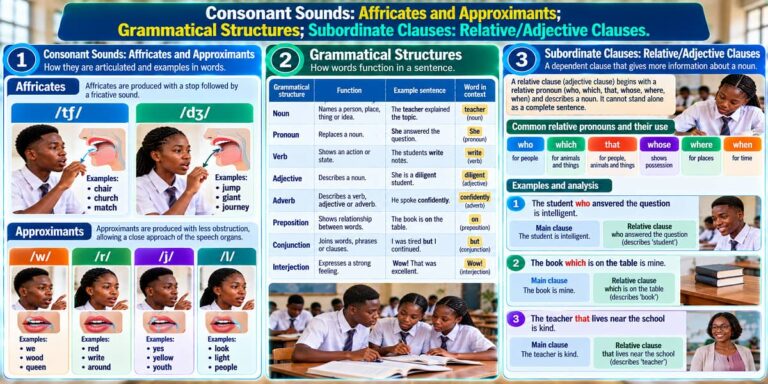
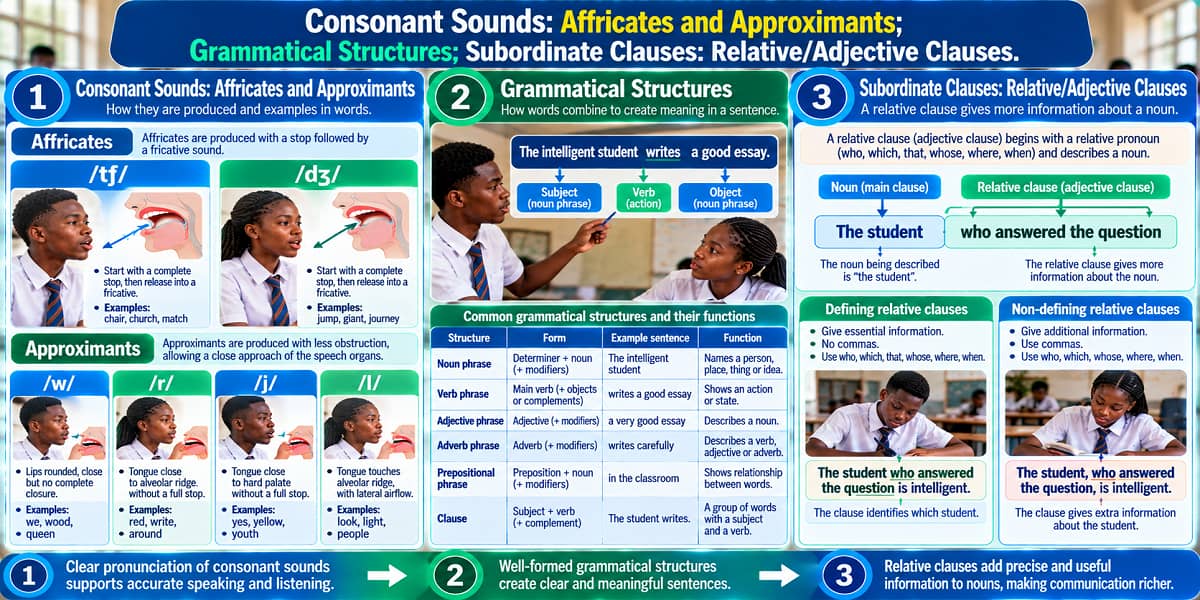
An affricate begins with a complete blockage of airflow and then releases it through a narrower opening, creating friction. The two English affricate phonemes considered here are /tʃ/ and /dʒ/. The first is heard in chair, chin, church, catch and lunch. The second occurs in judge, age, jeep, edge and large.
The contrast can be heard at the beginning of chair and jar. Their initial sounds are different even though the words share some spelling features. This is a useful reminder that identifying a consonant sound requires attention to pronunciation, not merely to letters on a page.
| Sound | Examples | Useful observation |
|---|---|---|
| /tʃ/ | chin, chest, rich, catch, church | May occur at the beginning, middle or end of a word. |
| /dʒ/ | judge, age, jeep, edge, large | Different spellings can represent the same target sound. |
The sound /dʒ/ appears in several spelling patterns: dg in judge, dj in adjacent, gg in suggest, and di in soldier. These examples show why spelling and pronunciation should be studied together without assuming that one letter or letter group always represents one sound.
Approximants: smooth movement of air
Approximants are produced when two articulators come close together without touching. Air moves through the vocal tract without the strong friction associated with a fricative. The four approximants in this area of study are /w/, /r/, /j/ and /l/.
- /w/: west, woman, water, wink.
- /r/: rest, red, era, crown.
- /j/: yes, you, young, few.
- /l/: love, allow, total, track.
One particularly important distinction concerns the symbol /j/. In phonetic transcription, /j/ represents the initial sound in yes and young. It is not the initial sound in judge, which is /dʒ/. A learner who recognises this difference can classify sounds more accurately and explain the difference between a sound symbol and an ordinary letter.
From individual sounds to confident speech
Sound practice is most useful when it moves beyond lists of words. A learner can begin with a single word, place it in a sentence and then use it in a short dialogue. For example, The child chose a chocolate chip cookie offers repeated practice with /tʃ/. The judge sent Jim to jail provides several opportunities to practise /dʒ/.
Reading aloud also develops listening awareness. When learners listen to one another, they can notice whether a sound is clear, compare different attempts and make corrections respectfully. Rhymes, tongue twisters, short stories and dialogues offer practical ways to practise these sounds in connected speech. The goal is not simply to recite a list, but to communicate clearly enough for listeners to follow the message.
2. Grammar Is a Guide to Meaning
Grammar is sometimes treated as a collection of labels to memorise. In reading and writing, however, its value lies in showing how words work together. Grammatical structures include phrases, clauses, sentences, modifiers and verb structures. These patterns help readers understand relationships, follow an argument or narrative, and identify what a writer wants to emphasise.
Consider the sentence The Ghanaian footballers are skilful. The word Ghanaian qualifies the noun footballers. Its grammatical name is an adjective, and its function in this sentence is to describe the noun. The word is easier to interpret accurately because it is examined in the sentence rather than in isolation.
How structure supports comprehension
Grammatical structure can help readers in several connected ways:
- It establishes relationships. Readers can see which words describe, modify or relate to others.
- It organises information. Sentence and clause patterns help readers follow the order in which ideas are presented.
- It signals emphasis. A writer can arrange a sentence to draw attention to a particular element.
- It supports inference. The relationship between clauses can offer clues to meaning that is implied rather than stated directly.
- It strengthens coherence. Grammatical links help readers move from one idea to another without losing the thread of the passage.
- It helps identify purpose. Patterns of language can support the recognition of narrative, descriptive and argumentative writing.
Grammar also helps readers become more efficient. When familiar with common structures, a reader can concentrate more fully on the message instead of struggling with every sentence. Context remains essential, however, because the grammatical function of a word or expression depends on how it is used.
A practical approach to grammar questions
When a comprehension question asks for the grammatical name and function of an expression, read the entire sentence first. Locate the target word or phrase, examine its relationship with neighbouring words, and ask what role it plays. Then provide the name and explain the function.
For example, in She quickly finished her work, quickly is an adverb. It modifies the verb phrase by indicating how she finished the work. In She is a happy person, happy is an adjective qualifying the noun person. The same method—sentence first, relationship second, grammatical label third—makes answers more precise.
Other examples show how phrases contribute to meaning. In I live in the city, the prepositional phrase in the city indicates location. In The book is under the table, under the table also expresses location. Recognising these functions helps a reader understand not only what a sentence says, but how it communicates that information.
3. Relative Clauses: Adding Information with Precision
A relative clause is a subordinate clause that gives information about a noun in a main clause. It is also called an adjective clause because it describes or identifies a noun. Relative clauses commonly begin with the relative pronouns who, whom, whose, which or that. They often answer the question “Which one?”
Compare these examples:
- The person who is smiling is my friend.
- The dog that continues barking is my neighbour’s.
- The woman whose name I know is waiting outside.
- The book which is on the table is mine.
Each highlighted clause gives information about a noun. Instead of writing a separate sentence to describe the person, dog, woman or book, the writer incorporates the information into a larger sentence. This can make description more precise and help sentences connect naturally.
Essential information and additional information
Relative clauses may identify the particular person or thing being discussed, or they may add information about something already identified. A restrictive or defining clause supplies essential identifying information in its sentence. A non-restrictive or non-defining clause supplies additional information and is set apart by commas in the examples below.
| Sentence | Meaning of the clause |
|---|---|
| The book that is on the table is mine. | The clause identifies which book is meant. |
| The book, which is on the table, is mine. | The clause adds information about a book already identified. |
| The woman who is smiling is my sister. | The clause identifies the particular woman. |
| My sister, who is smiling, is a doctor. | The clause adds information about the already identified sister. |
The commas matter because punctuation helps signal how the clause relates to the noun. In the first and third examples, the clause identifies which person or object is meant. In the second and fourth, the clause provides an additional description. Understanding this difference supports both reading comprehension and accurate writing.
Finding a relative clause in a passage
A reliable method is to look for a relative pronoun, read the clause that follows it, and identify the noun that the clause describes. Then decide whether the information identifies the noun or adds extra detail.
In The student who answered the question received praise, the clause is who answered the question. It describes student and identifies which student received praise. In My sister, who is smiling, is a doctor, the clause who is smiling adds information about my sister. The commas help show that the description is additional.
Relative clauses are useful in speech as well as writing. They help speakers identify people and objects, explain relationships, and make descriptions more informative. In a narrative, for example, a clause can introduce a character through an action or distinguishing feature. In a descriptive passage, it can clarify which object or person is being discussed.
4. What These Three Areas Have in Common
Affricates and approximants, grammatical structures and relative clauses may appear to be separate topics, but they all support clear communication. Pronunciation makes spoken words more recognisable. Grammatical structure helps readers understand relationships among ideas. Relative clauses give writers a way to identify and describe nouns precisely.
Imagine reading a short passage aloud. You need to articulate its consonants clearly, recognise how its sentences are organised, and understand the function of any relative clauses. If you encounter a sentence such as The child who chose the chocolate chip cookie smiled, you can practise the /tʃ/ sound in child, chose and chocolate chip, while also identifying who chose the chocolate chip cookie as a relative clause describing child. The example brings pronunciation and grammar together in a meaningful context.
Reading with attention to sound and structure also encourages active learning. Instead of merely completing a passage, readers can ask: Which sound am I practising? What grammatical work does this expression perform? Which noun does this clause describe? Such questions turn reading into a process of noticing, interpreting and checking meaning.
5. Practical Ways to Strengthen the Skills
Short, regular practice can make these ideas easier to use:
- Read aloud. Choose words containing /tʃ/, /dʒ/, /w/, /r/, /j/ and /l/. Say them in complete sentences and listen for clarity.
- Build sound groups. Arrange words by the sound they contain, not simply by their spelling. Explain why each word belongs in its group.
- Annotate a sentence. Underline a target word, identify its grammatical name and write its function in that context.
- Find relative clauses. Locate who, whom, whose, which or that, identify the clause and name the noun it describes.
- Compare punctuation. Write one defining and one non-defining relative clause. Check whether commas are needed to set off additional information.
- Create a short dialogue. Use target consonant sounds and at least one relative clause, then read the dialogue to a partner.
When practising with others, feedback should be specific and respectful. Rather than saying that a sentence is simply “wrong”, identify the sound or structure that needs attention and offer a clearer example. This approach encourages confidence as well as accuracy.
Conclusion
Clear English develops through the interaction of pronunciation, grammatical awareness and meaningful sentence construction. Affricates /tʃ/ and /dʒ/ and approximants /w/, /r/, /j/ and /l/ provide a foundation for careful spoken communication. Grammatical structures help readers interpret how words and ideas are connected. Relative clauses extend this ability by identifying nouns or adding useful information about them.
The practical lesson is simple: pay attention to how language works, not only to what individual words mean. Listen to sounds, examine sentence patterns, and ask how clauses contribute to the message. These habits support clearer speech, more accurate comprehension and more informative writing.
Access NaCCA-aligned Support Packs
Download your structured NaCCA-aligned Teacher Support Pack and Student Learning Pack, designed for clarity, practicality, and reliable teaching and learning.