Consonant Sounds: Patterns of Consonant Clusters; Reading for Pleasure; Subordinate Clause – Adverbial Clause
1. Begin with Three Language Experiences
Imagine reading a story aloud, choosing a book because its subject interests you, and explaining why an event happened. Each activity uses a different aspect of English. You need to pronounce consonant clusters clearly, read with understanding and enjoyment, and construct sentences that show relationships between ideas.
Read these examples aloud:
- The strong student crossed the street.
- I read for pleasure because I enjoy stories.
- When the book ended, I borrowed another one.
In the first sentence, words such as strong and street contain consonant clusters. In the second, the clause beginning with because explains why the person reads. In the third, the clause beginning with when tells us when the action occurred. These examples introduce the three areas of this lesson.
2. Consonant Sounds: Patterns of Consonant Clusters
2.1 What is a consonant cluster?
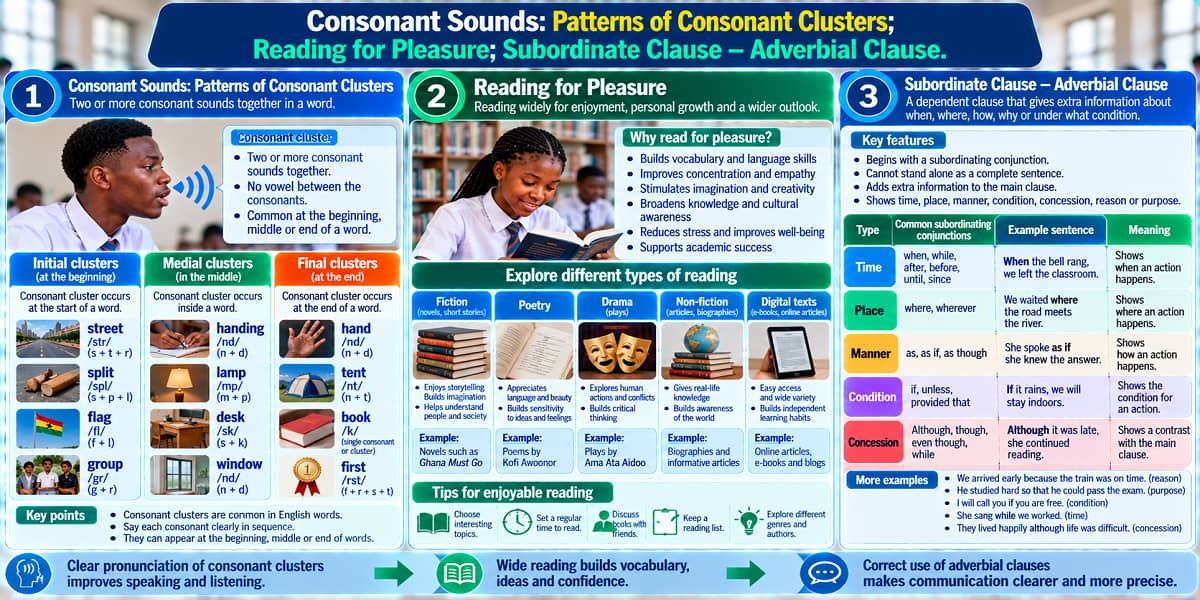
A consonant cluster is a group of two or three consonant sounds that occur together in a word without a vowel sound between them. Clusters occur in different positions: at the beginning, in the middle or at the end of a word. Recognising these positions helps you pronounce words more clearly and identify sound patterns when reading.
For example, the beginning of brain contains /br/, while split begins with /spl/. In hand, the final consonant sounds include /nd/. The important point is to notice the consonant sounds that occur together, rather than simply counting letters.
2.2 Initial consonant clusters
An initial consonant cluster occurs at the beginning of a word. The following examples show common two-consonant clusters and some three-consonant clusters.
| Cluster | Examples |
|---|---|
| /br/ | brain, bridge, bread, bright |
| /fr/ | free, phrase, fruit |
| /gr/ | green, grey, grin, great |
| /kl/ | clean, clay, clap, cloud |
| /kr/ | cream, crate, crane, crew |
| /sk/ | skit, score, scold, school |
| /sl/ | slit, slate, slot, slum |
| /tr/ | treat, tray, trim, trait |
| /bl/ | black, blue, bless |
| /spl/ | split, splash, spleen |
| /str/ | stretch, straight, strength |
Practise by saying each word slowly, paying attention to the beginning sounds. Then repeat the word at a natural speaking pace. Avoid inserting an extra vowel between the consonants. For example, practise the beginning of street as one connected cluster rather than separating the sounds with an added vowel.
2.3 Medial consonant clusters
A medial consonant cluster occurs in the middle of a word. Examples include /nd/ in handing and standard, /ng/ in singers and banger, and /ld/ in folded, scolding and folder.
To recognise a medial cluster, say the word clearly and listen to the consonant sounds inside it. The sounds before and after the cluster help you hear its position. Practising words in complete sentences makes it easier to use them naturally in speech.
2.4 Final consonant clusters
A final consonant cluster occurs at the end of a word. Examples include /nd/ in hand, brand and sand; /ld/ in old, bold and wield; and /rst/ in first, burst and thirst.
| Position | Examples | What to listen for |
|---|---|---|
| Initial | black, split, street | Consonants at the beginning of the word. |
| Medial | handing, standard, folded | Consonants occurring together inside the word. |
| Final | hand, old, first | Consonants at the end of the word. |
Final clusters can be difficult to hear when speaking quickly. Practise the entire word without dropping its final sounds. Clear articulation helps listeners distinguish words and understand your message.
2.5 Practise through rhymes and tongue twisters
Tongue twisters encourage careful listening and controlled articulation. Start slowly, then gradually increase your speed while maintaining clarity.
- She sells seashells at the seashore.
- The shells she sells at the seashore are seashore shells.
- Through three cheese trees three free fleas flew.
- While these fleas flew, frenzy breeze blew.
You can also create a short story or rhyme containing words with initial and final clusters. Working with a partner makes practice more enjoyable: one person reads, the other listens for the target sounds, and both discuss which words need another attempt.
3. Reading for Pleasure
3.1 Meaning of reading for pleasure
Reading for pleasure means reading voluntarily because you enjoy it or are interested in what you are reading, rather than reading only to complete an academic or professional task. It may involve novels, short stories, magazines, comics, poetry, plays, biographies, folktales or digital books.
You might choose a story because you enjoy its characters, read a poem because its language interests you, or explore a non-fiction book because you want to understand a subject. The choice is guided by curiosity and personal interest.
3.2 Why reading for pleasure matters
Reading for enjoyment can support learning and personal development in several ways.
- Vocabulary and language skills: Reading exposes you to words, phrases and sentence patterns that can strengthen communication.
- Critical thinking: Stories and informative texts invite you to consider evidence, evaluate information and make judgements.
- Imagination and creativity: Fiction and poetry can inspire new ideas and ways of seeing situations.
- Personal growth: Reading about different experiences and perspectives can help you reflect on yourself and others.
- Relaxation: An enjoyable book can provide a calming activity and a break from everyday pressures.
- Knowledge: Non-fiction and informative texts can expand understanding of science, history, technology and other subjects.
- Focus: Following a text encourages attention and concentration.
- Empathy: Reading about characters and their experiences can help readers consider other people’s feelings and perspectives.
- Academic and professional development: Strong reading habits support the understanding and application of information.
- Enjoyment: Reading can simply be entertaining, satisfying and personally meaningful.
3.3 What can you read?
Reading for pleasure does not mean choosing only long novels. The most useful starting point is material that interests you and is suitable for your reading level.
| Reading material | Examples | What it may offer |
|---|---|---|
| Novels and fiction | Things Fall Apart by Chinua Achebe; Changes: A Love Story by Ama Ata Aidoo | Characters, plots, cultures and imaginative experiences. |
| Short stories | Collections of African short stories and individual stories | Complete narratives that can be read in shorter periods. |
| Poetry | Poems by Kofi Awoonor, Kwame Dawes and Kofi Anyidoho | Imagery, rhythm, emotion and concise expression. |
| Drama | The Marriage of Anansewa by Efua Sutherland | Dialogue, conflict and character relationships. |
| Magazines | The Mirror and Junior Graphic | Articles, interviews and varied topics. |
| Non-fiction | Biographies and books on science, history or technology | Information and real-life experiences. |
| Digital reading | E-books, audiobooks and digital library collections | Different ways to access reading materials. |
| Local literature | Ghanaian folktales and contemporary Ghanaian writing | Stories, values, heritage and local perspectives. |
You can also read class anthologies, stories written by friends and book reviews created by other learners. Sharing reading experiences may help you discover new material and understand why different readers enjoy different texts.
3.4 Build a reading habit
Choose something that genuinely interests you. Set aside a regular time for reading, even if the period is short. If a text is too difficult or does not hold your attention, try another suitable text or format. After reading, tell someone what you enjoyed, record an interesting word, or write a brief review. The aim is to make reading a meaningful and sustainable habit, not merely another task to complete.
4. Subordinate Clause: Adverbial Clause
4.1 What is an adverbial clause?
An adverbial clause is a dependent clause that functions like an adverb. It modifies a verb, an adjective or another adverb by providing information such as time, place, manner, condition or concession. It typically begins with a subordinating conjunction such as after, although, because, before, if, since, unless, until or while.
Consider: I went for a walk because I needed some fresh air. The clause because I needed some fresh air explains why the speaker went for a walk. It cannot stand alone as a complete sentence in this example because it depends on the main clause to complete the thought.
4.2 Types of adverbial clauses
| Type | Example | Question answered |
|---|---|---|
| Time | After I finish my homework, I’ll watch TV. | When will I watch TV? |
| Place | Where I live, there are many parks. | Where are there many parks? |
| Manner | She screamed loudly, as if she were scared. | How did she scream? |
| Condition | If it rains, I’ll take an umbrella. | Under what condition will I take an umbrella? |
| Concession | Although I’m tired, I’ll finish the project. | What contrast is expressed? |
A time clause tells when something happens. A place clause gives location. A manner clause explains how an action is carried out. A condition clause states what must happen for something else to occur. A concession clause presents a contrast between an expected situation and what actually happens.
4.3 Structure and punctuation
A common structure for an adverbial clause is:
Subordinating conjunction + subject + verb + additional information.
For example, in because I needed some fresh air, because introduces the clause, I is the subject, and needed is the verb. The remaining words complete the meaning.
An adverbial clause can come before or after the main clause. When it comes first, a comma commonly separates it from the main clause: When I got home, I realised I had forgotten my keys. When the dependent clause follows the main clause, a comma is often unnecessary: I realised I had forgotten my keys when I got home.
4.4 Guided practice with answers
Identify the adverbial clause and its type.
- We’ll leave when the movie finishes.
- If it rains, I’ll take an umbrella.
- Although I’m tired, I’ll stay up late to finish the project.
- She screamed as if she were scared.
- Where I live, there are many parks.
Answers:
- when the movie finishes — time.
- If it rains — condition.
- Although I’m tired — concession.
- as if she were scared — manner.
- Where I live — place.
5. Independent Practice
Complete the following tasks. Check your answers by asking whether each example meets the stated purpose.
- Write four words with initial consonant clusters and four with final consonant clusters. Identify the cluster in each word.
- Write a five-line poem or tongue twister using words that contain consonant clusters. Read it aloud clearly.
- Explain at least two benefits of reading for pleasure to a friend. Name three kinds of reading material you would choose for enjoyment and explain your choices.
- Write a five-paragraph short story that explores one or more of these themes: love, commitment, honesty or hard work.
- Write one adverbial clause each for time, place, manner, condition and concession.
- Combine these pairs using an adverbial clause: “She studied hard. She passed the exam.” “He arrived late. He missed the bus.”
Suggested answers for Task 6: “She passed the exam because she studied hard.” “He missed the bus because he arrived late.” In both sentences, the clause beginning with because gives a reason. Other grammatically correct combinations are possible if they preserve a sensible relationship between the ideas.
6. Bring the Three Areas Together
Consonant clusters help you pronounce words clearly. Reading for pleasure encourages regular contact with language, ideas and different perspectives. Adverbial clauses help you express relationships such as time, place, manner, condition and concession. These skills support one another: reading provides opportunities to notice sound patterns and sentence structures, while speaking and writing allow you to practise them.
As you continue reading and communicating, ask yourself: Can I pronounce the consonant clusters clearly? Am I choosing reading material that interests me? Does my adverbial clause explain the intended relationship? Accurate answers will help you develop confidence in spoken and written English.
Access NaCCA-aligned Support Packs
Download your structured NaCCA-aligned Teacher Support Pack and Student Learning Pack, designed for clarity, practicality, and reliable teaching and learning.