Consonant Sounds: Patterns of Consonant Clusters; Reading for Pleasure; Subordinate Clause – Adverbial Clause Explained for SHS 2 English Language (Sem. 1 – Week 7)
Three Habits That Make English More Effective
Speaking clearly, reading willingly and organising ideas into meaningful sentences may seem like separate skills. In practice, they strengthen one another. Clear pronunciation helps listeners recognise words. Reading for pleasure brings learners into contact with vocabulary, stories and different viewpoints. Grammatical structures help speakers and writers explain when, where, why and under what conditions events happen.
These connections can be explored through three areas of English Language: consonant clusters, reading for pleasure and adverbial clauses. Each offers a practical way to become a more confident communicator, whether speaking in a discussion, reading a story or writing about an experience.
1. Consonant Clusters: Small Sound Groups, Clearer Speech
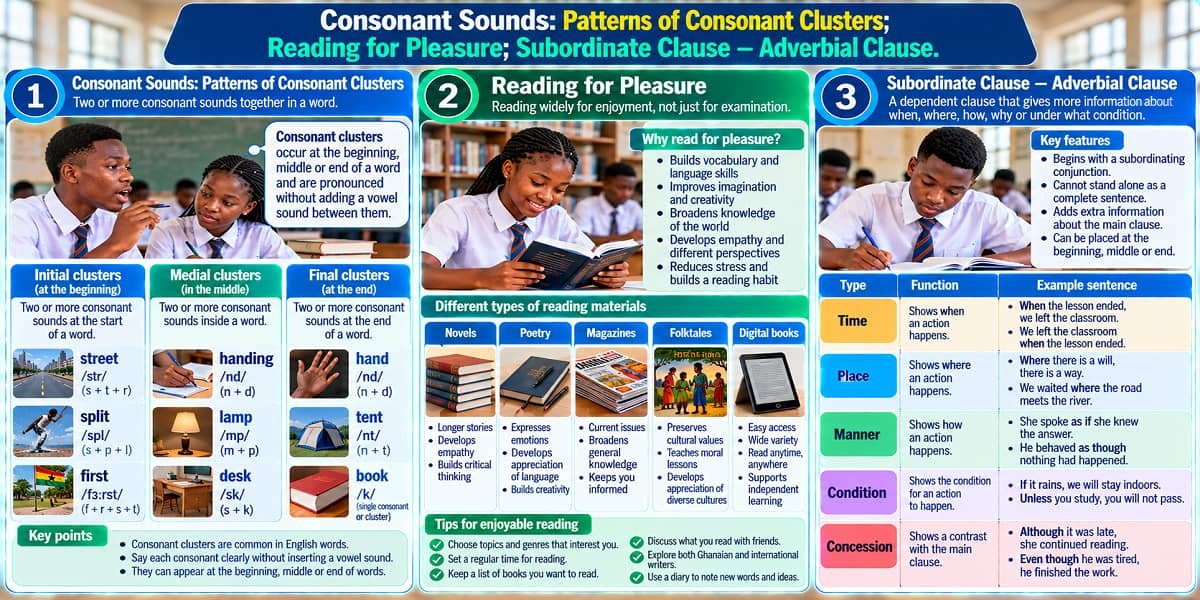
A consonant cluster is a group of two or three consonant sounds that occur together in a word without a vowel sound between them. Clusters can appear at the beginning, middle or end of a word. Recognising these patterns helps learners listen carefully and articulate words more clearly.
Consider the words brain, split and hand. The word brain begins with /br/, split begins with /spl/, and hand ends with /nd/. Each example gives learners a different position in which consonant sounds occur together.
Where clusters occur
| Position | Examples | What to notice |
|---|---|---|
| Initial | brain, black, clean, split, street | The consonant group occurs at the beginning. |
| Medial | handing, standard, folded | The consonant group occurs in the middle. |
| Final | hand, brand, old, first | The consonant group occurs at the end. |
Initial clusters include /br/ in bridge, /fr/ in free, /gr/ in green, /kl/ in clean, /kr/ in cream, /sk/ in school, /sl/ in slate, /tr/ in treat and /bl/ in blue. Three-consonant examples include /spl/ in split and /str/ in strength.
Medial examples include /nd/ in handing and standard, /ng/ in singers and banger, and /ld/ in folded and folder. Final examples include /nd/ in sand, /ld/ in bold and /rst/ in first.
How practice improves articulation
When a learner finds a cluster difficult, the answer is not to rush through the word. Begin slowly, identify the consonants that occur together, and repeat the whole word without adding an extra vowel between the sounds. Then use the word in a complete sentence. This movement from isolated word to connected speech helps pronunciation become more natural.
Tongue twisters offer an enjoyable form of practice. Try “She sells seashells at the seashore” or “Through three cheese trees three free fleas flew.” The purpose is not speed alone. A fast reading that makes the words unclear is less useful than a steady reading in which the consonants can be heard.
Learners can work in pairs or groups to collect words with particular clusters, create short rhymes, write stories or compete in word-finding games. One learner can read while another listens for the target sounds. They can then exchange roles. This makes practice interactive and encourages patience, cooperation and respectful feedback.
2. Reading for Pleasure: Learning Beyond Assignments
Reading for pleasure is reading voluntarily for enjoyment or personal interest rather than solely to complete an academic or professional requirement. It includes novels, short stories, poetry, plays, magazines, comics, biographies, folktales, non-fiction books and digital texts. A learner might read because a character is interesting, a topic raises questions or the language of a poem creates a memorable impression.
The key feature is choice. When readers can explore material that interests them, reading becomes more than a task set by someone else. It becomes an activity they can return to for entertainment, curiosity and personal growth.
What readers gain
Reading for pleasure can support vocabulary development and language awareness because readers encounter words and sentence patterns in meaningful contexts. It can also encourage critical thinking: a story may invite readers to question a character’s decision, while an informative text may prompt them to evaluate a claim or consider evidence.
Imaginative works can inspire creativity by presenting unfamiliar situations and possibilities. Reading about people whose lives differ from our own can broaden understanding and encourage empathy. Non-fiction can expand knowledge of science, history, technology and other subjects. Following a story or argument also gives readers practice in maintaining attention and remembering how ideas develop.
Reading can be relaxing and enjoyable as well. A reader may turn to a story for entertainment, a poem for its language or a biography for inspiration. These different reasons are all compatible with reading for pleasure. The value does not depend on reading only one kind of book or treating every text as an examination exercise.
Choosing what to read
A useful reading habit begins with material that matches the reader’s interests and reading level. African literature offers many possible starting points. Chinua Achebe’s Things Fall Apart, Ama Ata Aidoo’s Changes: A Love Story and Ayi Kwei Armah’s The Beautyful Ones Are Not Yet Born are examples of novels. Readers interested in shorter narratives can explore short-story collections, including collections of contemporary African stories.
Poetry offers another experience: the reader can notice imagery, rhythm, emotion and carefully chosen language. Works by African poets such as Kofi Awoonor, Kwame Dawes and Kofi Anyidoho provide options for exploring poetry. Drama, including Efua Sutherland’s The Marriage of Anansewa, presents stories through dialogue and action.
Reading does not have to be limited to books. Magazines such as The Mirror and Junior Graphic, biographies, informational books, e-books, audiobooks and digital library collections offer different ways to explore interests. Ghanaian folktales and contemporary Ghanaian writing can connect readers with local stories, heritage and values. Class anthologies and peer book reviews can also help learners discover writing by their classmates.
Turning occasional reading into a habit
Choose a text that makes you curious, set aside a regular time to read and allow yourself to explore different genres. You do not need to finish every book you start if it is unsuitable for your interests or level. After reading, share a favourite moment, explain what surprised you or write a short review. These simple responses can help you reflect on the reading experience without turning every enjoyable text into a formal assignment.
Reading for pleasure is not a replacement for academic reading. Rather, it complements formal study by giving learners additional opportunities to encounter language, explore ideas and develop confidence as readers.
3. Adverbial Clauses: Showing How Ideas Connect
A sentence becomes more informative when it explains the relationship between events. Compare “I went for a walk” with “I went for a walk because I needed some fresh air.” The second sentence explains why the walk happened. The words because I needed some fresh air form an adverbial clause.
An adverbial clause is a dependent clause that functions like an adverb. It modifies a verb, an adjective or another adverb by providing information such as time, place, manner, condition or concession. It often begins with a subordinating conjunction, including after, although, because, before, if, since, unless, until and while.
Five useful types
- Time: “After I finish my homework, I’ll watch TV.” The clause indicates when the action will happen.
- Place: “Where I live, there are many parks.” The clause indicates location.
- Manner: “She screamed as if she were scared.” The clause explains how the action was performed.
- Condition: “If it rains, I’ll take an umbrella.” The clause states a condition for the main action.
- Concession: “Although I’m tired, I’ll finish the project.” The clause presents a contrast between being tired and continuing the project.
Recognising the type of clause helps readers understand the relationship between the ideas. Time clauses establish sequence or duration. Place clauses locate an event. Manner clauses explain how something happens. Condition clauses establish a circumstance on which another event depends. Concession clauses show that an action happens despite an opposing circumstance.
How the clause fits into the sentence
A common pattern is subordinating conjunction + subject + verb + additional information. In because I needed some fresh air, because introduces the clause, I is the subject and needed is the verb. The rest of the clause completes the meaning.
An adverbial clause can appear before or after the main clause. In “When I got home, I realised I had forgotten my keys,” the clause comes first and is followed by a comma. In “I realised I had forgotten my keys when I got home,” it follows the main clause, and a comma is generally unnecessary.
Adverbial clauses allow writers to move beyond a list of disconnected statements. They can show cause, sequence, contrast and conditions, making explanations and narratives easier to follow. A reader who recognises these relationships can interpret a passage more accurately.
4. A Connected Approach to English
These three areas can reinforce one another during a single reading activity. When learners read a story aloud, they can notice consonant clusters in words, follow the story for enjoyment and examine adverbial clauses that explain when or why events happen. Reading provides examples of language in context; pronunciation practice makes learners more aware of the sounds within words; grammar helps explain how sentences organise meaning.
For example, in “After the student crossed the street, she continued reading because the story interested her,” the initial cluster in street provides a pronunciation example. The clause beginning with after establishes time, while the clause beginning with because gives a reason. The sentence also describes someone engaged in reading, linking the language skills to an everyday activity.
To practise, collect words containing initial and final clusters, read a text you genuinely enjoy, and identify adverbial clauses that explain time, place, manner, condition or concession. Share examples with a partner and explain why each one belongs to its category. Discussion helps learners check their reasoning and learn from different examples.
Conclusion
Clear speech, voluntary reading and meaningful sentence construction are complementary parts of English learning. Consonant clusters help learners articulate words accurately. Reading for pleasure develops a sustained relationship with language, ideas and imagination. Adverbial clauses make relationships between events explicit, allowing readers and writers to communicate time, place, manner, condition and contrast.
The most effective practice is regular and purposeful: speak clearly, read what interests you, and examine how sentences connect ideas. These habits can make English more understandable, more expressive and more enjoyable to use.
Access NaCCA-aligned Support Packs
Download your structured NaCCA-aligned Teacher Support Pack and Student Learning Pack, designed for clarity, practicality, and reliable teaching and learning.