Adverbial Clauses, Narrative Writing and Poetry Themes
Introduction: How Language Creates Meaning
Think about three situations. You explain why you stayed at home, tell a friend about an experience that changed you, and read a poem that makes you question whether people are always sincere. Each situation requires you to understand and communicate meaning. Grammar helps you express relationships between ideas; narrative writing helps you organise events into an engaging story; and poetry invites you to interpret ideas and feelings through carefully chosen language.
In this lesson, you will explore three connected areas of English Language: adverbial clauses, narrative writing, and the identification of common themes in poetry. As you work through them, pay attention not only to what words say, but also to the relationships they create and the meanings they suggest.
1. Subordinate Clauses: Adverbial Clauses
What is an adverbial clause?
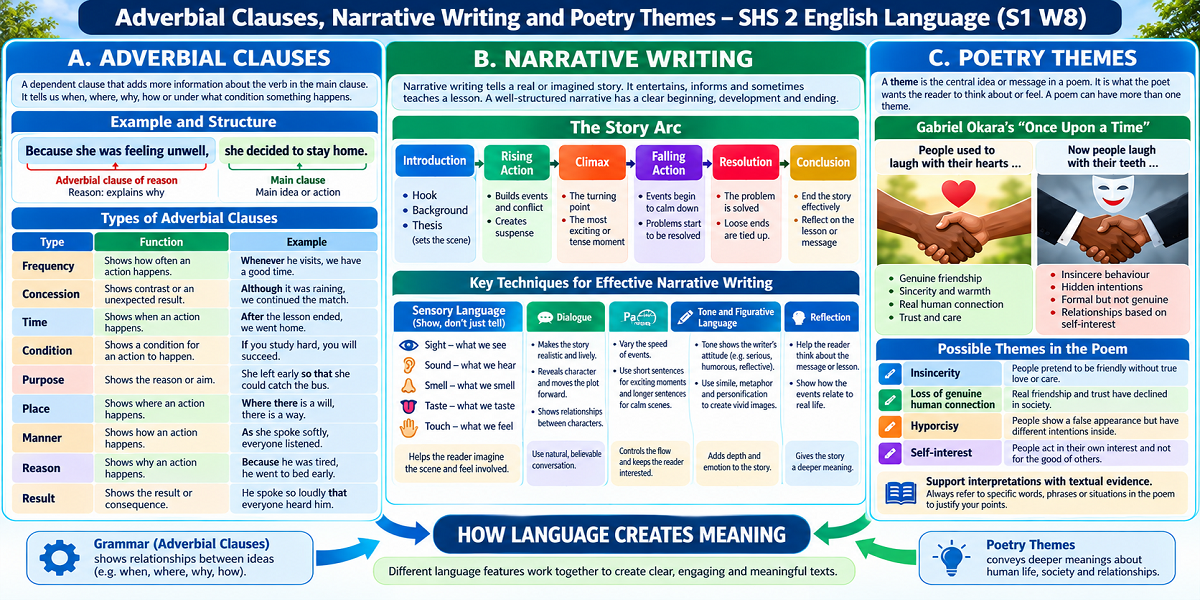
An adverbial clause is a dependent clause that functions like an adverb. It adds information about an action or situation in a main clause. It may tell us when or where something happens, how often it happens, how it happens, why it happens, what condition applies, what purpose is intended, what contrast exists, or what result follows.
For example: Because she was feeling unwell, she decided to stay home. The expression Because she was feeling unwell cannot communicate the complete main message on its own in this sentence. It gives the reason for the decision expressed in she decided to stay home.
Adverbial clauses are often introduced by subordinating words or expressions such as after, although, as, because, before, if, since, so that, unless, whenever, when, wherever and even though. The introductory word provides a clue to the relationship between the clauses, but you should always interpret the whole sentence to identify the function accurately.
Types and functions of adverbial clauses
Different adverbial clauses express different relationships. Study the examples and ask what question each clause answers.
| Type | Example | Function |
|---|---|---|
| Frequency | Whenever she visits her grandparents, she brings them fresh flowers. | Shows how often the action occurs. |
| Concession | Although the experiment was difficult, the students completed it successfully. | Shows contrast between difficulty and success. |
| Time | When the bell rings, the students rush to their next class. | Specifies when the action occurs. |
| Condition | If it rains tomorrow, we shall cancel the picnic. | States the condition for an action. |
| Purpose | She saved money so that she could buy a new laptop. | Explains the intention behind an action. |
| Place | You can sit wherever you find a free seat. | Identifies the place related to the action. |
| Manner | Adoma solved the problem as if she were a professional mathematician. | Describes how the action was performed. |
| Reason | Because she was feeling unwell, she decided to stay home. | Explains why an action occurred. |
| Result | Aziz studied so hard that he aced all his exams. | Shows the consequence of an action or situation. |
Look closely at meaning
Frequency: In Every time he reads a book, he takes notes, the clause Every time he reads a book tells us how often he takes notes. It is not simply a statement about one reading event; it indicates a repeated pattern.
Concession: In Even though she had little time to study, she performed excellently on the test, the first clause introduces a difficulty. The main clause presents an outcome that contrasts with what might have been expected.
Time and condition: Compare After she finishes her homework, she likes to read a novel with Unless you complete your assignment, you cannot join the field trip. The first indicates when an action follows; the second makes participation dependent on a condition.
Purpose and result: Purpose concerns intention, while result concerns what follows. In They are learning English so that they can communicate with their new neighbours, communication is the intended purpose. In The presentation was so captivating that the audience was left in awe, the audience’s reaction is the result.
Place and manner: Wherever the coach goes, the team follows relates the team’s action to a place. The artist painted the landscape as if he had seen it in a dream describes the manner of painting through a comparison.
Grammatical name and grammatical function
When a question asks for the grammatical name (GN), identify what the expression is: an adverbial clause of result, reason, or manner, for example. When it asks for the grammatical function (GF), explain what the clause does in that particular sentence.
- “Because she was feeling unwell” — GN: adverbial clause of reason. GF: explains why she decided to stay home.
- “As if she were a professional mathematician” — GN: adverbial clause of manner. GF: describes how Adoma solved the problem.
- “So that the audience was left in awe” — in the sentence about the captivating presentation, this is an adverbial clause of result. GF: shows the effect of the presentation’s captivating nature.
Notice that the function must relate to the meaning of the whole sentence. Naming the type without explaining its contribution does not fully answer a question about both GN and GF.
Practise the grammar
Activity A: Identify the type of adverbial clause in each sentence.
- Whenever they meet, they discuss their future plans.
- Though the weather was unfavourable, the soccer match continued as planned.
- Provided that they study hard, they will pass the exams.
- He plants flowers wherever there is space in the garden.
- Since it was his birthday, he received many gifts from his friends.
Answers: 1. Frequency. 2. Concession. 3. Condition. 4. Place. 5. Reason.
Activity B: Combine each pair of ideas using an adverbial clause.
- She studied hard. She passed the examination.
- He arrived late. He missed the bus.
- She saved money. She wanted to buy a new laptop.
Sample answers: 1. Because she studied hard, she passed the examination. 2. Because he arrived late, he missed the bus. 3. She saved money so that she could buy a new laptop. Other grammatically correct answers may be possible if the intended relationship is clear.
2. Narrative Writing: Features, Structure and Style
What makes a narrative effective?
A narrative essay tells a story about an experience or event. It usually presents a clear sequence of events and may include the writer’s reflections on what happened. A narrative does more than list actions: it guides the reader through an experience and helps the reader understand why that experience matters.
Narratives often use a first-person perspective, with words such as I, me and my, especially when the writer recounts a personal experience. They can include characters, a setting, dialogue, descriptive language, sensory details, an engaging opening, transitions and a meaningful conclusion. Reflection may reveal how the narrator’s thoughts or understanding changed.
The structure of a narrative essay
The introduction uses HBT: Hook to attract attention, Background to establish context, and Thesis to preview the story and its significance. The rising action develops events and builds tension. The climax is the most intense or critical moment. The falling action shows what follows that turning point, while the resolution addresses the conflict. The conclusion summarises the experience, returns to its significance and offers final thoughts or reflection.
These stages guide the reader, but they do not require every story to follow an identical pattern. Some narratives use a non-linear structure, presenting events out of chronological order. In such a story, transitions must help readers understand changes in time and the relationship between events.
Imagery: helping readers experience a story
Sensory language appeals to sight, sound, smell, taste and touch. These details make a setting or experience more vivid when they are chosen carefully. Consider: I stepped into the dim room, where the smell of damp wood lingered and a loose window rattled in the wind. The word dim suggests sight; smell of damp wood appeals to smell; and rattled helps the reader imagine a sound.
Effective imagery is selective. A writer does not need to describe every object or sensation. Instead, choose details that establish the atmosphere, reveal a character’s experience or make an important moment memorable. Figurative language can add further force: a simile compares using like or as; a metaphor describes one thing in terms of another; personification gives human qualities to something non-human; hyperbole deliberately exaggerates; and alliteration repeats initial consonant sounds.
Style and coherence
A writer’s style includes tone, vocabulary, sentence arrangement, pacing, dialogue, imagery and figurative language. Tone may be humorous, reflective, serious or informal. Pacing controls how quickly events unfold: a short sentence may sharpen a moment of danger, while a longer reflective sentence may slow the narrative. Dialogue can reveal relationships or character, but it should contribute to the story rather than interrupt it.
Transitions help events and ideas connect. Words and expressions such as later, before long, meanwhile, after that and eventually can clarify sequence when appropriate. A coherent story has connected paragraphs and a clear direction. Its ending should arise from the events rather than introduce an unrelated new issue.
Plan before you write
For the topic “No pain, no gain,” you might plan a narrator who enters a school competition without adequate preparation, struggles during practice, makes a serious mistake, recognises the need for effort, practises regularly, seeks feedback and improves. The lesson should emerge from the events and reflection, not merely be attached as an unrelated moral.
For a story ending with “It was a blessing in disguise,” plan a narrator who misses a trip because of an unexpected problem, feels disappointed, later learns that the absence kept the narrator away from a difficulty affecting the group, and reflects on the unexpected benefit. These are planning possibilities: the writer must develop the characters, details and sequence into a complete, coherent story.
Writing practice with a complete model plan
Task: Write a narrative ending with “It was a blessing in disguise.”
- Hook and background: Begin with the narrator’s excitement about an important trip and introduce the unexpected problem that prevents attendance.
- Rising action: Show the narrator’s disappointment and the efforts made to resolve the problem.
- Climax: Reveal the moment when the narrator learns that the group encountered a serious difficulty.
- Falling action and resolution: Describe the narrator’s changed feelings and explain how the new information changes the meaning of the missed trip.
- Conclusion: Reflect on the difference between an immediate disappointment and an unexpected benefit.
Model concluding paragraph: At first, missing the trip seemed like the worst thing that could have happened to me. Later, when I learnt about the difficulty the group had faced, I understood that my disappointment had hidden an unexpected benefit. I could not have predicted the outcome, but the experience taught me to judge a situation carefully before deciding that everything has gone wrong. It was a blessing in disguise.
3. Poetry: Identifying Common Themes Across Poems
From subject to theme
A poem may describe a person, a conversation or a remembered experience, but its theme is the larger idea explored through that material. A subject is what the poem is about on the surface; a theme is the meaning or insight that develops from it. Themes should be supported by details in the poem rather than by personal opinion alone.
In Gabriel Okara’s poem “Once Upon a Time,” the speaker addresses his son and compares how people behaved in the past with how they behave in the present. The contrast invites readers to consider whether outward friendliness always reflects genuine feeling.
Reading the poem for evidence
The speaker remembers a time when people “used to laugh with their hearts” and “laugh with their eyes.” The expression connects laughter with inner feeling: the friendliness described appears genuine. The speaker then contrasts this memory with people who “only laugh with their teeth.” This image suggests that a smile may remain visible even when warmth or sincerity is absent.
The description of “ice-block-cold eyes” strengthens the contrast. Eyes that search “behind my shadow” suggest suspicion rather than open friendliness. The speaker also remembers a handshake made “with their hearts,” but says that people now shake hands “without hearts” while their left hands search his empty pockets. The handshake becomes a sign of outward politeness that may conceal self-interest.
The poem also describes something that once seemed “a giant as tall as / Rice stacks” shrinking “to less than a peanut,” and something mighty becoming a whisper. These images communicate a dramatic loss of size, strength or importance. Their meaning should be interpreted in relation to the speaker’s wider contrast between past and present, rather than treated as isolated descriptions.
Possible themes and how to support them
- Insincerity: The contrast between laughter with the heart and laughter with the teeth suggests that outward expressions can hide a lack of genuine feeling.
- Loss of genuine human connection: The remembered heart-felt laughter and handshakes are contrasted with colder, less sincere interactions.
- Hypocrisy and outward appearance: A friendly smile or handshake may look welcoming while the person’s actions suggest a different intention.
- Self-interest: The image of a left hand searching the speaker’s empty pockets suggests an attempt to gain something from the interaction.
These themes overlap, but they are not identical. Insincerity concerns the gap between appearance and feeling; hypocrisy concerns a misleading outward presentation; self-interest focuses on personal gain. When discussing a theme, identify a relevant image or contrast and explain how it supports the interpretation.
How to compare themes across poems
To identify a common theme across two or more poems, first identify the main concern of each poem. Next, locate a shared idea, such as love, hard work, commitment, nature, insincerity or hatred, where the texts genuinely support that connection. Then compare how each poem develops the idea through its images, speaker, language and contrasts. Do not assume that two poems have the same theme merely because they mention the same subject.
For example, two poems might both discuss friendship, but one could celebrate trust while another explores betrayal. Their subject may be similar, while their treatment of the subject differs. A strong comparison recognises both the common idea and the difference in the poets’ presentation.
4. Review and Application
Use the following questions to check your understanding. Suggested answers are included so you can review your reasoning.
- What is an adverbial clause?
A dependent clause that functions like an adverb by adding information such as time, place, frequency, manner, condition, concession, purpose, reason or result. - Identify the clause type and function: “The presentation was so captivating that the audience was left in awe.”
Answer: “That the audience was left in awe” is an adverbial clause of result. It shows the result of the presentation being so captivating. - What does HBT mean in a narrative introduction?
Answer: Hook, Background and Thesis. These elements attract attention, establish context and preview the story’s significance. - Name three sensory details a narrative writer can use.
Answer: A visual detail, a sound and a smell are three possibilities. Taste and touch may also be used where relevant. - Give one theme in “Once Upon a Time” and support it with evidence.
Sample answer: Insincerity is a possible theme. The contrast between laughter “with their hearts” in the past and laughter “with their teeth” in the present suggests that outward friendliness may not reflect genuine feeling.
Conclusion
Adverbial clauses clarify relationships between ideas and help sentences express precise meanings. Narrative writing turns events into a structured and meaningful experience through plot, sensory language, style and reflection. Poetry develops ideas through images, contrasts and carefully chosen words, allowing readers to infer themes and support interpretations with textual evidence. As you practise these three areas, move beyond naming features: explain what each feature contributes to meaning.
Access NaCCA-aligned Support Packs
Download your structured NaCCA-aligned Teacher Support Pack and Student Learning Pack, designed for clarity, practicality, and reliable teaching and learning.