Discourse and Conversations, Story Elements and Adjectives
Introduction
Effective communication depends on more than knowing the meanings of words. It also involves understanding the situation in which communication takes place, organising information clearly and choosing expressions that convey the intended meaning.
Imagine speaking with your friends during break time and then addressing your school’s headteacher about an important matter. Would you use exactly the same expressions in both situations? Similarly, when reading a story, how can you identify its most important events without repeating every detail? When describing a person, object or experience, which words help you communicate the intended qualities?
These situations demonstrate the importance of appropriate language use, summarising and grammatical accuracy.
This lesson explores three areas of English Language: discourse and conversations, the parts and elements of a story, and adjectives. Together, they develop the ability to communicate appropriately, understand written texts and describe people and things accurately.
PART ONE: ORAL LANGUAGE — DISCOURSE AND CONVERSATIONS
1. Understanding Discourse and Conversations
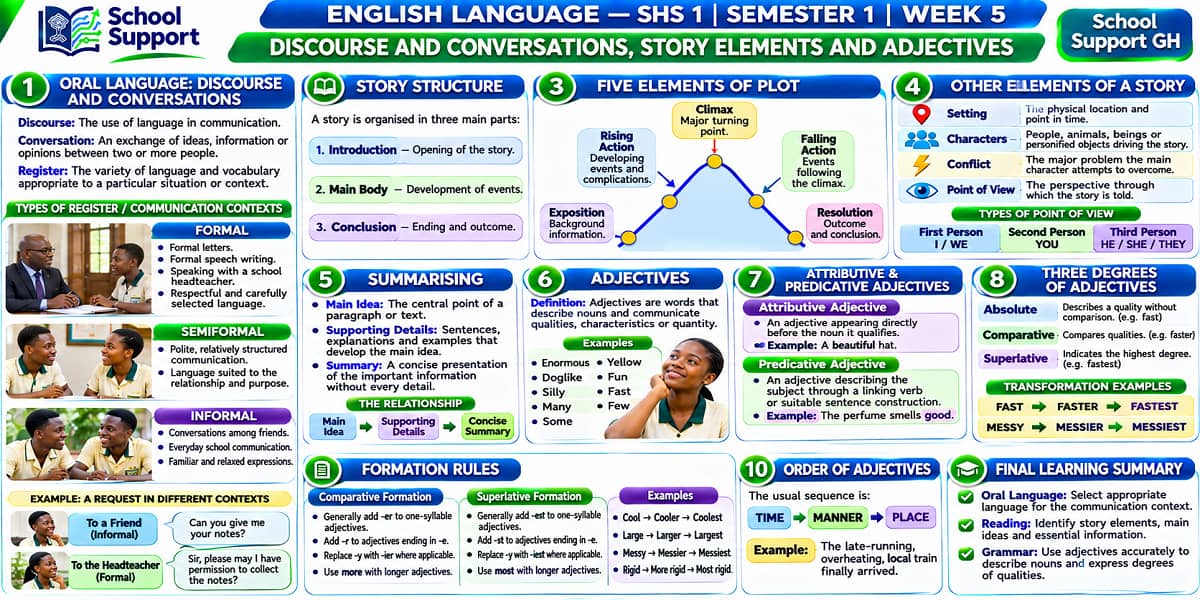
Discourse refers to the use of language in communication. It involves expressing ideas, exchanging information and responding appropriately in different situations.
Conversation is an exchange of ideas, information or opinions between two or more people. It involves speaking, listening and responding in ways that help participants understand one another.
Communication does not take place in the same way everywhere. The relationship between speakers, the purpose of the interaction and the situation determine the kind of language that is appropriate.
For example, a conversation between close friends may contain familiar expressions, while an interaction with a school headteacher may require more respectful and formal language.
2. Understanding Register
Register refers to the variety of language and vocabulary appropriate to a particular situation or context. It determines the expressions, tone and level of formality that speakers use when communicating.
Three speech contexts are identified in this lesson:
Formal context: This involves situations where careful, respectful and relatively official language is expected. Examples include formal speech writing, formal letters and speaking with a school headteacher.
Semiformal context: This involves communication that is neither completely formal nor entirely informal. The language is generally polite and conversational, depending on the relationship between the speakers and the purpose of the interaction.
Informal context: This involves relaxed communication among people who are familiar with one another, such as friends and classmates. Everyday conversations within the school environment provide examples.
3. Choosing Appropriate Language in Different Contexts
The same message can be expressed differently depending on the situation.
Asking a friend for assistance: “Please, can you help me with this exercise?”
Requesting assistance from a headteacher: “Good morning, Sir. May I kindly request your assistance with this matter?”
Both expressions communicate a request. However, the second uses a more formal and respectful register suitable for addressing a school authority.
Appropriate communication therefore requires speakers to consider their audience, purpose and surroundings before selecting their expressions.
4. Examples of Speech Situations
Communication in a school setting: Learners interact with friends, teachers and school authorities. The vocabulary used should reflect the relationship between the people communicating.
Asking for directions: A speaker should use clear and polite expressions when requesting information about a location.
Requesting a favour: The language should communicate the request respectfully while recognising the relationship between the speaker and the person being addressed.
Describing a market scene: Speakers select appropriate descriptive vocabulary to explain what they observe, including people, activities and surroundings.
Attending a job interview: Formal and respectful language is important when responding to questions and presenting information about oneself.
Asking questions in class: Learners should communicate their questions clearly and respectfully to teachers and classmates.
5. Communicative Strategies
Effective conversations require participants to listen, respond and contribute meaningfully to discussions.
Listening attentively: Speakers should pay attention to what others say before responding. This helps prevent misunderstanding and supports meaningful interaction.
Choosing appropriate expressions: Participants should select vocabulary that suits the situation and the people involved.
Giving relevant responses: Responses should address the subject being discussed rather than introducing unrelated information.
Respecting different opinions: Communication should allow participants to express different views without unnecessary conflict.
Taking turns: Participants should allow others to speak and avoid dominating conversations.
Using role-play: Practising different speech situations helps learners understand how language and communicative strategies change according to context.
6. Comparing Formal and Informal Language
| Feature | Formal communication | Informal communication |
|---|---|---|
| Situation | Official or professional interactions. | Relaxed everyday interactions. |
| Language | Carefully selected and respectful expressions. | Familiar and conversational expressions. |
| Audience | Authorities, officials and unfamiliar people. | Friends, classmates and familiar people. |
| Example | Speaking with a school headteacher. | Communicating with a close friend. |
Semiformal communication falls between these contexts. Its expressions depend on the purpose of the interaction and the relationship between the speakers.
PART TWO: READING — PARTS AND ELEMENTS OF A STORY
7. Understanding the Structure of a Story
A story is a narrative that presents events involving characters within a particular setting. To understand and communicate its meaning, readers need to recognise how the information is organised.
The three main parts of a story are Introduction, Main Body and Conclusion.
Introduction: This is the opening part of a story. It introduces the situation and provides relevant information that helps readers understand what is happening.
Main Body: This is the central part of the story where the events develop. Problems emerge, characters respond to situations and the main action progresses.
Conclusion: This is the final part of the story. It brings the narrative to an end and presents the outcome of the events.
8. The Elements of a Story
Beyond its three main parts, a story contains elements that help organise events, establish meaning and maintain the reader’s interest.
1. Plot: Plot refers to the events or actions that drive a story. It describes what happens, the problems characters attempt to solve and how they respond to those problems.
The plot contains five important elements:
Exposition: Introduces the background information and circumstances necessary for understanding the story.
Rising Action: Presents the developing events and complications that build towards the central problem.
Climax: Represents the major turning point or most intense moment in the story.
Falling Action: Presents the events that follow the climax as the situation moves towards its outcome.
Resolution: Brings the main problem or conflict towards its conclusion.
2. Setting: Setting refers to the physical location and point in time in which the plot takes place. It establishes where and when the events occur.
For example, a story may take place in a village, a school, a market or a city. Its events may occur in the morning, at night or during a particular historical period.
3. Characters: Characters are the people, animals, beings or personified objects that drive a story. A narrative may contain many characters or focus on one main character.
4. Conflict/Climax: Conflict refers to the major problem in a story. It concerns what the main character is attempting to overcome or resolve. The source also identifies conflict/climax as a focal area in discussing story elements.
5. Point of View (POV): Point of view describes the perspective or lens through which a story is told. The common forms identified in the learning material are first-person, second-person and third-person.
First-person point of view: The story is told from the perspective of a narrator who uses expressions such as I and we.
Second-person point of view: The narrative addresses the reader or another person using you. This form is relatively rare in storytelling.
Third-person point of view: The story is narrated using expressions such as he, she and they. The source identifies third-person omniscient narration as a common form.
9. Main Ideas and Supporting Details
Understanding a story or passage requires identifying the central message and the information that explains it.
Main idea: The main idea is the central point or most important message communicated in a paragraph or text.
Supporting details: These are sentences, explanations and examples that develop or provide evidence for the main idea.
For example, a paragraph about the importance of reading may state that regular reading improves knowledge. Supporting sentences may explain how reading develops vocabulary, exposes learners to new ideas and improves comprehension.
The supporting details help readers understand and appreciate the central idea.
10. Summarising as a Reading Technique
Summarising involves identifying and presenting the main parts or important ideas of a text without including every detail.
A useful summary communicates the essential information in a shorter and more focused form. It helps readers interpret texts and understand the main events of stories.
For example, when retelling a story to someone who has not read it, a learner should concentrate on the important events rather than reproduce every conversation and description.
Identifying the main idea: Read the paragraph carefully and determine the central point being communicated.
Recognising supporting information: Examine the sentences that explain, illustrate or provide examples of the main idea.
Selecting important story events: Identify the major parts of the narrative, including significant actions and developments.
Presenting the essential information: Communicate the selected ideas in a clear and organised manner without allowing minor details to dominate the summary.
11. Retelling and Interpreting Stories
Retelling a story involves presenting its main events in a way that allows another person to understand what happened.
When retelling a story, consider its introduction, main body and conclusion. Identify the characters, setting, important events and central problem.
The ability to retell stories also develops critical thinking because learners must decide which information is important and how the events are connected.
Stories may be obtained from short videos, drama, written passages and other reading materials. Learners can discuss their interpretations and explain how the language used influences their understanding of the story.
PART THREE: GRAMMAR — ADJECTIVES
12. Understanding Adjectives
Adjectives are words that describe nouns. They make nouns more specific by providing information about their qualities, appearance, characteristics or quantity.
Examples include enormous, doglike, silly, yellow, fun, fast, many, few and some.
Consider the sentence: “The brilliant learner won the competition.”
The word brilliant describes the noun learner by providing information about the learner’s quality.
Similarly, in “The yellow bus stopped outside the school”, yellow describes the noun bus.
13. Functions of Adjectives
Adjectives qualify the nouns they are linked to. They help readers and listeners understand exactly which person, object or thing is being discussed.
Describing qualities: An adjective may communicate a quality or characteristic of a noun. Example: Maggie wore a beautiful hat.
Describing appearance: Adjectives may explain the physical appearance of people, animals or objects. Example: Furry dogs may overheat in the summertime.
Indicating quantity: Some adjectives communicate the amount or number of things. Examples include many, few and some.
Expressing degree: Adjectives may indicate the extent to which a quality is present. Example: The scariest villain of all time is Kweku Ananse.
14. Attributive Use of Adjectives
Attributive adjectives are adjectives used directly before the nouns they qualify.
Examples:
- Maggie wore a beautiful hat.
- The furry dogs were resting.
- My cake should have sixteen candles.
- The scariest villain frightened the children.
In each sentence, the adjective appears before the noun it describes.
15. Predicative Use of Adjectives
Predicative adjectives qualify nouns without appearing directly before them. They are commonly used with linking verbs and function as complements that describe the subject.
A linking verb connects the subject to information that describes its state or condition. Examples include forms of to be, feel, seem and taste.
Examples:
- The perfume smells good.
- Driving is faster than walking.
- Fatima is very intelligent.
- Papa Minka seemed very upset.
The adjectives describe the subjects or nouns even though they do not appear immediately before them.
Adjectives may also occur with sensory verbs such as taste, smell, touch and hearing, as well as verbs of appearance.
16. Degrees of Adjectives
Adjectives have three degrees: absolute, comparative and superlative. These forms express different levels of a quality.
Absolute degree: This describes a quality without making a comparison with another person or thing.
Examples: a cool guy, a messy desk, a rigid guideline, an awful situation and a mischievous cat.
Comparative degree: This is used to compare two or more things. It indicates that one has a greater or different degree of a particular quality than another.
Examples: a cooler guy, a messier desk, a more rigid guideline, a more awful situation and a more mischievous cat.
Superlative degree: This indicates the highest degree of a particular quality among the things being compared.
Examples: the coolest guy, the messiest desk, the most rigid guideline, the most awful situation and the most mischievous cat.
17. Forming Comparative Adjectives
Comparative adjectives are generally formed using the suffix -er or the word more, depending on the adjective.
One-syllable adjectives: Most form their comparative by adding -er.
Examples: cool → cooler; fast → faster.
Adjectives ending in -e: Add -r.
Example: large → larger.
Some two-syllable adjectives: These may take -er, particularly adjectives ending in -er, -le, -ow, -ure or -y. For adjectives ending in -y, replace y with -ier.
Examples: messy → messier; narrow → narrower.
Longer adjectives: Adjectives with three or more syllables generally use more before the adjective.
Examples: rigid → more rigid; mischievous → more mischievous.
18. Forming Superlative Adjectives
Superlative adjectives generally use the suffix -est or the word most.
One-syllable adjectives: Add -est to form the superlative.
Examples: cool → coolest; fast → fastest.
Adjectives ending in -e: Add -st.
Example: large → largest.
Two-syllable adjectives ending in -y: Replace y with -iest.
Example: messy → messiest.
Longer adjectives: Use most before the adjective.
Examples: rigid → most rigid; mischievous → most mischievous.
When a superlative adjective is used with an article, the definite article the is generally appropriate because the expression identifies the item or items with the highest degree of a quality.
19. Adjectives in Different Sentence Contexts
Adjectives can appear in several positions depending on the construction of a sentence.
Directly before nouns: “Amuzu is an amazing footballer.” The adjective amazing describes the noun footballer.
With the verb to be: “Fatima is very intelligent.” The adjective intelligent describes the subject Fatima.
With sensory verbs: “The food tastes awful.” The adjective awful describes the food through the sensory verb tastes.
With verbs of appearance: “Papa Minka seemed very upset.” The adjective upset describes the subject through the verb seemed.
20. Order of Adjectives
When several adjectives are used together, their order should be appropriate to the context. The source draws attention to relationships such as minor to, superior to and inferior to.
It also identifies a particular ordering pattern for the rare rhetorical use of three different adjectives together: TIME, MANNER, PLACE.
Example: “The late-running, overheating, local train finally arrived.”
The adjectives communicate different aspects of the train’s description in a particular order.
Learners should practise constructing similar expressions and examining whether a proposed adjective arrangement communicates the intended meaning naturally.
PART FOUR: PRACTICE QUESTIONS AND MODEL ANSWERS
21. Oral Language — Discourse and Conversations
Question 1: What is register in communication?
Model Answer: Register is the variety of language and vocabulary appropriate to a particular situation or context.
Question 2: Identify the three speech contexts discussed in the lesson.
Model Answer: Formal, semiformal and informal contexts.
Question 3: State two examples of formal communication.
Model Answer: Writing formal letters and speaking with a school headteacher.
Question 4: Give two examples of informal communication.
Model Answer: Conversations among close friends and everyday communication among classmates.
Question 5: Why should speakers use appropriate language in different situations?
Model Answer: Appropriate language helps speakers communicate respectfully, clearly and effectively according to the situation and the people involved.
Question 6: What is role-play?
Model Answer: Role-play is an activity in which learners act out situations or conversations to practise appropriate language and communicative strategies.
22. Reading — Parts and Elements of a Story
Question 7: State the three main parts of a story.
Model Answer: Introduction, main body and conclusion.
Question 8: What is plot?
Model Answer: Plot refers to the events or actions that drive a story and explain what happens.
Question 9: State the five elements of plot.
Model Answer: Exposition, rising action, climax, falling action and resolution.
Question 10: What is setting?
Model Answer: Setting is the physical location and point in time in which the plot takes place.
Question 11: Explain conflict in a story.
Model Answer: Conflict is the major problem in a story that the main character attempts to overcome or resolve.
Question 12: What is point of view?
Model Answer: Point of view is the perspective or lens through which a story is told.
Question 13: Identify the three common points of view.
Model Answer: First-person, second-person and third-person.
Question 14: What is the main idea of a paragraph?
Model Answer: The main idea is the central point or most important message communicated in a paragraph.
Question 15: What are supporting details?
Model Answer: Supporting details are sentences, explanations and examples that develop or provide evidence for the main idea.
Question 16: What is summarising?
Model Answer: Summarising involves identifying and presenting the main parts or important ideas of a text without including every detail.
23. Grammar — Adjectives
Question 17: What are adjectives?
Model Answer: Adjectives are words that describe nouns by providing information about their qualities, characteristics or quantity.
Question 18: Differentiate between attributive and predicative adjectives.
Model Answer: Attributive adjectives appear directly before the nouns they qualify, while predicative adjectives describe subjects through linking verbs or other suitable sentence constructions.
Question 19: Identify the adjective in the sentence: “The red car belongs to my father.”
Model Answer: Red.
Question 20: State the three degrees of adjectives.
Model Answer: Absolute, comparative and superlative.
Question 21: Change fast into its comparative and superlative forms.
Model Answer: Comparative: faster. Superlative: fastest.
Question 22: Change messy into its comparative and superlative forms.
Model Answer: Comparative: messier. Superlative: messiest.
Question 23: Change rigid into its comparative and superlative forms.
Model Answer: Comparative: more rigid. Superlative: most rigid.
Question 24: Identify the adjective and the verb in the sentence: “The perfume smells good.”
Model Answer: Adjective: good. Verb: smells.
Question 25: State the adjective order highlighted in the lesson for three different adjectives used rhetorically together.
Model Answer: Time, Manner, Place.
PART FIVE: STANDARD APPLICATION ACTIVITIES
24. Oral Language Activities
Activity 1: Informal Conversation
Work with a partner to create a conversation between two friends discussing a school activity. Identify the informal expressions used and explain why they are appropriate.
Activity 2: Formal Conversation
Prepare a conversation between a learner and the school headteacher. Use respectful expressions and appropriate formal language when asking questions or making requests.
Activity 3: Speech Context Comparison
Discuss how language changes when asking for directions, requesting a favour, describing a market scene and attending a job interview. Identify suitable expressions for each situation.
Activity 4: Role-Play and Self-Assessment
Choose a conversational situation and perform it with your group. Evaluate the appropriateness of the expressions, listening skills and communicative strategies used.
25. Reading and Summarising Activities
Activity 5: Identifying the Main Idea
Read a paragraph and identify its main idea. Underline the supporting sentences and explain how they develop the central point.
Activity 6: Story Structure
Read a short story and identify its introduction, main body and conclusion. Explain what information is presented in each part.
Activity 7: Plot Analysis
Select a story and identify its exposition, rising action, climax, falling action and resolution. Arrange the five elements in their correct sequence.
Activity 8: Story Retelling
Watch a short video or read a story. Retell the main events to someone who has not watched or read it. Concentrate on the important information rather than unnecessary details.
Activity 9: Summary Writing
Read a passage, identify its main ideas and supporting details, and write a summary that communicates the essential information clearly.
Activity 10: Story Appreciation
Discuss a story read in class. Explain your opinion about it and describe how the language used makes the writing meaningful or significant.
26. Grammar Activities
Activity 11: Identifying Adjectives
Read a passage and identify the adjectives. State the nouns they qualify and explain the information each adjective communicates.
Activity 12: Attributive and Predicative Practice
Construct five sentences using attributive adjectives and another five using predicative adjectives. Underline each adjective and identify its position in the sentence.
Activity 13: Degrees of Adjectives
Write the absolute, comparative and superlative forms of suitable adjectives. Use each form in a meaningful sentence.
Activity 14: Adjective Formation
Explore how adjectives can be formed from other word classes, including nouns and verbs. Provide examples and use the resulting adjectives in sentences.
Activity 15: Adjective Order
Complete the following sentences by selecting the appropriate adjective arrangement.
Question A: I was thrilled to receive a ______ book with my order.
- Big, beautiful, leather-bound.
- Leather-bound, big, beautiful.
- Beautiful, big, leather-bound.
Question B: I have been shopping for perfect ______ chopsticks.
- Japanese long sushi.
- Long Japanese sushi.
- Long sushi Japanese.
Conclusion
Effective English Language communication requires appropriate vocabulary, organised ideas and accurate grammatical structures.
Discourse and conversations develop the ability to communicate according to formal, semiformal and informal situations. Recognising register helps speakers select expressions that suit their audience and purpose.
Understanding story structure and its elements helps readers identify important events, recognise relationships between ideas and summarise written texts. The ability to distinguish main ideas from supporting details also improves comprehension and interpretation.
Adjectives make communication more descriptive and specific. Understanding their functions, positions and degrees enables learners to construct meaningful sentences and express qualities accurately.
Final Self-Check
Before completing this lesson, confirm that you can:
- Explain discourse, conversation and register.
- Distinguish formal, semiformal and informal communication.
- Select appropriate expressions for different speech situations.
- Identify the three main parts of a story.
- Explain the five elements of plot.
- Identify setting, characters, conflict and point of view.
- Distinguish main ideas from supporting details.
- Retell and summarise a story using its important information.
- Define adjectives and explain their functions.
- Differentiate between attributive and predicative adjectives.
- Identify absolute, comparative and superlative degrees.
- Form and use adjectives appropriately in sentences.
Final Application: Read a short story and prepare a brief summary of its main events. Identify its introduction, main body, conclusion and five plot elements. Retell the story using appropriate language for your audience. Finally, select five adjectives from your summary and explain their functions and degrees where applicable.
Access NaCCA-aligned Support Packs
Download your structured NaCCA-aligned Teacher Support Pack and Student Learning Pack, designed for clarity, practicality, and reliable teaching and learning.