Examining How Dramatic Forms Are Developed in Varied Texts
Introduction: How Do Playwrights Develop Different Forms of Drama?
Two plays may present completely different experiences even though both are written for performance. One may explore human suffering and the consequences of serious decisions, while another may combine difficult situations with humour. A third may use exaggerated emotions and strong contrasts between characters to create intense dramatic experiences.
These differences do not happen accidentally. Playwrights develop particular forms of drama through carefully selected themes, characterisation, conflicts, dialogue, language and dramatic events. The way these elements interact influences the overall tone and meaning of a play.
Understanding how dramatic forms are developed requires more than identifying whether a text is a tragedy, comedy, tragicomedy or melodrama. It requires examining the features within the text and explaining how they contribute to the dramatic form.
In this lesson, you will examine how tragedy, tragicomedy and melodrama are developed in dramatic texts, consider the contribution of comedy to dramatic storytelling and practise supporting your interpretations with evidence.
PART ONE: HOW DRAMATIC FORMS DEVELOP
1. Understanding the Development of Dramatic Forms
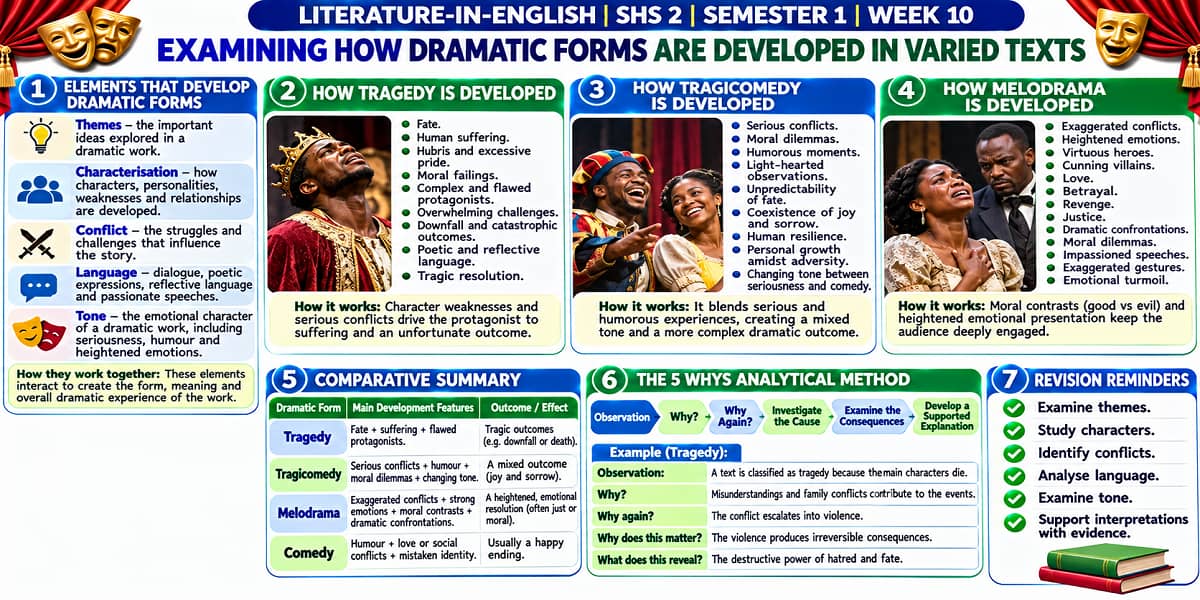
A dramatic form is developed through the combined use of different literary and dramatic elements. These elements influence the tone, themes and interactions between characters and help determine the overall nature of a play.
Themes
Themes are the important ideas or subjects explored in a dramatic work. They influence what the play communicates and the issues that receive attention. For example, fate, human suffering and moral failings are important themes in tragedy, while love, betrayal, revenge and justice feature prominently in melodrama.
Characterisation
Characterisation refers to how characters are presented and developed within a play. Their personalities, weaknesses, decisions and relationships influence the direction of the story. Complex and flawed protagonists contribute to the development of tragedy, while clearly contrasted virtuous heroes and cunning villains are characteristic of melodrama.
Conflict
Conflict involves the struggles and difficulties experienced by characters. The nature of these struggles helps shape a dramatic work. Overwhelming challenges may lead a tragic protagonist towards downfall, while serious conflicts combined with humorous situations contribute to tragicomedy.
Language and Dialogue
The language used by characters contributes to the emotional and intellectual experience of a play. Poetic and reflective language can deepen the serious issues explored in tragedy. Melodrama may use impassioned speeches and exaggerated expressions to communicate intense emotions.
Tone
Tone refers to the overall emotional character of a dramatic work. A play may maintain a serious tone, combine seriousness with humour or create heightened emotional experiences through dramatic exaggeration. Changes in tone can also reveal the combination of different dramatic elements.
Dramatic Outcomes
The consequences of characters’ decisions and the way conflicts develop towards resolution contribute to the identity of a dramatic work. A tragic downfall, for example, reinforces the serious nature of tragedy, while a combination of serious and humorous developments can establish a tragicomic tone.
2. How the Dramatic Elements Work Together
It is important to understand that dramatic forms are not created through isolated features. Themes, characters, conflicts and language interact to shape the audience’s experience.
For example, a protagonist may possess a serious character weakness. That weakness influences a decision, the decision produces consequences, and those consequences move the plot towards a tragic outcome. The language and tone used throughout the play can further strengthen the audience’s understanding of the character’s suffering.
Similarly, a tragicomedy may present serious conflicts while introducing humorous observations. The contrast between these experiences influences how the audience interprets the characters and the events.
The diagram illustrates an important principle: a dramatic form should be identified by examining the combined effect of its elements rather than relying on one isolated characteristic.
PART TWO: DEVELOPING THE MAJOR DRAMATIC FORMS
3. How Tragedy Is Developed
Tragedy is developed through serious themes, complex characters, overwhelming challenges and events that lead towards a tragic resolution. Its purpose is not simply to present sadness but to explore significant human experiences and the consequences of actions and weaknesses.
Fate and Human Suffering
Fate is an important theme in tragedy. The experiences of characters may reveal how circumstances and events influence their lives. Human suffering is also central because the characters encounter serious challenges that produce painful consequences.
Hubris and Moral Failings
Hubris refers to excessive pride or overconfidence. Moral failings are weaknesses in a person’s judgement or conduct. These features can influence the decisions of characters and contribute to the development of tragic events.
Complex and Flawed Protagonists
Tragic protagonists are not necessarily presented as completely good or completely bad. They may possess admirable qualities while also having weaknesses. These flaws contribute to the complexity of their personalities and influence the direction of the plot.
Overwhelming Challenges
Tragic protagonists face challenges that may become increasingly difficult to overcome. As the events develop, their circumstances move towards downfall or catastrophic outcomes.
Poetic and Reflective Language
Tragedy often employs poetic and reflective language. Such language deepens the emotional experience of the audience and encourages consideration of the serious issues explored in the narrative.
Tragic Resolution
The events of tragedy move towards an unavoidable and unfortunate resolution. The downfall of the protagonist or the catastrophic outcome reinforces the seriousness of the play.
These elements work together. The themes establish the serious issues, the characters provide the human experiences, the conflicts develop the plot and the language strengthens the emotional depth.
4. How Tragicomedy Is Developed
Tragicomedy combines elements of tragedy and comedy to explore the complexities of human experience. It recognises that life may contain joy and sorrow, seriousness and humour, and difficult circumstances alongside moments of amusement.
Serious Conflicts
Tragicomedies may present significant conflicts that create difficult situations for the characters. These conflicts contribute to the seriousness of the narrative and provide opportunities for exploring important human experiences.
Moral Dilemmas
A moral dilemma occurs when a character faces a difficult situation involving competing considerations about what is right or appropriate. Such situations add complexity to the story because the characters must confront challenging decisions.
Humorous Moments
Humour and light-hearted observations may appear alongside serious developments. These moments create contrasts in the narrative and prevent the dramatic experience from remaining entirely serious.
Fate, Joy and Sorrow
Tragicomedy often explores the unpredictability of fate and the coexistence of joy and sorrow. These themes reflect the changing experiences that people encounter in life.
Resilience of the Human Spirit
Characters may demonstrate resilience as they respond to adversity. Their experiences can involve personal growth and the ability to continue despite difficult circumstances.
Shifting Tone
The tone may move between seriousness and comedy. These changes reflect the dual nature of human experience and influence the audience’s emotional response.
Tragicomedy therefore develops through the interaction of serious conflicts, humorous observations, changing emotional experiences and characters who grow through adversity.
5. How Melodrama Is Developed
Melodrama engages audiences through exaggerated conflicts, heightened emotions and clear moral contrasts between characters. Its development relies on strong dramatic situations and emotionally expressive presentations.
Exaggerated Conflicts
Melodramas present conflicts in highly dramatic ways. The struggles between characters may involve intense confrontations that emphasise the seriousness of the situations.
Heightened Emotions
Characters express strong emotions in response to the events they experience. Their reactions help create emotional intensity and encourage audiences to respond strongly to the situations presented.
Clear Moral Contrasts
Melodrama often presents virtuous heroes in contrast with cunning villains. These contrasting character positions make moral conflicts more visible to the audience.
Important Themes
Love, betrayal, revenge and justice are important themes explored in melodrama. These themes create opportunities for dramatic confrontations and moral dilemmas.
Character Confrontations
Heroes and villains may become involved in intense confrontations that reveal their opposing intentions and values. Such encounters contribute to emotional turmoil and the progression of the plot.
Impassioned Speeches and Exaggerated Gestures
Melodramas use dramatic language, passionate speeches and exaggerated gestures. These techniques strengthen the emotional presentation and may communicate moral lessons through heightened and sensational situations.
Melodrama therefore depends on the combination of dramatic conflict, strong emotional expression and clearly presented moral differences.
6. Understanding Comedy Within Dramatic Development
Comedy is another important dramatic form considered when examining how plays are developed. The central learning task is to examine a dramatic text and explain why it belongs to a particular form.
When studying a comedy, consider the features that make the story funny and how the playwright develops those features through the events and characters. Examine the situations that produce humour and consider how the audience is expected to respond.
It is also useful to compare a comedy with a tragedy. A comparison should examine how the nature of the story influences character experiences, the progression of events and the emotional response created by the play.
The analysis should be supported by details from the dramatic text rather than simply describing a play as funny or serious.
PART THREE: ANALYSING DRAMATIC TEXTS
7. Using the 5 Whys Strategy
The 5 Whys strategy is a method of analysis in which a learner repeatedly asks why a particular observation or conclusion is correct. Each answer leads to another question that encourages deeper examination.
For example, consider the following analysis of a dramatic text classified as tragedy.
Initial Observation: The text is a tragedy.
Why 1? Because the main characters die at the end.
Why 2? Because a series of misunderstandings and family conflicts contributes to the development of the events.
Why 3? Because the conflicts escalate into violence.
Why 4? Because the violence produces irreversible consequences.
Why 5? Because those consequences highlight the destructive power of hatred and fate.
This approach moves beyond simply naming the dramatic form. It helps learners establish a chain of reasoning that connects the events of a play with its themes and overall dramatic character.
The final explanation should be concise and supported by the details identified during the analysis.
8. Analysing Characters, Conflicts and Language
When examining a dramatic text, pay attention to the following areas.
Characters
Identify the central characters and examine their personalities, weaknesses, motivations and relationships. Consider whether their experiences contribute to the development of tragedy, tragicomedy or melodrama.
Conflicts
Identify the struggles experienced by the characters. Examine whether the conflicts are serious, humorous, exaggerated or a combination of different elements.
Themes
Identify the major ideas explored in the play. Consider fate, suffering, moral failings, joy, sorrow, love, betrayal, revenge and justice where relevant.
Language
Examine how dialogue, poetic expressions, reflective language, passionate speeches and exaggerated expressions contribute to the presentation.
Tone and Audience Response
Consider whether the dramatic experience is serious, humorous, emotionally intense or changing between different moods. Explain how the selected features influence the audience’s thoughts and feelings.
9. Examining Drama Through Film and Performance
Dramatic forms can also be examined through performances and film excerpts. Watching a scene allows learners to observe how actors communicate emotions and how dramatic elements appear in action.
Pay attention to the characters’ expressions, gestures, dialogue, conflicts and interactions. These details can provide evidence for identifying the dramatic form represented.
Grand Guignol is another dramatic form mentioned for exploration. It combines elements of tragedy, horror and comedy. Selected Hitchcock films are identified as possible examples, while Arsenic and Old Lace is mentioned as a gentler, old-fashioned version of this form.
This example demonstrates that dramatic experiences can combine different elements and that the relationship between tragedy and comedy can be explored in more complex ways.
PART FOUR: PRACTICAL APPLICATION AND ASSESSMENT
10. Practice Questions and Model Answers
Attempt each question before reading the model answer. Use complete explanations where required.
Question 1: Mention three elements that contribute to the development of dramatic forms.
Model Answer: Themes, characterisation and conflict are three important elements. Language, tone and dramatic outcomes also contribute to the development of dramatic forms.
Question 2: Explain two themes commonly explored in tragedy.
Model Answer: Fate explores how circumstances and events influence the experiences of characters. Human suffering examines the pain and serious difficulties experienced by characters as the dramatic events develop.
Question 3: What is hubris, and how can it contribute to tragedy?
Model Answer: Hubris refers to excessive pride or overconfidence. It can influence a character’s decisions and contribute to actions that lead towards downfall or serious consequences.
Question 4: Explain three features that contribute to the development of tragicomedy.
Model Answer: Tragicomedy combines serious conflicts with humorous moments, explores moral dilemmas and may present changing tones between seriousness and comedy. It also explores themes such as fate, joy, sorrow and human resilience.
Question 5: State four characteristics of melodrama.
Model Answer:
- Exaggerated conflicts.
- Heightened emotions.
- Clear moral contrasts between virtuous heroes and cunning villains.
- Impassioned speeches and exaggerated gestures.
Question 6: How does language contribute to the development of tragedy and melodrama?
Model Answer: Tragedy uses poetic and reflective language to deepen emotional experiences and communicate serious issues. Melodrama uses dramatic language, passionate speeches and exaggerated gestures to evoke strong emotional responses.
Question 7: What is the purpose of the 5 Whys strategy when analysing a dramatic text?
Model Answer: It encourages learners to ask repeated why questions to investigate the reasons behind a classification or observation. It helps them develop deeper explanations and connect dramatic features with themes and outcomes.
Question 8: Identify four themes explored in melodrama.
Model Answer: Love, betrayal, revenge and justice.
Question 9: Explain how tragicomedy reflects the dual nature of human experience.
Model Answer: Tragicomedy combines serious and humorous experiences. Its changing tone reflects how joy and sorrow, adversity and amusement can coexist in human life.
11. Extended Application Activities
Activity 1: Examining a Tragic or Comic Text
Select a short dramatic excerpt and identify the form it represents. Examine the characters, themes, conflicts and language. Explain how these elements contribute to the development of that dramatic form.
Activity 2: Applying the 5 Whys
Work in groups and select a dramatic text. Begin with a statement identifying its form, then ask and answer five connected why questions. Use the answers to develop a concise explanation supported by evidence from the text.
Activity 3: Analysing a Film or Drama Clip
Watch a selected dramatic scene and identify the features that suggest its form. Examine the emotions created, the characters’ behaviour, the conflicts and the language used. Compare your observations with those from the earlier text.
Activity 4: Think-Pair-Share
Think independently about the dramatic elements observed in a selected performance. Discuss your observations with a partner and then share your conclusions with the class. Explain how the elements influence the audience’s emotional response.
Activity 5: Presentation on Dramatic Development
Prepare a PowerPoint presentation or a three-paragraph essay explaining how comedy or tragedy influences what happens to the characters in a story. Support your explanation with relevant examples and demonstrate the connection between the dramatic form and the characters’ experiences.
Activity 6: Independent Exploration
Select examples of drama from books, films or television programmes you enjoy. Apply the 5 Whys strategy to explain why each example belongs to its chosen dramatic form. Present your findings and support your conclusions with specific observations.
Conclusion: Understanding How Dramatic Forms Are Crafted
Dramatic forms develop through the interaction of themes, characters, conflicts, language, tone and dramatic outcomes. These elements determine how a play communicates ideas and creates emotional experiences for its audience.
Tragedy explores fate, suffering, hubris and moral failings through complex protagonists and serious outcomes. Tragicomedy combines serious conflicts and moral dilemmas with humour, changing tones and human resilience. Melodrama uses exaggerated conflicts, heightened emotions and clear moral contrasts to produce intense dramatic experiences.
Analysing these features requires careful examination of dramatic texts. Strategies such as the 5 Whys encourage deeper reasoning, while discussions, film analysis and presentations provide opportunities to apply literary understanding.
Ultimately, the ability to explain how dramatic elements work together is more valuable than simply memorising the names of dramatic forms. It enables readers to interpret plays, understand characters and appreciate how playwrights develop their stories.
Final Self-Check
Confirm that you can:
- Explain how dramatic forms are developed through literary elements.
- Identify themes and character features associated with tragedy.
- Explain how serious conflicts and humour combine in tragicomedy.
- Describe the use of exaggerated conflicts and heightened emotions in melodrama.
- Explain how language and tone influence dramatic experiences.
- Apply the 5 Whys strategy to analyse a dramatic text.
- Support the classification of a play with evidence.
- Present an explanation of how a dramatic form influences characters and events.
Final Application: Select a dramatic text and explain how its themes, characters, conflicts and language contribute to its dramatic form. Use the 5 Whys strategy to deepen your reasoning and prepare a concise presentation of your findings.
Access NaCCA-aligned Support Packs
Download your structured NaCCA-aligned Teacher Support Pack and Student Learning Pack, designed for clarity, practicality, and reliable teaching and learning.