Informal Letter Writing Explained for SHS 1 English Language (Semester 2, Week 3)
Writing an informal letter is one of the easiest and most personal ways of communicating with friends, relatives, and family members. It allows writers to share experiences, express feelings, give information, and maintain strong relationships using friendly and natural language.
What You Will Learn
- The meaning of an informal letter.
- The purposes of informal letter writing.
- The features and format of an informal letter.
- How to organise the introduction, body, and conclusion of a letter.
- How to write an effective informal letter using the correct format.
Main Explanation
An informal letter is a personal letter written to close acquaintances such as friends, family members, relatives, and other people with whom the writer has a familiar relationship. Because of this close relationship, informal letters use a friendly, conversational, and personal tone rather than formal language. They may also express the writer’s emotions and personal experiences.
Informal letters may be written for many different purposes. A writer may inform a friend about success in a competition, describe a recent holiday or trip, talk about a movie, enquire about someone’s health, congratulate someone on an achievement, invite a friend to an event, send greetings, or simply keep in touch. The subject of an informal letter depends on what the writer wishes to communicate.
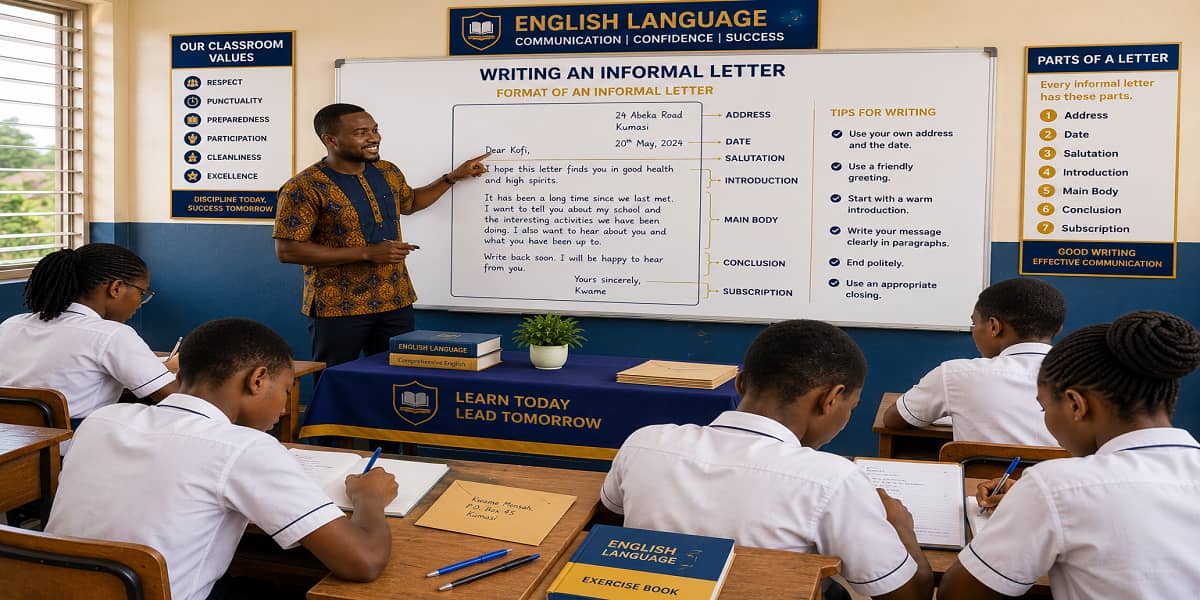
Every informal letter follows a recognised format. The writer begins with the address at the top left-hand side of the page, followed by the date. Next comes a friendly salutation beginning with the word Dear and the recipient’s name. The introduction opens the discussion and prepares the reader for the main message. The main body explains the reason for writing in detail, while the conclusion ends the discussion on a friendly note. Finally, the subscription closes the letter with expressions such as Your loving friend, Yours ever, or simply Yours, followed by the writer’s name.
Features Of An Informal Letter
| Feature | Purpose | Example |
|---|---|---|
| Address | Shows the writer’s address | Written at the top left-hand side |
| Date | Indicates when the letter was written | Written below the address |
| Salutation | Greets the recipient | Dear Ama, Dear Kweku |
| Introduction | Introduces the purpose of the letter | Opening paragraph |
| Main Body | Explains the message in detail | Middle paragraphs |
| Conclusion | Ends the letter on a friendly note | Closing paragraph |
| Subscription | Provides a polite closing | Your loving friend, Yours ever, Yours |
Organising the ideas properly is essential when writing an informal letter. The introduction should briefly explain why the letter is being written. The main body should provide all the necessary details in a logical order, while the conclusion should end warmly and politely before the subscription is written. Following this structure helps the reader understand the message clearly.
Steps In Writing An Informal Letter
| Step | Action |
|---|---|
| 1 | Write the address. |
| 2 | Write the date. |
| 3 | Write the salutation. |
| 4 | Introduce the purpose of the letter. |
| 5 | Develop the main body with relevant details. |
| 6 | Write a friendly conclusion. |
| 7 | End with an appropriate subscription and your name. |
Worked Examples
Example 1
Scenario: A learner wants to write to a friend about winning a school quiz competition.
Explanation: Since the letter is addressed to a friend, it should follow the informal letter format by including the address, date, salutation, introduction, main body, conclusion, and subscription while maintaining a friendly tone throughout.
Example 2
Scenario: A student writes to invite a cousin to spend the vacation together.
Explanation: The writer should begin with the correct format, explain the purpose of the invitation in the body of the letter, and end with a warm and friendly conclusion before signing appropriately.
Why This Topic Matters
Informal letter writing helps learners communicate effectively with friends and family in everyday life. It develops writing skills, improves organisation of ideas, encourages clear expression of thoughts and emotions, and prepares learners to communicate confidently in personal situations. Mastering the correct format also provides a foundation for learning other forms of written communication.
Quick Practice
- Define an informal letter.
- State the seven main features of an informal letter.
- Write an informal letter to a friend describing a memorable event in school.
Summary
An informal letter is a personal letter written to friends, relatives, family members, and other close acquaintances. It uses a friendly and conversational style and follows a clear format consisting of the address, date, salutation, introduction, main body, conclusion, and subscription. Following this format enables writers to communicate personal messages clearly and effectively.
Access NaCCA-aligned Support Packs
Download your structured NaCCA-aligned Teacher Support Pack and Student Learning Pack, designed for clarity, practicality, and reliable teaching and learning.