Mastering Short Vowel Sounds, Reading Techniques and Nouns
Introduction: Building Strong English Language Skills
Effective communication requires more than knowing English words. You must be able to pronounce words clearly, understand written information and use grammatical structures correctly. These abilities work together whenever you speak, read or write.
Consider three everyday situations. When speaking to someone, unclear pronunciation may cause your message to be misunderstood. When reading a newspaper, you may need to locate a particular name or date without reading every sentence. When writing a message, you must select appropriate words to identify people, places, objects and ideas.
These situations introduce the three important areas of this lesson: short vowel sounds, reading techniques and nouns. Each develops a different aspect of communication, but all three contribute to effective English Language use.
PART ONE: ORAL LANGUAGE — PURE VOWELS (SHORT VOWELS)
1. Understanding English Speech Sounds
English speech sounds are generally grouped into two major categories: vowels and consonants. There are forty-four or more speech sounds in English.
A vowel sound is produced without obstruction of the pulmonary air coming from the lungs. Vowel sounds are also described as oral sounds because they are produced with air passing through the mouth without the kind of obstruction associated with consonant production.
It is important to distinguish between vowel sounds and vowel letters. The letters a, e, i, o and u are commonly recognised as vowels in written English. However, the sounds produced when these letters appear in words are not necessarily identical to their letter names.
For example, the words live and leave have different vowel sounds and meanings. Similarly, hit and heat are different words. A change in vowel articulation can therefore change the meaning of a spoken word and lead to confusion.
2. Understanding Pure Vowel Sounds
Pure vowels are also known as monophthongs. They are produced with a relatively stable tongue and mouth position during their articulation.
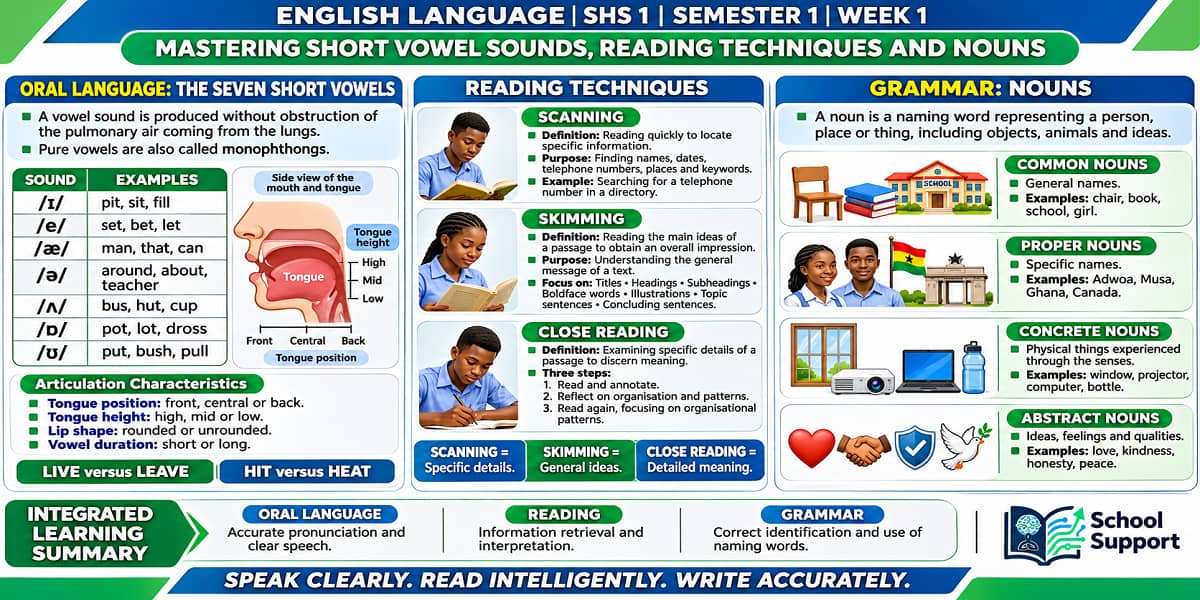
The vowel chart provides a visual representation of the positions of the tongue in vowel production. It helps learners understand how the position of the tongue and the shape of the lips contribute to different vowel sounds.
The twelve pure vowel sounds presented in the lesson include:
| Sound | Examples |
|---|---|
| /i:/ | See, sea, peel |
| /ɪ/ | Pit, sit, fill |
| /e/ | Set, bet, let |
| /æ/ | Man, that, can |
| /ɑ:/ | Art, park, part |
| /ɒ/ | Pot, lot, dross |
| /ɔ:/ | Port, tall, sort |
| /ʊ/ | Put, bush, pull |
| /u:/ | Pool, cool, stool |
| /ʌ/ | Bus, hut, cup |
| /ɜ:/ | Bird, earth, birth |
| /ə/ | Around, about, teacher |
Although these twelve sounds provide a wider picture of English pronunciation, the main focus here is the seven short vowel sounds.
3. The Seven Short Vowel Sounds
Short vowels are noticeably shorter in duration than long vowels. They are produced with one relatively stable mouth position rather than a movement from one vowel position to another.
The seven short vowel sounds are:
| Short vowel | Examples |
|---|---|
| /ɪ/ | Pit, sit, fill |
| /e/ | Set, bet, let |
| /æ/ | Man, that, can |
| /ə/ | Around, about, teacher |
| /ʌ/ | Bus, hut, cup |
| /ɒ/ | Pot, lot, dross |
| /ʊ/ | Put, bush, pull |
/ɪ/ — The short i sound
This sound occurs in words such as pit, sit and fill. Practise saying each word clearly without confusing the sound with the longer /i:/ sound.
/e/ — The short e sound
This sound occurs in set, bet and let. Listen carefully to the vowel when pronouncing these words.
/æ/ — The short a sound
This sound occurs in man, that and can. Pay attention to the position of the mouth when producing it.
/ə/ — The short schwa sound
This sound occurs in words such as around, about and teacher. It is an important vowel sound to recognise when listening to connected speech.
/ʌ/ — The short central vowel
This sound occurs in bus, hut and cup. Practise producing it without replacing it with another vowel sound.
/ɒ/ — The short o sound
This sound occurs in pot, lot and dross. Notice how the sound is represented in the pronunciation of these words.
/ʊ/ — The short u sound
This sound occurs in put, bush and pull. It should be distinguished from the longer /u:/ sound.
4. Characteristics of Vowel Articulation
Vowel sounds can be described according to four important characteristics.
Part of the Tongue Involved
The tongue may be positioned towards the front, centre or back of the mouth. These positions contribute to the production of different vowel sounds.
Position of the Tongue Relative to the Palate
The tongue may be high, mid or low in relation to the palate. Its vertical position affects the quality of the vowel produced.
Shape of the Lips
The lips may be rounded or unrounded (spread). Lip shape is another important feature of vowel articulation.
Length of Vocalisation
Vowel sounds may be short or long. The duration of the sound is important when distinguishing words such as hit and heat.
5. Practising Short Vowels in Connected Speech
Knowing the individual sounds is not enough. You must also practise using them in words, sentences and continuous speech.
Activity 1: Word Pronunciation
Practise saying the following pairs clearly: ship/sheep, cat/cart, cot/court and pull/pool. Listen carefully to the differences in vowel sounds.
Activity 2: Sentence Formation
Use words containing short vowel sounds to form meaningful sentences. For example: “His lip is pink.” Pay attention to the pronunciation of the vowel in each word.
Activity 3: Tongue Twisters
Practise expressions such as “Can you can, as a canner cans a can?” and “Nine nice night nurses nursing nicely.” Concentrate on clear articulation rather than speed.
Activity 4: The Confinement Game
Identify short vowel sounds in words such as simplicity, seminar, accurate, again, absurd, aggregate, hullabaloo, cucumber and pedagogical. Pay attention to the sound and its position in each word.
PART TWO: READING — READING TECHNIQUES
6. Why Reading Techniques Matter
Reading is not always performed in the same way. Sometimes you need to locate a particular detail quickly. At other times, you want to understand the general message of a passage. You may also need to examine a text carefully to understand its meaning and organisation.
Different reading techniques help you achieve these purposes. The three techniques covered here are scanning, skimming and close reading.
7. Scanning: Searching for Specific Information
Scanning is reading very quickly to locate specific details in a text.
For example, imagine searching a telephone directory for a particular telephone number. You do not need to read every entry. Instead, you move your eyes across the information until you find the required number.
Scanning is useful when searching for names, dates, telephone numbers, places, keywords and other specific information.
How to scan effectively
First, identify the exact information you need. Next, move your eyes quickly across the text, paying attention to words, numbers or other features that match your search. Stop when you locate the required detail.
8. Skimming: Understanding the General Idea
Skimming is the process of reading the main ideas in a passage to obtain an overall impression of its content.
Unlike scanning, skimming does not concentrate on locating one particular detail. Its purpose is to help you understand what a text is generally about.
When skimming, pay attention to the title, headings, subheadings, illustrations, boldface words, topic sentences and concluding sentences. The first and last paragraphs may also provide useful information about the general message.
How to skim effectively
Begin with the title to identify the subject. Look through the headings and important visual features. Read selected sentences, especially those that introduce or conclude paragraphs. Combine the information to develop an overall understanding of the text.
9. Close Reading: Examining a Text Carefully
Close reading is a method of reading that concentrates on the specific details of a passage or text in order to discern meaning.
It requires more attention than scanning and skimming because the reader examines the information carefully, considers how the text is organised and interprets important details.
There are three important steps in close reading.
Step 1: Read and Annotate
Read the text and make notes about its main elements and important details. Highlight information that contributes to understanding the passage.
Step 2: Reflect on Organisation and Patterns
Consider how the information is arranged. Look for patterns in the text and examine how different parts contribute to its meaning.
Step 3: Read Again
Read the passage again, concentrating on its organisational patterns. This second reading can help you recognise relationships and meanings that may not have been obvious initially.
10. Distinguishing the Three Reading Techniques
| Technique | Main purpose | Example |
|---|---|---|
| Scanning | Find specific information. | Searching for a telephone number. |
| Skimming | Understand the general idea. | Surveying a story to understand its subject. |
| Close reading | Understand detailed meaning and organisation. | Examining a passage and interpreting its details. |
These techniques can also be combined. You might skim a newspaper article to understand its general subject, scan it to locate a particular date and then close-read an important paragraph to interpret its meaning.
PART THREE: GRAMMAR — NOUNS
11. Understanding Nouns
A noun is a word that represents a person, place or thing. Things include objects, animals and ideas. Nouns are often described as naming words because they give names to the people, places and things we see, discuss or think about.
Consider these examples: teacher, Ghana, bottle, dog, honesty and happiness. Each word names something. However, not all nouns refer to physical objects. Some identify qualities, feelings and ideas.
12. Forms and Types of Nouns
Nouns can be classified into different forms according to what they name and how they represent their meanings. Four important types are common, proper, concrete and abstract nouns.
Common Nouns
Common nouns are general names given to people, places or things. Examples include chair, book, plate, phone, bottle, man, church, school, girl, pot, truck, pastor and ghost.
Proper Nouns
Proper nouns are specific names given to particular people, places or other identified entities. Examples include Adwoa, Musa, Dzifa, Kukua, Ghana, Lake Volta, Canada, Kakum National Park and The Speaker of Parliament.
Proper nouns begin with capital letters. This helps distinguish specific names from general naming words.
Concrete Nouns
Concrete nouns name things that can be experienced through the senses. Examples include window, projector, computer, bottle and phone. These refer to identifiable physical objects.
Abstract Nouns
Abstract nouns name ideas, qualities, feelings and conditions that cannot be experienced as physical objects. Examples include love, kindness, honesty, integrity, sincerity, peace, joy, happiness and hatred.
13. Comparing the Four Types of Nouns
| Type | Meaning | Examples |
|---|---|---|
| Common | General names. | School, chair, girl. |
| Proper | Specific names. | Ghana, Adwoa, Canada. |
| Concrete | Physical things experienced through the senses. | Window, computer, bottle. |
| Abstract | Ideas, feelings and qualities. | Love, honesty, peace. |
Notice that noun classifications describe different aspects of naming. A proper noun identifies a specific name, while a concrete noun identifies something physical. The classifications help you examine and use nouns accurately.
14. Using Nouns in Communication
Recognising nouns is only the beginning. You must also use them correctly in sentences and connected speech.
Activity 1: Identifying Nouns
Read a short passage and identify the words that name people, places, objects, animals and ideas. Separate the nouns from other word classes.
Activity 2: Classifying Nouns
Arrange the nouns you have identified under common, proper, concrete and abstract categories. Explain why each word belongs to its category.
Activity 3: Singular and Plural Usage
Use nouns in both singular and plural forms when constructing sentences. Ensure that the noun form agrees with the meaning you want to communicate.
Activity 4: Connected Speech
Practise using nouns in meaningful conversations and written sentences. Choose words that communicate your ideas clearly.
PART FOUR: PRACTICE QUESTIONS AND MODEL ANSWERS
15. Oral Language: Short Vowel Sounds
Question 1: What is a vowel sound?
Model Answer: A vowel sound is produced without obstruction of the pulmonary air coming from the lungs. It is produced orally through the mouth.
Question 2: What are pure vowels also called?
Model Answer: Pure vowels are also known as monophthongs.
Question 3: Identify the seven short vowel sounds.
Model Answer: /ɪ/, /e/, /æ/, /ə/, /ʌ/, /ɒ/ and /ʊ/.
Question 4: State four characteristics used to describe vowel articulation.
Model Answer:
- Part of the tongue involved: front, central or back.
- Tongue position relative to the palate: high, mid or low.
- Lip shape: rounded or unrounded.
- Length of vocalisation: long or short.
Question 5: Identify the short vowel sounds in the words can, put, look, trust and lend.
Model Answer:
- Can — /æ/
- Put — /ʊ/
- Look — /ʊ/
- Trust — /ʌ/
- Lend — /e/
16. Reading Techniques
Question 6: What is scanning?
Model Answer: Scanning is reading quickly to locate specific information such as names, dates, telephone numbers and places.
Question 7: Differentiate between skimming and scanning.
Model Answer: Skimming is used to obtain the general idea of a text, while scanning is used to locate specific details within a text.
Question 8: Explain close reading.
Model Answer: Close reading is a method of reading that focuses on specific details of a passage to understand its meaning and organisation.
Question 9: State the three steps involved in close reading.
Model Answer:
- Read and annotate the text, focusing on important details.
- Reflect on the organisation and patterns in the text.
- Read the text again, concentrating on its organisational patterns.
17. Grammar: Nouns
Question 10: What is a noun?
Model Answer: A noun is a naming word that represents a person, place or thing, including objects, animals and ideas.
Question 11: Identify the four types of nouns covered in this lesson.
Model Answer: Common nouns, proper nouns, concrete nouns and abstract nouns.
Question 12: Differentiate between common and proper nouns.
Model Answer: Common nouns are general names given to people, places or things, while proper nouns are specific names given to particular people, places or identified entities.
Question 13: Give three examples each of concrete and abstract nouns.
Model Answer:
- Concrete nouns: window, computer and bottle.
- Abstract nouns: love, honesty and happiness.
Question 14: Use the words result, neck, hut, complete and socks in sentences.
Model Answer:
- The result of the examination was encouraging.
- He wore a shirt that covered his neck.
- The family lived in a small hut.
- We must complete the assignment today.
- She washed her socks.
PART FIVE: EXTENDED APPLICATION ACTIVITIES
18. Integrated Learning Activities
Activity 1: Short Vowel Identification and Pronunciation
Work with a partner to identify words containing the seven short vowel sounds. Practise pronouncing them accurately and use selected words to construct meaningful sentences. Pay attention to differences between short and long vowel sounds.
Activity 2: Reading for Specific Information
Select a short newspaper article or passage. Use scanning to identify specific details such as names, dates and places. Record the information you find and explain how you located it.
Activity 3: Understanding the General Message
Choose another short passage and skim it to identify its general subject. Examine its title, headings, illustrations, topic sentences and concluding sentences. Write a short statement explaining the overall message.
Activity 4: Close Reading and Interpretation
Read a passage carefully. Annotate important details, reflect on the organisation and patterns, and read it again. Answer questions about its meaning, suitable title and the writer’s mood where the passage provides sufficient evidence.
Activity 5: Noun Identification and Classification
Select a short passage and identify its nouns. Classify the words as common, proper, concrete or abstract. Explain your classification and use selected nouns in your own sentences.
Conclusion: Using English with Greater Accuracy and Confidence
Effective English communication depends on the ability to pronounce words accurately, retrieve and interpret written information, and use grammatical structures correctly.
Short vowel sounds help learners develop clearer pronunciation and reduce confusion between words with different vowel sounds. Scanning, skimming and close reading provide different methods for retrieving information and understanding written texts. Nouns help identify people, places, objects, animals and ideas in speech and writing.
These three areas are connected through everyday communication. Practising them regularly improves your ability to speak, read and write with greater accuracy.
Final Self-Check
Before completing this lesson, confirm that you can:
- Identify and pronounce the seven short vowel sounds.
- Explain the characteristics of vowel articulation.
- Distinguish short vowel sounds from longer vowel sounds.
- Use short vowels accurately in connected speech.
- Explain the differences between scanning, skimming and close reading.
- Apply the three reading techniques to retrieve and interpret information.
- Define nouns and identify their functions as naming words.
- Distinguish common, proper, concrete and abstract nouns.
- Use nouns accurately in sentences and connected speech.
Final Application: Select a short passage. First, scan it for specific information. Next, skim it to establish its general message. Then close-read it to interpret important details. Identify and classify the nouns in the passage, and select words containing short vowel sounds for pronunciation practice.
Access NaCCA-aligned Support Packs
Download your structured NaCCA-aligned Teacher Support Pack and Student Learning Pack, designed for clarity, practicality, and reliable teaching and learning.